



UAE official says opening Hormuz integral to any Iran deal, describes infrastructure damage 'manageable'
Abdulla Balalaa, UAE assistant minister of foreign affairs for energy and sustainability, spoke to Al-Monitor about the situation in the Gulf along with the UAE's focus on promoting privatization in the water sector and the 2026 UN Water Conference.
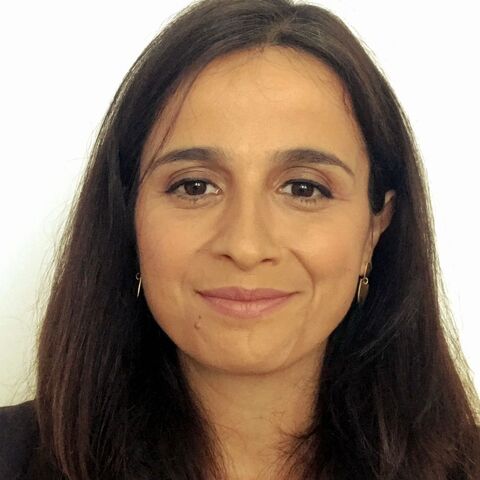


WASHINGTON — A senior official Emirati official told Al-Monitor this week that “no one should be closing the Strait of Hormuz,” as regional tensions from the US-Israeli war with Iran continue disrupting global energy flows.
Abdulla Balalaa, the United Arab Emirates' assistant minister of foreign affairs for energy and sustainability, made the remarks in an interview on the sidelines of the World Bank and International Monetary Fund Spring Meetings in Washington, where Gulf officials have been grappling with the fallout from the war launched by Israel and the United States on Feb. 28.
“The Strait of Hormuz should be open for everyone,” Balalaa told Al-Monitor. “I don’t think Iran or any other state is in a position to close international waters that affect not only this region, but globally.” Balalaa stressed that securing open traffic at Hormuz should be part of any incoming deal between the Trump administration and Iran.
“The ripple effect of closing the Strait of Hormuz is witnessed globally. Look at the oil prices. It also damages and affects international agendas—I’m talking about food security. A third of fertilizers passes through this, along with helium, oil, gas, and trade,” he added.
“As far as the UAE is concerned, this is one of the priorities that needs to be tackled,” the senior official said.
Over the course of the week in Washington, Balalaa held a series of high-level bilateral meetings with senior US and international government officials, multilateral development banks, institutional investors, business leaders, entrepreneurs, and think tank experts, focusing on regional geopolitics, elevating water on the global agenda ahead of the 2026 UN Water Conference, strengthening water security, and mobilizing private sector investment for inclusive solutions.
His comments came as shipping through the critical chokepoint remained at a trickle amid a US blockade on Iranian oil exports and despite a fragile ceasefire between Washington and Tehran that expires next week. On Friday, Iranian Foreign Minister Abbas Araghchi said the Strait of Hormuz had been declared open to commercial shipping for the duration of the Israel-Lebanon ceasefire that took effect that day and is set to expire April 26 at 5 p.m. EST.
The broader disruption of traffic through the strait has rattled oil markets and raised global concerns over food security and trade, given the volume of commodities that pass through the waterway. Balalaa pointed to the ripple effect of any closure, noting that a third of the world's fertilizer passes through Hormuz alongside significant volumes of helium, oil, gas and trade. The official repeatedly highlighted the UAE’s stance as a “non-warring” party in this conflict, which has exposed all Gulf Cooperation Council countries to economic shocks and direct attacks, including on critical infrastructure.
Balalaa said more than 2,600 projectiles had been launched toward the UAE, the vast majority of them intercepted.
“Whatever damage we see is as an outcome of an interception,” he said, adding that infrastructure impacts have been “manageable” and that “everything is working.”
He added that UAE officials are in close coordination and contact with their regional counterparts, pointing to alignment on the March 11 adoption of UN Security Council Resolution 2817, condemning Iran's missile and drone attacks against Gulf states and Jordan. He noted that coordination is ongoing to “basically mitigate or stop this as much as possible.”
Iran should not weaponize water
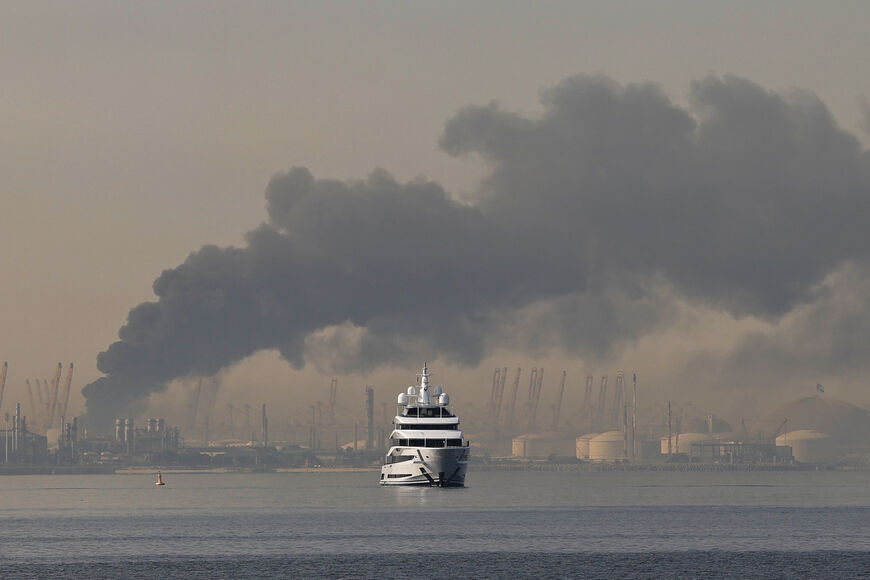
In the UAE, where desalination underpins nearly every potable water supply, the war has underscored the vulnerability of water systems. Over the course of the war, Iranian strikes hit the Jebel Ali Port area, with explosions and fires reported near critical infrastructure, including one of the UAE’s largest desalination hubs. Iran "should not weaponize water," Balalaa stressed.
He stopped short of detailing specific damage to water facilities in the country, but acknowledged the broader risk environment, accusing Iran of targeting civilian sites.
“No one is immune from a state that doesn’t differentiate between civilian infrastructure and military infrastructure,” he said.
Upcoming water conference
Against the security backdrop in the Gulf, Balalaa’s focus in Washington has centered on advancing preparations for the upcoming UN Water Conference, which the UAE is scheduled to co-host with Senegal in December.
The event aims to accelerate progress on global water access and governance, an area widely seen as lagging behind other climate and development priorities. It follows on the 2023 UN Water Conference, at the time the first such event in nearly five decades, co-hosted by Tajikistan and the Netherlands.
Central to the UAE’s pitch is a push to reframe water as an investment opportunity rather than solely as a public good and attract private sector interest.
“This sector has to be privatized,” Balalaa said, noting that almost 90% of expenditures on water are from governments. “So who else needs to pick this up? The multilateral development banks and the banking systems globally.”
He described a “tremendous opportunity” to mobilize capital into water infrastructure, citing an estimated $6.7 trillion financing gap in the sector that needs to be addressed by 2030.
The private sector and international development banks should be looking at water “as a profitable business,” he said. This framing aligns with a broader UAE strategy of positioning itself as a hub for water technology and finance, particularly in desalination, where Gulf states have developed significant expertise. It also reflects a wider debate over how to fund water systems globally, especially in lower-income countries where public budgets are constrained.
At the same time, critics have questioned whether increased privatization risks sidelining equity and access concerns in a sector already under strain. Globally, billions of people lack reliable access to safe water and sanitation, and governance remains fragmented, with no binding international framework comparable to climate agreements.
Balalaa emphasized the need to elevate water politically, calling it “underprivatized, underfunded” and always “on the margin of other agendas.” The December conference, he said, aims to “bring water back where it truly belongs in the international agenda” and to inject high-level political momentum.
Yet his remarks did not offer many specifics on how the conference would address emerging risks highlighted by the current crisis.
For now, the UAE appears to be focused on shaping the conversation around investment and innovation, even as regional instability reinforces the strategic importance of water.
As Balalaa put it, water “touches and intersects with so many things” — summarizing the reality of its importance as an everyday resource and the significance of its vulnerability in times of conflict.
This one's on us.
The story doesn't end here.
Our correspondents are already on the next chapter. Read everything they file, from $2/week.
See Offers