



China seeks deconfliction in Iran war regardless of regime future
China’s leverage remains limited, with little influence over the US, Israel and Iran’s Islamic Revolutionary Guard Corps, so it’s left adapting to Iran’s uncertain future through economic adjustments and deconfliction.


Hi readers,
The US-Israeli war against Iran complicates Beijing’s trade, energy security and regional stability goals. It's less about who is at the helm in Iran, as China won't be coming to rescue the regime or losing sleep over Supreme Leader Ali Khamenei's killing, and it's more about the economic cost of the war. Beijing, reliant on steady Gulf oil flows and secure shipping lanes, faces risks of fuel price spikes and stalled growth.
So what can China do? Containment and prevention of the war's further expansion.
Chinese diplomats are sounding out Tehran, Washington and Gulf capitals to try deescalation. In phone calls on Wednesday, Foreign Minister Wang Yi told Saudi and UAE counterparts that China would dispatch a mediator to the Middle East, in an attempt to prevent the expansion of the war.
China’s leverage, however, remains limited. It has little influence over the US, Israel and Iran’s Revolutionary Guards Corps, so it’s left adapting to Iran’s uncertain future through economic adjustments and deconfliction.
Let’s unpack,
Rosaleen and Joyce (sign up here)

Leading this week
Interests at stake
China’s deep ties with Iran as Tehran's largest oil client complicate the calculus. Since Saturday, the war has snarled maritime traffic, driven up tanker insurance and put the Strait of Hormuz — and six China-friendly Gulf states — under IRGC missile and drone fire, exposing the fragility of energy lanes Beijing depends on.
On Monday, a senior adviser to the IRGC said that any ship attempting to transit the strait will be attacked.
Transit in the strategic strait, a key global shipping route through which 20% of the world's oil supplies pass, has slowed to a near standstill. On Tuesday, the Chinese Foreign Ministry called on all parties "to immediately cease military operations, avoid escalating tensions and safeguard the safety of navigation in the Strait of Hormuz."
For Beijing, Khamenei’s killing is secondary to core priorities:
- Reliable energy: affordable oil from Iran, Saudi Arabia, UAE and others to power China’s economy
- Belt and Road assets: protecting billions in Gulf ports, railways, industrial zones and digital infrastructure
- Strategic neutrality: remaining a non-interventionist partner for Gulf governments wary of US volatility
➡️ China is unlikely to send weaponry to rescue the Iranian government. With President Donald Trump due in Beijing this April, preserving US ties outweighs Iran’s rulers, especially as phase two of the war morphs into internal revolts inside Iran.
Beijing’s mediation bid aims to:
- Contain the war: keep Gulf states out, avoiding a regional firestorm
- Secure the lanes: replicate its Houthi approach, in which Chinese ships sail free in exchange for diplomatic and economic engagement
➡️ Securing the lanes could be achievable. Bloomberg reported Wednesday night that a bulk carrier had successfully transited the strait. That ship, according to Bloomberg, had changed its destination signal to China from "For Orders."
Chinese ships have largely passed through the Red Sea without incident since Yemen’s Houthis began attacking commercial vessels there after Oct. 7, 2023, following an arrangement between China and the group.

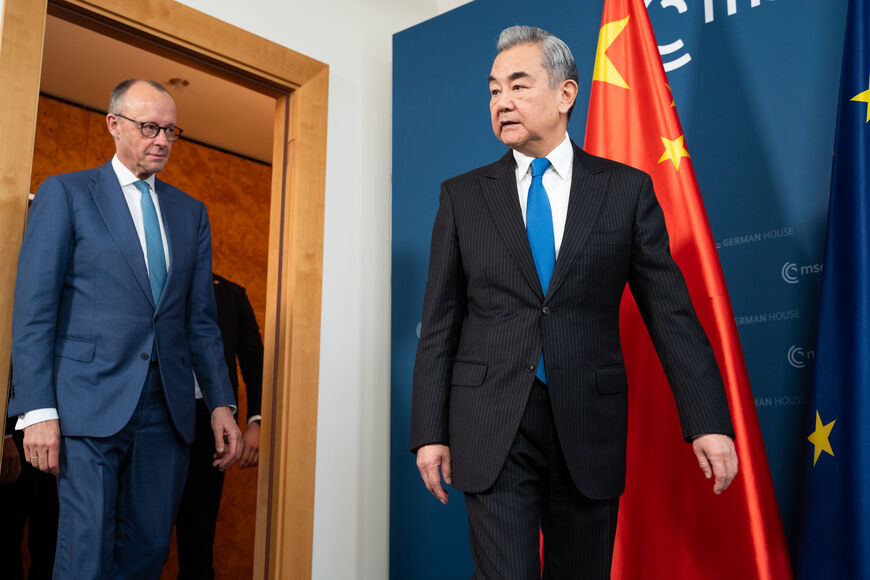
German Chancellor Friedrich Merz (L) arrives with Chinese Foreign Minister Wang Yi for a bilateral meeting during the 62nd Munich Security Conference at the Hotel Bayerischer Hof on Feb. 14, 2026 in Munich, Germany. (Michael Bihlmayer/Getty Images)
Opportunity amid risk
A regional war sparked by the US bolsters Beijing’s narrative of American chaos versus Chinese stability. That framing is already evident across the editorial pages of China’s leading state-backed outlets.
In an opinion piece on the war for CGTN, commentator Pang Xinhua wrote, "Military force replaces diplomatic negotiation, the law of the jungle supplants the spirit of contract, and human civilization regresses amid the flames of war." He added, "The world urgently needs crisis management and rational mediation."
Another CGTN commentator, Huang Yinan, described the US-Israeli war in "US should understand 'A great nation fond of war is doomed to perish" as "a high-stakes gamble devoid of regard for consequences."
An editorial by the People’s Daily Online team stated, “One cannot claim to defend non-proliferation while simultaneously resorting to force that erodes trust and verification mechanisms."
Beyond official editorials, the war has also generated significant attention on Chinese social media. Newsweek reported on Tuesday that AI-generated videos purporting to show a US aircraft carrier being struck by Iranian missiles garnered millions of views by Tuesday evening on platforms including Weibo and Douyin.
The videos followed a report repeated by Chinese state broadcaster CCTV, citing Iran’s Islamic Revolutionary Guard Corps, that the USS Abraham Lincoln had been hit by cruise missiles in the Gulf of Oman. The US denied the claim.

Photo of the week
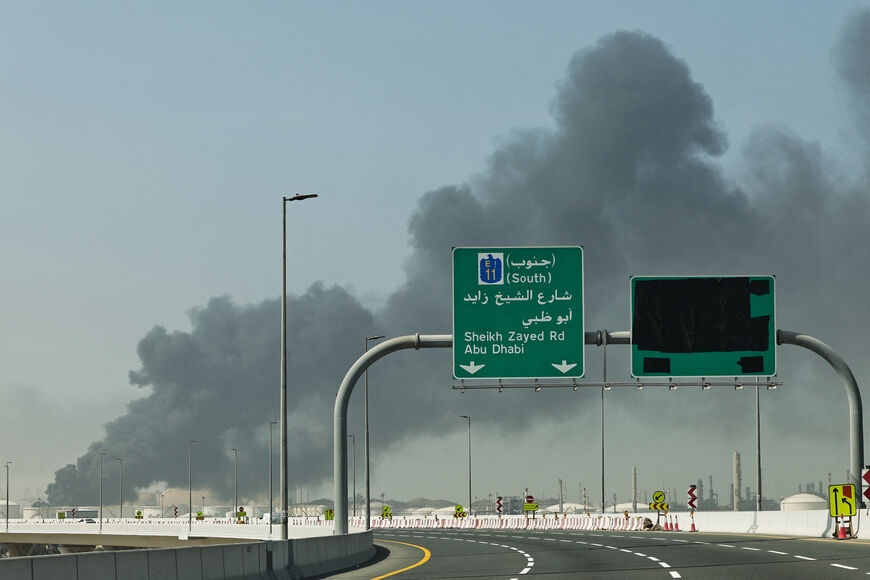
Smoke rises from the port of Jebel Ali following a reported Iranian strike in Dubai on March 1, 2026. (Fadel Senna/AFP via Getty Images)
Deals and visits ✈️
- Chinese foreign minister holds phone call with Israeli, Iranian counterparts as Iran war widens
- China's government tells top oil refiners to suspend exports of diesel and gasoline amid war in Middle East, Bloomberg reports
- China's Himile Group to invest $100 million in tire factory in Egypt
- Three Chinese robotaxi firms halt services in Middle East
- Air China, China Eastern and China Southern Airlines offer refund policies for Middle East flights
- Egyptian president hosts high-level delegation from Chinese clean energy company GCL
- China calls for protection of vessels in Strait of Hormuz

What we are reading
- China to lean on Russian oil as Iran crisis chokes supply (Financial Times)
- More generals purged as delegates gather for China's Two Sessions event (The Guardian)
- China’s first railway project in EU open at last (The Economist)
This one's on us.
The story doesn't end here.
Our correspondents are already on the next chapter. Read everything they file, from $2/week.
See Offers