



Championing legalizing cannabis, Israeli ultra-right party amasses support
The head of the Zehut party, Moshe Feiglin, is a gifted politician: He advances Libertarian principles and legalization of cannabis while concealing his ambitions for a Jewish State law that would expel Arabs and annex the West Bank and Gaza.
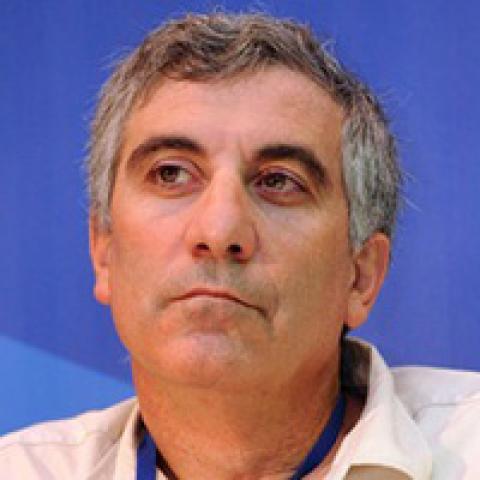

At a time when political parties, such as Finance Minister Moshe Kahlon’s Kulanu, Avigdor Liberman’s Yisrael Beitenu and in some polls even Meretz, are treading water around the vote threshold of four Knesset mandates, one new party that is not currently represented in the Knesset seems to be drawing the support of a growing public. Polls, despite their drawbacks and lack of accuracy, lately point toward the possibility of an election surprise and project Moshe Feiglin’s Zehut party would win at least four mandates. In one poll, he even reaches seven mandates.
Zehut has an extremist right-wing platform that includes, among other items, canceling the Oslo Accord; annexing all Palestinian territories as well as the Gaza Strip; deportation of Palestinians who oppose this; and granting residency status to Palestinians who openly declare loyalty to the state. Pledging allegiance to Israel should accord the Palestinian residence with civil rights such as the right for property and human rights in general, but no right to vote for the Knesset. Another status would be accorded to those interested in serving in the army, like the Druze or the Bedouins. According to Zehut’s platform, they would go through a process of proving their loyalty to the state. Only after that would they receive full citizenship. According to Feiglin, the state’s institutions should function according to Jewish religious law, and the Chief Rabbinate should manage the Temple Mount. Despite all this, Zehut has many supporters on the left.
Feiglin debuted on the public scene with his This Is Our Land movement that he founded in 1994, which opposed the Oslo Accord with nonviolent protests. His sharp political sense led him into the Likud in 2000 in order to transform and influence the party from within. The change the Likud has undergone in the past decade — from liberal right sympathetic to Jewish tradition to super-conservative with ultra-Orthodox leanings on matters of religion and state — attests to the fact that Feiglin succeeded.
Feiglin had run twice for the leadership of the Likud and was elected to the Knesset once in 2013. But he decided to quit the party when in the Likud primaries of 2015 he was elected to an unrealistic spot. When he left, he established “Zehut — an Israeli Jewish Movement.” The key tenets of the party seem to include an internal contradiction: On the one hand, it calls for a state that returns most of the freedoms to citizens, defends the values of the family and the community, and upholds a free market; on the other hand, it calls for a state that realizes and strengthens its sovereignty over all the land, starting with Jerusalem and the Temple Mount, and aims to end the situation of conflict and bloodletting by defeating Israel’s enemies. “The Land of Israel belongs only to the Jewish people by virtue of divine election,” Feiglin asserts.


