



Lacking deterrence, Israel’s security establishment opposes attacks on Houthis
Senior Israeli intelligence sources told Al-Monitor that Israel seeks to avoid involvement in the conflict between the Houthis and Saudi Arabia, despite concerns that Yemen could further unravel and that Iran is backing the group.


TEL AVIV — The Israeli security establishment opposes a preemptive attack against the Houthis in Yemen, a senior Israeli intelligence source told Al-Monitor.
Israel is deeply concerned about the collapse of the Yemeni-Saudi front against the Houthi rebels and the capabilities the Iran-backed militia are demonstrating. Speaking on condition of anonymity, he said that while Israel’s position could change if the situation escalates, its military recommends that for now, efforts focus on forming a regional coalition against the Houthis.
The Houthis captured the Greater and Lesser Hanish islands in the Red Sea on Monday, expanding their foothold in the strategic waterway leading to Israel’s southern port of Eilat. Last Thursday, the Houthis seized the Red Sea port city of Mokha and on Friday, the group captured Mayyun Island, giving it control of the area around the strategic Bab el Mandeb Strait.
“They have taken some serious blows from our air force,” a top Israeli security official told Al-Monitor on condition of anonymity. “They have taken quite a few blows from the Americans, and they have also been subjected to years of Saudi airstrikes. And yet they seem to be only getting better,” he said, explaining that the group's attacks have shown ground and intelligence capabilities that should concern anyone within their range.
Three dangers
The Israeli intelligence source explained that three developments could change the military’s current position:
The first is an escalation in military tensions between Iran and the United States that pushes Tehran to instruct the Houthis to attack Israel with missiles and drones. In such case, the Jewish state would retaliate immediately.
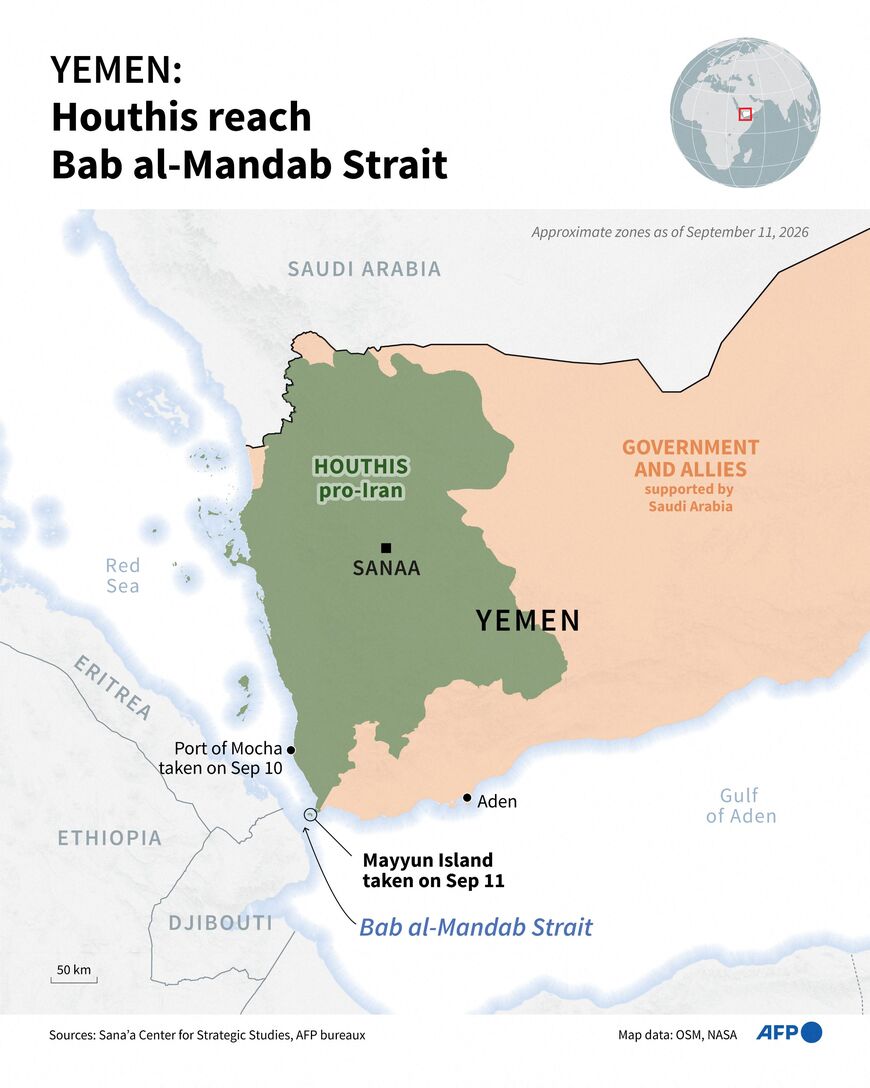
This infographic with a map of Yemen shows areas controlled by government forces and the pro-Iran Houthi rebels as of Sept. 11, 2026, according to the Sanaa Center. (Graphic by Paz PIZARRO and Olivia BUGAULT / AFP via Getty Images)
“For the time being, we have no intention of joining the campaign against the Houthis or resuming attacks on them,” said the Israeli intelligence source. Still, he said, “Israel is not forgetting that the Houthi rebels are the long arm of Iran's Islamic Revolutionary Guard Corps.” The Houthis’ successful surprise attack around Bab el Mandeb Strait and against the Saudis proves that they are becoming Iran’s most effective and important proxy, he said.
A second possibility involves the Houthis tightening their grip on the strategic waterway. The threat of a Houthi takeover of the strait has far-reaching implications for international maritime traffic, a senior Israeli diplomat also commented, explaining that Israel would have to consider entering the conflict should the port of Eilat become paralyzed.
The Houthis’ swift advance will undoubtedly affect the global economy, the diplomat added, noting, “The rebels could try to capitalize on their moves to collect transit fees for shipping through the strait.”
He said that the immediate threat is to Saudi oil shipments, which have been passing through Bab el Mandeb as an alternative to the blockaded Strait of Hormuz and have been attacked several times since the Houthis began their blockade on the kingdom's Red Sea ports in July.
In a third scenario, Saudi Arabia could seek to involve Israel in efforts to defend itself against Houthi attacks. Citing Middle East diplomatic sources, Channel 12 reported Tuesday that Israel and Saudi Arabia had held talks under the auspices of US Central Command on providing Riyadh with intelligence assistance. Israeli officials declined to comment on the report. But the question remains: How would Israel respond to a request from Saudi Arabia or other parties for assistance against the Houthis?
Middle East's dark horse
Israelis first srated paying attention to the Houthis in 2017, and then in 2021, when the last Yemenite Jewish families were driven out of the country by the group. Still, at the time, they were widely seen as a comic, bumbling militia, inspiring skits on the prime-time satirical show “It’s a Wonderful Country.”
They have proven anything but. Iran itself and its front-line proxies, Hamas in the Gaza Strip and Hezbollah in Lebanon, have suffered heavy blows at Israel’s hands since the 2023 Hamas massacre. Despite several long-range Israeli strikes on the group, the Houthis have proven resilient.
The Israeli intelligence source said, “At the moment, no one has deterrence over the Houthis. Not the Americans, not us and certainly not the Saudis. They are the dark horse that no one expected.”
“The Houthis are evolving from a local tactical problem into a global strategic one,” an Israeli political source told Al-Monitor on condition of anonymity. “They have the ability to influence the entire Middle East. They could push the Saudis and their allies closer to Israel, leading them to rely on Israel’s capabilities and intelligence. But the opposite could also happen,” he added.
“The Houthis could convince Saudi Arabia and other Gulf states that the Iranians are not losing the war, but rather the opposite. That could prompt all these countries to cool their relations with Israel and seek understandings with the Iranians,” he explained, adding that much would depend on US and Israeli policy as well.
Israel struck Houthi targets on several occasions between May and October 2025, retaliating for strikes launched from Yemen against Ben Gurion Airport and urban residential areas. Targets included the ports of Hodeidah, Ras Isa and Al-Salif, as well as the Ras Qantib power plant. On June 14, 2025, Israel targeted a meeting of senior Houthi officials. Fifty people were killed in the aerial attack, including Ahmed Ghaleb Nasser al-Rahawi, the prime minister of the Houthi government and several cabinet ministers.
"There is little doubt that Israel has inflicted the most painful blows on the Houthis, including eliminating a significant portion of their military and political leadership," the Israeli security official said. The Israeli diplomat said that the Saudis are "primarily projecting panic."
“What we saw in the latest attack was a clear failure by both the Yemeni government and Saudi Arabia in the face of the Houthis’ capabilities and determination.” The fact that the United States is reluctant to jump once again into the Bab el Mandeb fray does little to ease the Saudi concerns, he argued.