Feature

Backed by Trump and Turkey, Armenia's Pashinyan eyes third term in pivotal poll

As Russia and the West vie for influence, Prime Minister Nikol Pashinyan appears on track to secure a new mandate for his peace agenda with Azerbaijan and rapprochement with Turkey.

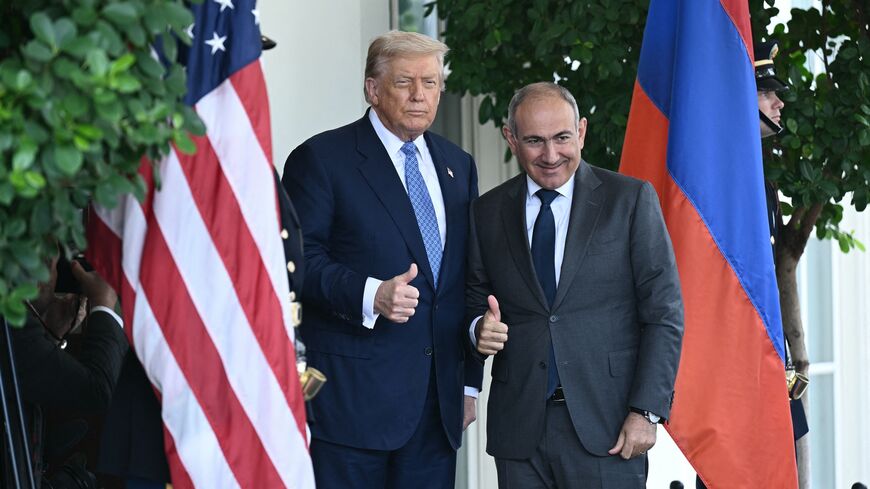
US President Donald Trump (L) welcomes Armenian Prime Minister Nikol Pashinyan outside the West Wing of the White House in Washington, DC, on Aug. 8, 2025.
US President Donald Trump (L) welcomes Armenian Prime Minister Nikol Pashinyan outside the West Wing of the White House in Washington, DC, on Aug. 8, 2025. — BRENDAN SMIALOWSKI/AFP via Getty Images

YEREVAN, Armenia — In normal times, Mehmandar, Armenia’s largest wholesale market for fruits and vegetables in the Ararat valley near the Turkish border, is a beehive of activity. But these are not normal times. Russia, citing spurious hygiene concerns, had just slapped a ban on Armenian fruits and vegetables. Business is dead. Some 90% of Armenian produce was sold to Russia. “My tomatoes fetched 2,000 drams [$5.50] per kilo a week ago; now they are worth 900 [$2.45] at most,” said Karen Arakelian, a stony-faced farmer. “It’s because of the elections.”

Arakelian is right. On June 7, Armenia will hold nationwide parliamentary polls. They are being touted as a historical referendum on the future course of this Christian nation of 3 million in the southern Caucasus that was part of the Soviet empire. A startling burst of global interest has seen Russia and a Western bloc led by the United States, the European Union and Turkey backing rival candidates amid a dizzying disinformation campaign waged by both sides.

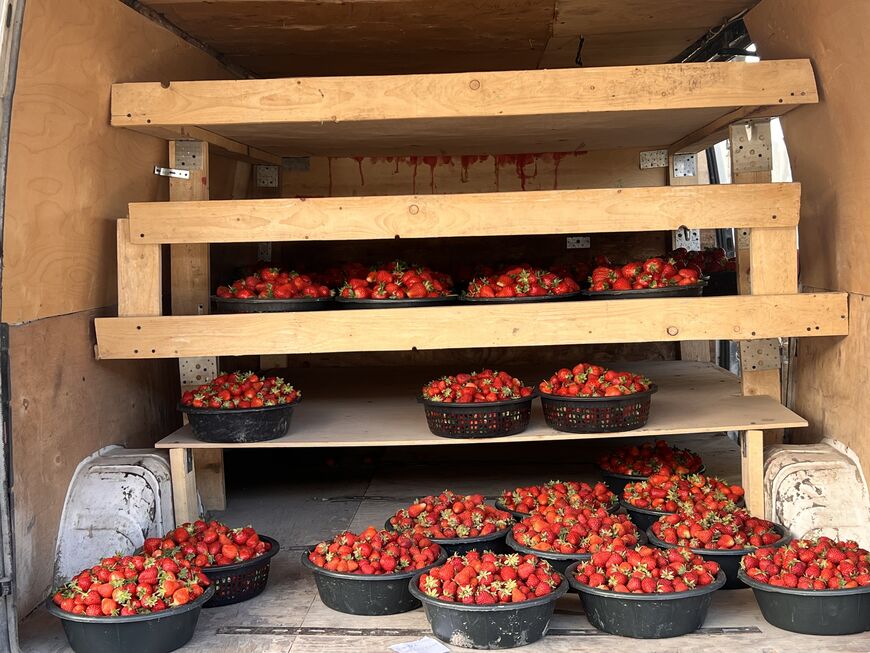
Strawberries are displayed for sale at Mehmandar Market in Armavir, Armenia, on May 30, 2026. Prices for strawberries and other produce have fallen by half since Russia imposed an import ban aimed at pressuring Armenia’s government.

Strawberries await local customers at Mehmandar Market in Armavir, Armenia, on May 30, 2026. Prices for strawberries and other produce have fallen by half since Russia imposed an import ban aimed at pressuring Armenia’s government. (Amberin Zaman/Al-Monitor)

Neighboring Iran and Azerbaijan have their own stakes in the emerging geopolitical order. If all goes to plan, Armenia would sit at the crossroads of the Middle Corridor, a trade route linking Europe to China that would bypass Russia’s northern corridor and Iran. “This is the first geopolitical election in Armenia’s history, and foreign actors each have their favorites,” Tigran Grigoryan, head of the Regional Center for Democracy and Security, a Yerevan-based think tank, told Al-Monitor.

The West is backing Armenia’s current prime minister, Nikol Pashinyan. The pugnacious former journalist led Armenia’s bloodless 2018 Velvet Revolution that ousted a succession of corrupt autocrats linked to Russia. Since 2020, when Armenia suffered a traumatizing defeat against Azerbaijan in a 44-day-long war, Pashinyan has been steering his country westward out of Russia’s orbit while taking on the pro-Kremlin clergy and aggressively seeking peace with Turkey, Armenia’s historic foe and a key NATO ally. Getting Turkey to reopen its land border and establish diplomatic ties is a key pillar of Pashinyan’s strategy of fending off further aggression from Baku.

In a May 28 post on Truth Social, President Donald Trump made his preference clear. “Nikol completely shares my vision of PEACE and PROSPERITY for Armenia and the entire South Caucasus region … Nikol has my COMPLETE and TOTAL Endorsement for Re-Election on June 7, 2026,” Trump wrote. Two days prior, Secretary of State Marco Rubio was in Yerevan inking agreements to expand cooperation in defense, energy, artificial intelligence and critical minerals. An updated version of the planned Trump Route for International Peace and Prosperity, which was unveiled last September at the White House during Pashinyan and Azerbaijani President Ilham Aliyev’s landmark meeting with Trump, was also signed.

A scene from Synunk, Armenia, in the country's Syunik region, which borders Iran, where the Trump Route for International Peace and Prosperity is being planned, on Jan. 20, 2023. (Amberin Zaman/Al-Monitor)
A scene from Syunik, Armenia, which borders Iran, where the Trump Route for International Peace and Prosperity is being planned, on Jan. 20, 2023. (Amberin Zaman/Al-Monitor)
 
In February, JD Vance became the first US vice president to formally visit Armenia, where he heralded the sale of $11 million worth of drone technology to the country. In May, EU leaders streamed into Yerevan to hold their first ever summit there in a flashy show of support for Pashinyan. NATO Secretary General Mark Rutte and Ukrainian President Volodymyr Zelenskyy joined the party.

Russia is hitting back. Even before banning Armenian produce, it had already ceased imports of Armenian mineral water and cognac, Churchill’s favorite kind. The bans were followed on Monday by yet another — on seafood. The Kremlin has darkly hinted at expelling tens of thousands of seasonal Armenian workers whose remittances are a big source of income and threatened to scrap a 2013 deal for subsidized sales of Russian natural gas and rough diamonds.

In a further escalation, Russia recalled its ambassador. Armenia would have to choose between the EU and its membership of the Russian-led Eurasian Economic Union in a popular referendum, Russian President Vladimir Putin told Pashinyan in a May 31 phone call to wish him a happy birthday. The bloc grants preferential terms to its former Soviet members. Pashinyan refused. “This situation is bad for Nikol. It will influence my decision,” Arakelian, the tomato farmer, said.

Most opinion polls this week suggest otherwise. Russian pressure has seen a surge of support for Pashinyan. Some give his Civil Contract party a landslide 65% victory over its top opponent, Strong Armenia, led by Samvel Karapetyan. The Russian Armenian multibillionaire is technically barred from running for parliament because he holds several nationalities and has been under house arrest since June last year on charges of supporting a coup allegedly plotted by the Armenian Apostolic Church.

Karapetyan denies the claims, to little effect. A poll published by the International Republican Institute (IRI) gave his Strong Armenia party 6% compared with 32% for Pashinyan’s Civil Contract.

'Real Armenia'

The pastoral village of Aygehovit in Pashinyan’s native Tavush province is overlooked by a medieval rock church on one side and Azerbaijan on the other. Villagers gathered on a Saturday in a cobblestone-paved square to hear Pashinyan speak — ridiculously exposed — from the back of a van. Clad in a puffer jacket and a baseball cap, the 51-year-old exudes approachability in sharp contrast to the macho austerity of Armenia’s old-style politicians.

A scene from Ijevan, located in Armenian Prime Minister Nikol Pashinyan's native Tavush province, May 29, 2026. (Amberin Zaman/Al-Monitor)
A scene from Ijevan, located in Armenian Prime Minister Nikol Pashinyan's native Tavush province, on May 29, 2026. (Amberin Zaman/Al-Monitor)
 
His voice hoarse from campaigning, Pashinyan repeats his mantra about how the race is a choice between the further peace and prosperity that he alone can deliver and war with Azerbaijan that his rivals would surely cause.

A measure of prosperity has already arrived. The government has been giving young couples $50,000 to build homes on the condition that they live in them for at least 10 years. Almost 200 on the village have benefited so far. It’s part of a nationwide scheme to keep border regions populated and free from potential Azerbaijani predations. “We see the job he is doing. He fixed the roads, the irrigation system. He updated the hospital, the clinic, the kindergarten,” said Alina Isakanyan, a local school teacher. “Look, we are a little Switzerland,” she told Al-Monitor. “Most critically,” Isakanyan added, “our boys are no longer dying.”

Her sentiments were echoed among the cheering crowds flooding central Yerevan on May 27 to watch a Soviet-style military parade that showcased Armenia’s thinning dependence on Russian kit. Wild whoops erupted as columns of armed vehicles rumbled towards the capital’s iconic Republic Square. On display were locally manufactured armed drones, French Caesar howitzers, Indian rocket launchers and Iranian Majid air defense systems.

“Armenia’s military may still not be strong enough to defeat Azerbaijan, but it is growing strong enough to make Azerbaijan think twice before attacking again,” a Western diplomat based in Yerevan told Al-Monitor on background.

Pashinyan’s moves to distance Armenia from Russia have seen Russian border guards leave Armenia’s international airport and Yerevan freeze its membership in the Russian-led Collective Security Treaty Organization in 2024 because it had “failed” to fulfill its obligations toward Armenia.

Shutting down Russia’s 102 military base in Gyumri will be much harder, as will transferring ownership of Armenia’s national railway network from a Russian company to potential foreign bidders, analysts say.

In their first post-Soviet conflict in the early 1990s, Armenia clobbered Azerbaijan. It wrested control of Nagorno-Karabakh, a contested majority Armenian enclave that is internationally recognized as Azerbaijani territory, along with large swathes of land around it. Up to 30,000 people are thought to have been killed. Nine villagers from Aygehovit perished from Azerbaijani shelling at that time. Three decades later, with support from Turkey and Israel, oil-rich Azerbaijan clawed back all those territories in a 44-day-long war that ended with Russian mediation and 7,000 killed in action on both sides. In a second blitzkrieg in 2023, Azerbaijan seized the rest of Nagorno-Karabakh after a protracted blockade. The enclave’s entire Armenian population — some 120,000 of them — fled in terror in the course of two weeks. Azerbaijan’s effective campaign of ethnic cleansing was complete.

Against this backdrop, Aygehovit’s enthusiasm for Pashinyan seems counterintuitive. The ancestors of its 300 or so inhabitants settled here from Nagorno-Karabakh. The village’s main source of income is fruit exports to Russia and remittances from men who go there for seasonal work. Yet many Aygehovit residents, like dozens of other ordinary Armenians interviewed by Al-Monitor, blamed their country’s ills on Russia and the old guard of politicians who allowed the military to rot from within while lining their own pockets.

Armenian Prime Minister Nikol Pashinyan at a campaign rally in Aygehovit village, May 29, 2026. (Amberin Zaman/Al-Monitor)
Armenian Prime Minister Nikol Pashinyan at a campaign rally in Aygehovit village, on May 29, 2026. (Amberin Zaman/Al-Monitor)
 
“Russia is the cause of everything real or imagined,” said Eric Hacopian, an Armenian American political analyst based in Yerevan.

Russia’s perceived failure to defend Armenia against Azerbaijani attacks is the biggest source of their ire. It is also what drove Pashinyan to do a 180 on his prewar rhetoric about annexing Nagorno-Karabakh, instead declaring that it was never Armenia’s to begin with. Armenians needed to shed their obsession with “historic Armenia” that would encompass not only Nagorno-Karabakh but large swathes of present-day Turkey, where more than a million Ottoman Armenians and other Christians were slaughtered en masse in 1915, in what is widely accepted by governments, parliaments and historians as an act of genocide.

In a document that was published in February 2025, Pashinyan set out the “ideology of a real Armenia,” where a free and democratic society would thrive within the country’s internationally recognized borders. The subtext was icily pragmatic: Shed victimhood and fantasies of restored grandeur. Live in the present and embrace the future. Pashinyan’s bright orange lapel pin, shaped in the form of the “Real Armenia” map, tells it all.

In fact, the Russian-brokered November 2020 ceasefire agreement with Azerbaijan had already formalized Armenia’s stance. The opposition labeled it total capitulation. Pashinyan won snap elections a year later. Voters chose peace above all else. He has since been steadily erasing symbols of “historic Armenia,” just as Azerbaijan is doing the same in Nagorno-Karabakh.

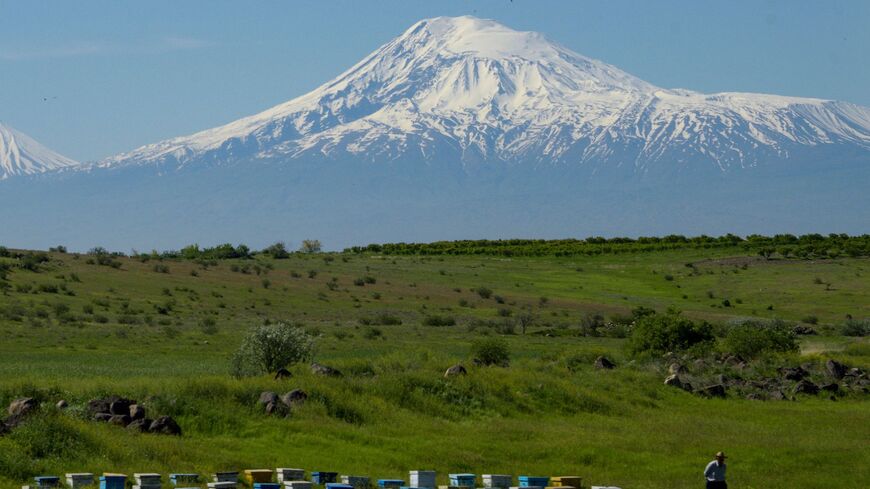
Mount Ararat, the symbol of an idealized Armenian homeland that towers over Yerevan, has been excised from passport stamps. Pashinyan asserts that Turkey’s acknowledgment of the genocide — an abiding goal of the influential Western-based Armenian diaspora — is not a condition for normalizing ties. In his February 2025 declaration, Pashinyan also called for a new constitution. This is Azerbaijan’s key remaining demand for signing a formal peace treaty with Armenia. Baku insists that the preamble of the constitution, which has references to Nagorno-Karabakh, amounts to territorial claims and therefore needs to be removed.

Mount Ararat and "Baby Ararat" viewed from Yerevan's Zvartnots International Airport, Yerevan, Armenia, May 31, 2026. (Amberin Zaman/Al-Monitor)
Mount Ararat and Baby Ararat, as viewed from Yerevan's Zvartnots International Airport, Yerevan, Armenia, on May 31, 2026. (Amberin Zaman/Al-Monitor)
 
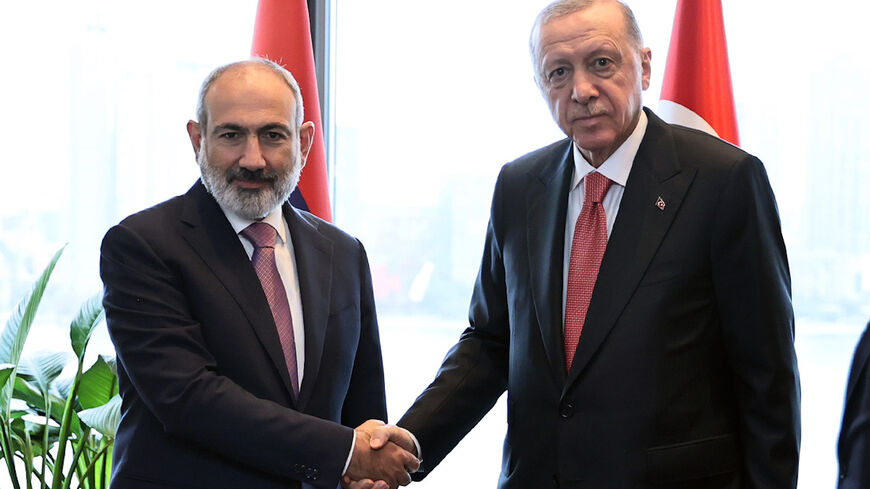
“Normalizing relations with Turkey and Azerbaijan is not a matter of whim" — rather, Yerevan “needs” these ties, Pashinyan said on Tuesday before speaking with Turkish President Recep Tayyip Erdogan by phone.

In February 2022, Turkey and Armenia resumed normalization talks after more than a decade in deep freeze. Turkey has taken some tentative steps such as launching Turkish Airlines flights to Yerevan and reopening a rail route to Armenia, albeit through Georgia. Armenian diplomats can now secure Turkish visas online. Turkey wants Pashinyan to prevail.

Ankara has signaled, however, that it won’t establish diplomatic ties and reopen the land border — which was sealed in solidarity with Baku in 1993 — until all of Azerbaijan’s conditions are met. There are several reasons for this. The most immediate is Turkey’s dependence on Azerbaijani oil and natural gas. This has grown exponentially since the start of the Iran conflict and the resulting spike in energy prices.

Under Armenian law, constitutional changes need to be put to a referendum. Two-thirds of parliament need to approve the plebiscite. The burning question, therefore, is not whether Pashinyan can win, but by how much.

An autocratic turn

Skeptics question the accuracy of opinion polls. Others claim they are manipulated outright.

Artur Khachatryan, a lawmaker for the opposition Armenia Alliance, is one of them. During an interview in the headquarters of his Armenian Revolutionary Federation, Khachatryan noted that the most recent IRI poll that gave Pashinyan a solid lead also indicated that 35% of respondents aged between 18 and 35 remained undecided. Some 18% of those above the age of 56, the group where Pashinyan polls highest, are undecided as well.

Artur Khachatryan, a lawmaker for the opposition Armenia Alliance, works the phones at his party's headquarters in Yerevan, Armenia, on May 27, 2026. (Amberin Zaman/Al-Monitor)
 
“Should Pashinyan fail to get two-thirds of seats, then he will have a big problem. If he does, the opposition will claim that the election was rigged,” a Yerevan-based political commentator speaking on condition of anonymity told Al-Monitor. “They will tell their supporters to take to the streets. Russia will jump in with provocations. There could be chaos,” he predicted.

Pashinyan has prepared for such contingencies, raising the salaries of military officers and the police force.

The overall health of the economy — it grew by more than 7% last year — is one of the prime minister’s strongest suits. Ironically, an influx of young Russian IT specialists in the wake of Russia’s 2022 invasion of Ukraine has contributed to the boost.

Around 30,000 are thought to have stayed on. They can be seen pounding their laptops in posh cafes. Others swill cognac in T-shirts that say “Billionaire Boys Club.” “Make Money Not Love” is a favorite among the ladies.

Critics say their philosophy fits well with Pashinyan's creed.

Rights groups have graver concerns. They say that Pashinyan has taken an autocratic turn in recent years, leading more people to be less open in their views. Even his supporters were shocked when Pashinyan fired the director of the Armenian Genocide Museum-Institute, Edita Gzoyan, for what he called “a provocative act contrary to the foreign policy of my government.” Gzyoyan’s principal offense was to have gifted Vance a book about the Armenian genocide during his February visit.

Pashinyan prompted further outcry last month during a heated exchange with Nagorno-Karabakh activist and refugee Artur Osipyan. He accused the premier of supporting corrupt leaders in the enclave and acting on behalf of Azerbaijan. Pashinyan flew into a rage. “If the Karabakh issue mattered, you should have gone and died. Why are you alive?” he fumed as he strode toward Osipyan, local media reported. Osipyan was arrested and jailed on charges of obstructing the election campaign and inciting violence. International watchdogs are calling for his release.

Zare Babayan is a refugee from Nagorno-Karabakh’s capital, Stepanakert. Like many women from the enclave, she makes a living selling “zhingyalov hats,” a flatbread stuffed with fresh herbs and greens. She lost a son during the September 2023 conflict while he was on duty. “He was only 25 and newly married. He died. I would like to ask Pashinyan why he didn’t die,” Babayan told Al-Monitor. “He gave away everything.”

Pashinyan is using similarly incendiary rhetoric to target his rivals. Foremost among them is the former prime minister, Robert Kocharyan, whom Pashinyan accuses of sacrificing Armenia to the narrow interests of his native Nagorno-Karabakh. Pashinyan calls the Armenian Alliance candidate “a son of a bitch” and has threatened to kill him “slowly and cruelly.” “He is driving an extreme polarization of Armenian society,” Khachatryan said.

Yet Pashinyan’s signature campaign symbol is the hand heart he flashes all the time. It’s part of a makeover that saw him shave off his beard and share videos of himself eating pastries and playing drums.

A young art gallery manager and former Pashinyan supporter remains unswayed by such tactics. “I took part in the Velvet Revolution and voted for Pashinyan,” Annette told Al-Monitor. She declined to give her last name for “privacy” reasons. “I am horrified by the language he uses with the people of Nagorno-Karabakh and the humiliating agreements he signed with Azerbaijan,” she added. "We have become slaves." 

She will be voting for the Against Everybody party. In doing so, she will ease Pashinyan’s path. Ballots for parties that fail to clear the 4% threshold for winning seats in the parliament go to the party with the highest share of the vote. By IRI’s reckoning, Against Everybody would get 1%. The lack of a credible opposition and the threat of renewed conflict combined with Western support and Russian meddling appear set to secure Pashinyan a third term.

Related Topics