



The weight of war: Erdal Duman’s sculptures probe politics of violence
As missiles cross again Middle Eastern skies, Turkish artist Erdal Duman’s brightly colored weapons ask an uncomfortable question: When does war really begin?


ANKARA — In Erdal Duman’s studio in Ostim — Ankara’s sprawling industrial zone of machine shops, metal suppliers and small-scale manufacturers — metal dust clings to the white walls. It is an environment built for production: spare, functional and unapologetic. Here, materials are cut, shaped and assembled into the machinery of war, and that machinery is turned into a question: Who controls force, and to what end?
“The state holds the monopoly of violence,” he says. “And it uses it easily. My problem is with that ease.”
On the second floor, a pink missile leans against the wall, its glossy surface and playful color complicating its lethal lineage. At a time when missiles once again cross Middle Eastern skies, Duman’s brightly colored missiles — now his artistic signature — acquire an unsettling immediacy.
Nearby stands another missile installation he prefers not to describe yet; it is reserved for his upcoming exhibition. Along one wall hangs a flag of his own design, imprinted with the maps and colors of multiple national flags and cinched with red straps faintly reminiscent of the American flag. “It was an old idea,” he says. “I carried it for years before I completed it.” The composite emblem gathers together countries often locked in cycles of conflict — a cartography of entanglement.
Across the studio sit compacted blocks of metal shavings. Each one, he explains, weighs roughly the same as a Kalashnikov rifle, about 3.8 kilograms. “The moment you produce this, the war has already begun,” he says. The shavings were once residue from his own cutting and welding. Melted down, they could become a weapon. By compressing industrial waste into the weight of a rifle, he traces violence back to its material origin. War, in his telling, does not begin with an explosion but with extraction, production and the language that justifies both.
That understanding has biographical roots. Born in 1976 in Germany and raised in Gaziantep, Duman grew up in the shadow of the first Gulf War. “People were preparing shelters in their bathrooms,” he recalls. “There was fear that something could cross the border.” War was not an abstraction; it entered domestic space.
Years later, as a sculpture student at Hacettepe University in Ankara, he encountered Jean Baudrillard’s assertion that “the Gulf War did not take place.” The statement unsettled him. “I thought, how can that be? We experienced it,” he says. Then he grasped Baudrillard’s argument about simulation and spectacle and how power can transform events into mediated narratives, reshaping perception itself. If language and image could distort reality, then sculpture, too, could intervene in that distortion. Ever since, words and shapes have gone together in his work, from the ironic titles of his exhibitions to his descriptions of his work.
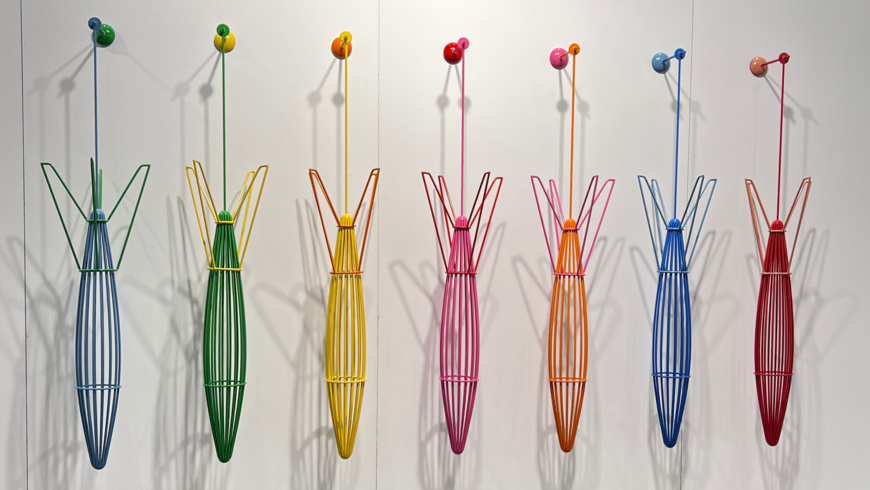
Tanks, rifles and missiles began appearing in his work, but never as straightforward replicas. He rendered them in bright, seductive colors and smooth finishes, forms that hover between weapon and toy. The aesthetic appeal complicates the viewer’s response. Violence, he argues, advances through normalization. Production lines operate quietly; political concepts follow. By the time “casus belli” (the Latin term describing an event meant to justify war) is invoked, the machinery has long been built.
The Middle East remains a persistent reference point. One of his most striking works is what he calls a “birthday cake” for the region's people. Constructed from soil, the piece resembles a celebratory birthday cake, complete with a pointed dome at its summit. The form carries the visual language of sanctity and martyrdom. “The Middle East has always been in my thoughts,” Duman says. “So many people have died for that land, and they were told that their martyrdom would lead them to eternal life in paradise. So here is my birthday cake for the people who die.” The use of earth underscores the cycle between territory and sacrifice, turning the soil itself into a commemorative object.
Duman’s reflections extend beyond geopolitics into the contemporary crisis of perception. He is wary of artificial intelligence and algorithmic mediation, particularly in language. He once designed a sculpture for a translation award and often returns to that example. “You can translate words with artificial intelligence,” he says, “but you cannot carry emotion, cultural nuance, the psychology of the author. If we hand over our intelligence, what remains of the subject?”
The question of the subject — the citizen capable of moral and political judgment — runs through his thinking. Drawing on Aristotle’s distinction between zoe (bare life) and bios (political life), Duman argues that modern politics increasingly mobilizes emotion rather than reason. “People make decisions emotionally,” he says. “You cannot undo an emotional bond with statistics. If power works through emotion, art must reach emotion too.” The artist, in his view, cannot remain within intellectual circles; he must engage the terrain where loyalty and fear are formed.
That concern shapes how he understands sculpture. Unlike painting or film, it cannot be absorbed from a fixed position. “You cannot understand a sculpture from one angle,” he says. “You have to walk around it. When you move to someone else’s position and see what they see, that is empathy.” The act of circling a work becomes an embodied reminder that perspective is partial.
The relationship between subject and object lies at the core of his practice. “At the beginning, I am the subject and the work is the object,” he says. “But after months of working, something changes.” He describes constructing a large tank form over several months, bending and welding metal rods into place. The repetition alters his rhythm. “At a certain point, the object begins to shape you. You are no longer only forming it — it is forming you.” The boundary between maker and made begins to blur.
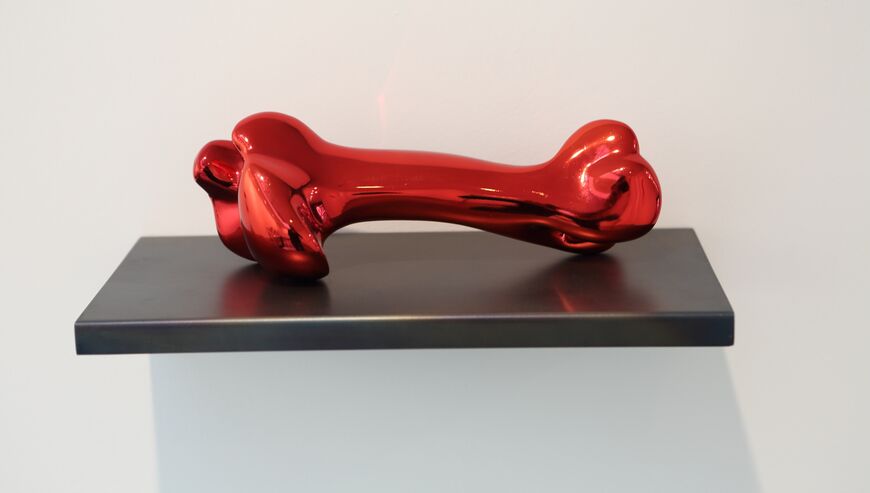
This reversal is evident in works such as his gold femur — a sculpted thigh bone rendered in a gleaming metallic finish, which he later created in different metallic hues. The bone recalls the prehistoric moment when a femur first became a tool and — by extension — a weapon. In isolating and gilding it, Duman draws a line from the earliest instruments of survival to modern armaments, confronting the long genealogy of force embedded in material culture.
His defense of public sculpture extends these ideas into civic space. When a sculpture by renowned Turkish artist Ilhan Koman was stolen from Ankara’s Segmenler Park, Duman joined a campaign to have it remade. For him, the theft was not simply the disappearance of metal but an erosion of collective memory. “The sculpture represents the city’s memory, our freedom,” he said at the time. Restoring it meant reaffirming the right to public expression.
This spring, Duman will open a major exhibition at Pi Artworks in Istanbul titled “Geldiysen Cama Tas At” (“If You’ve Arrived, Throw a Stone at the Window”), bringing together earlier works and new installations. In September, he will present at The Armory Show in New York, introducing his sculptural language to a broader international audience.
This one's on us.
The story doesn't end here.
Our correspondents are already on the next chapter. Read everything they file, from $2/week.
See Offers