



Syria reopens Aleppo's 1,300-year-old Great Umayyad Mosque after 13 years
Syrian authorities are working to restore cultural landmarks and ancient sites that had been damaged or destroyed during the civil war.


Syria reopened its historic Great Umayyad Mosque in the northern city of Aleppo on Thursday, after more than 13 years of closure following damages sustained throughout the country’s civil war.
Its reopening comes nearly a year after restoration work began following the ouster of former President Bashar al-Assad in December 2024, as part of the new Syrian authorities’ efforts to revive the country’s various sectors that had been devastated by more than a decade of civil war (2011-24) and sanctions.
The reopening ceremony was held on Thursday evening in the mosque, which lies within the Old City of Aleppo, a UNESCO World Heritage site, in the presence of presidential media adviser Ahmad Muwaffaq Zaidan, Aleppo Gov. Azzam al-Gharib and Minister of Endowments Mohammad Abu al-Khair Shukri, along with several other officials and clerics, the state-run news agency, SANA, said.
لحظة فتح باب الجامع الأموي الكبير خلال فعاليات افتتاحه بعد انتهاء أعمال الترميم pic.twitter.com/WkFRHoGL58
— Halab Today TV قناة حلب اليوم (@HalabTodayTV) October 8, 2026
“We stand here today, honored to reopen one of the houses of God; we are restoring the Great Mosque of Aleppo — Al-Shahba — after difficult years during which it was subjected to treachery and destruction, and we are writing a new chapter of reconstruction, freedom and dignity,” Gharib said in a speech during the ceremony.
He said the 1,300-year-old mosque was part of Aleppo’s history, serving as a haven for scholars, preachers and thinkers since the Umayyad era, adding that it was a refuge for anti-regime protesters during the Syrian uprising.
Destruction of history
The Great Umayyad Mosque is one of Aleppo’s oldest mosques, dating back to the eighth century. Construction of the mosque began during the rule of Umayyad Caliph Sulayman in 715, and it is built on the site of a former cathedral and cemetery dating back to Roman rule.
It is also believed to be one of the largest mosques in Syria, covering a plot of land about 105 meters (about 344 feet) long from east to west and about 77.75 meters (about 255 feet) wide from south to north.
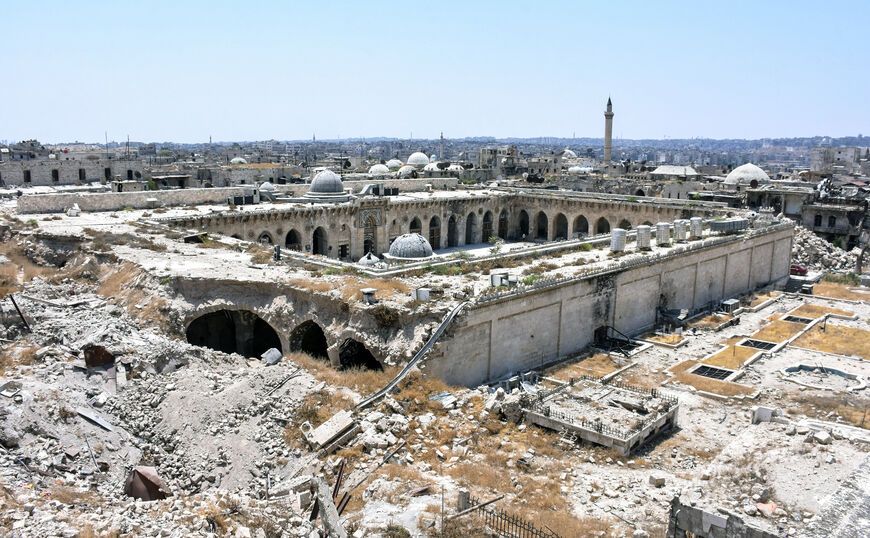
The mosque features a central courtyard with a black and white stone floor placed in distinctive geometric patterns, surrounded by several arcades, a prayer hall and niches, and a pulpit. It is said to hold the remains of Zechariah, the father of John the Baptist.
The mosque was subjected to heavy shelling and bombardment during the intense battles of Aleppo between 2012 and 2016, after which the government forces loyal to Assad took control of the city. The fighting left various structures of the mosque, including its walls, domes and arcades, heavily damaged.
According to reports back then, historical artifacts and valuable objects inside the mosque, including a box purportedly containing a strand of hair of Prophet Muhammed, were looted or destroyed throughout the civil war.
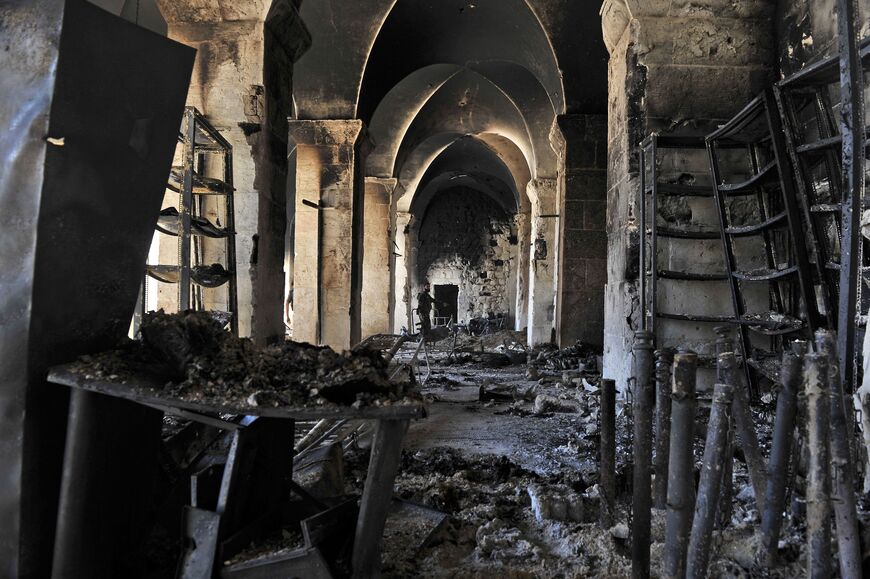
The mosque was put out of service in 2013, after its 45-meter-high minaret was completely destroyed and turned to rubble. At the time, Syrian government forces and rebel fighters of Jabhat al-Nusra — which merged with other Syrian rebel factions to form Hayat Tahrir al-Sham in 2017 after cutting ties with al-Qaeda — traded blame for the destruction.
The original minaret, which was built at a later stage in 1090, was distinguished by its square cross-section shape unlike traditional cylindrical minarets. It was adorned with intricate Arabic inscriptions in the old Kufic script characterized by its broad, blocky letters and the Naskh script — the traditional, cursive style of Islamic calligraphy.
Restoration efforts
The former Syrian regime had launched restoration work at the mosque in 2017. Still, it remained closed until the Aleppo Endowments Directorate under the new Syrian government resumed work there in November 2025. The directorate said the work was part of a project to “revitalize the mosque’s religious and cultural role and preserve its architectural and heritage identity, enabling it to once again serve as a beacon of knowledge and faith.”
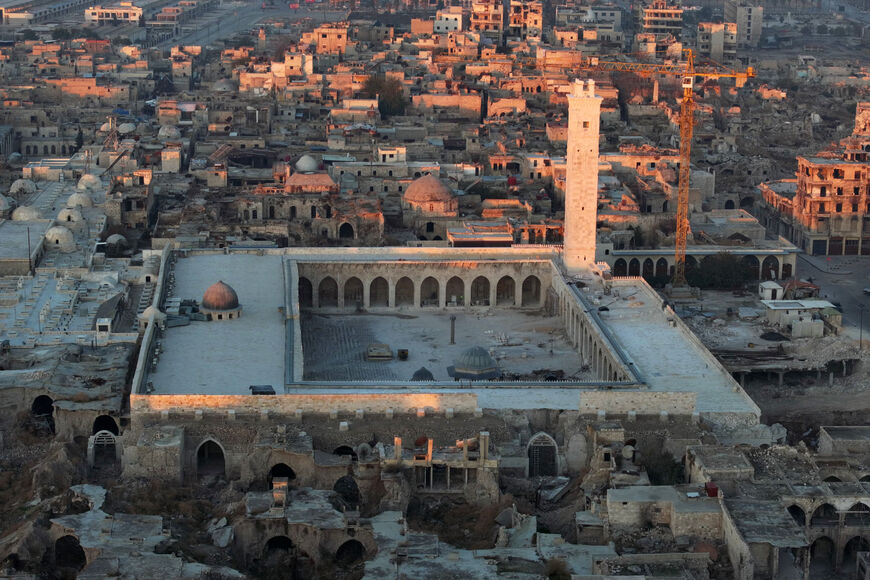
The mosque was partially reopened during the Muslim holy month of Ramadan in March 2025.
President Ahmed al-Sharaa and his government have sought to revive the country’s economy, with several projects already underway to restore ancient sites and cultural landmarks that suffered massive destruction and looting during the war.
In a March statement, Endowment Minister Shukri said that some 1,500 out of a total of nearly 16,000 mosques across Syria had been partially or completely destroyed during the civil war, adding that the ministry had a reconstruction plan based on available resources.
Last week, the fifth-century Saint Simeon church complex in Aleppo was reopened for tourism after more than 14 years of closure due to damage sustained during the war.
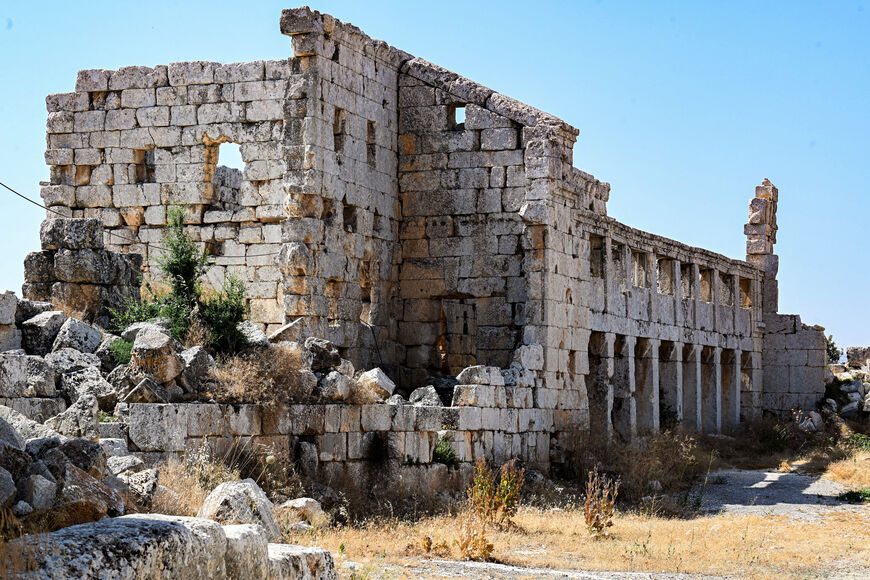
Syria is considered a cradle of civilization. Its capital, Damascus, and Aleppo are some of the world’s oldest continuously inhabited cities, with archaeological evidence of human settlement dating back 8,000 to 10,000 years.
This one's on us.
The story doesn't end here.
Our correspondents are already on the next chapter. Read everything they file, from $2/week.
See Offers