

Explainer

Why Trump bid to lift CAATSA sanctions on Turkey faces complicated path

Trump's announcement could reset US-Turkey defense ties, but congressional approval and separate legal restrictions stand in the way.

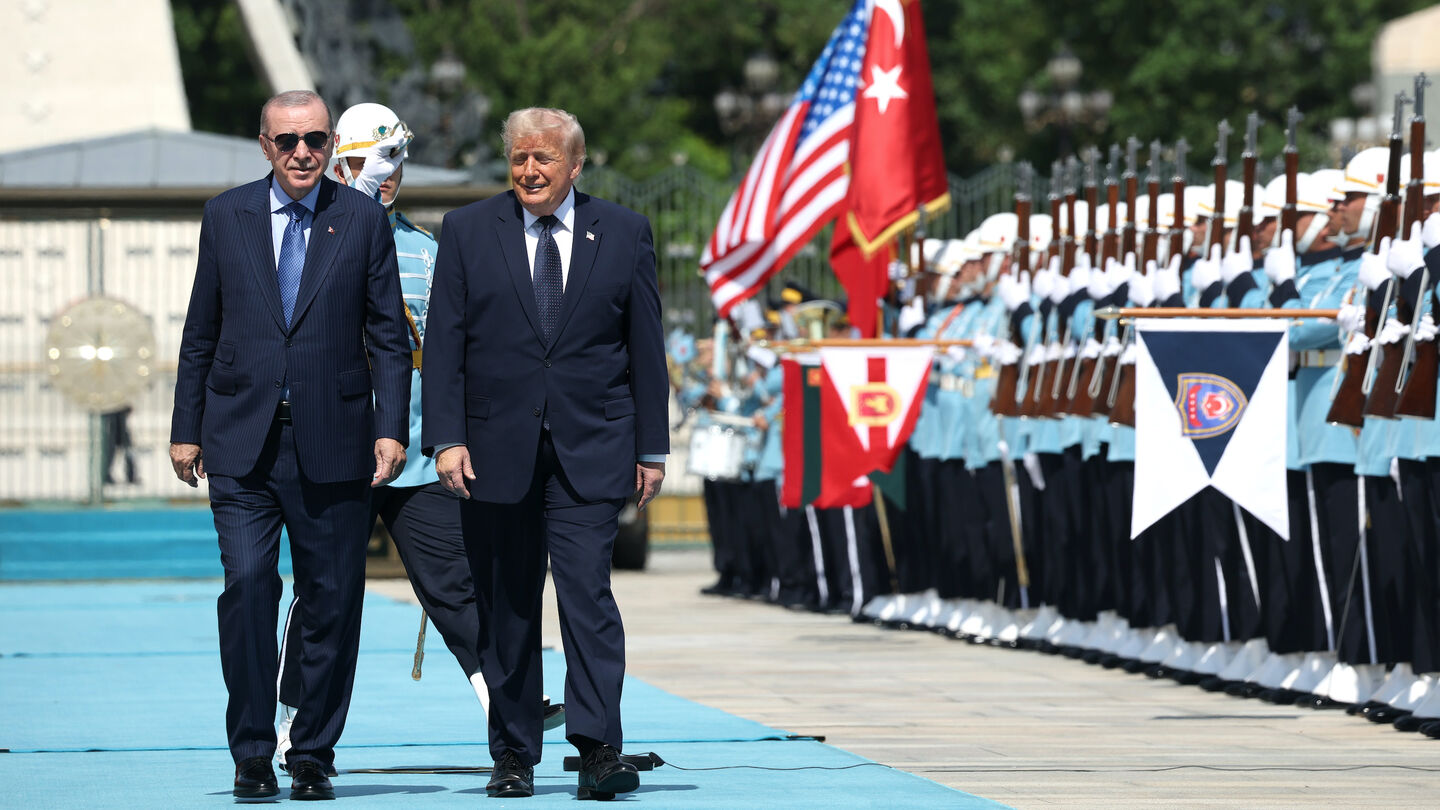
US President Donald Trump walks with Turkish President Recep Tayyip Erdogan during a state arrival ceremony at the Bestepe Presidential Complex for the annual NATO Summit on July 7, 2026 in Ankara, Turkey.
US President Donald Trump walks with Turkish President Recep Tayyip Erdogan during a state arrival ceremony at the Bestepe Presidential Complex for the annual NATO Summit on July 7, 2026 in Ankara, Turkey. — Win McNamee/Getty Images

US President Donald Trump said Tuesday that his administration would remove sanctions imposed on Turkey under the Countering America’s Adversaries Through Sanctions Act (CAATSA), signaling a potential breakthrough in a yearslong dispute between Washington and Ankara over the purchase of a Russian missile system.

“We are going to be taking the sanctions off. It's time,” Trump said during a meeting with Turkish President Recep Tayyip Erdogan in Ankara on Tuesday. “We don't want to sanction friends. It's very simple.”

But lifting the sanctions is not as simple as a presidential announcement. The penalties were imposed under a 2017 law passed by Congress, and removing them requires approval from lawmakers.

What are CAATSA sanctions?

CAATSA was signed into law in 2017 as part of a broader effort by Congress to punish Russia, Iran and North Korea for activities including foreign military sales. Section 231 of the law requires the US government to impose sanctions on entities that knowingly engage in significant transactions with Russia’s defense and intelligence sectors.

In 2020, Turkey became the first NATO ally targeted under CAATSA after it purchased Russia’s S-400 surface-to-air missile system in 2019. The measures included sanctions on Turkey’s Defense Industry Agency (commonly referred to as SSB) — the state agency responsible for managing major defense procurement projects — as well as restrictions on US export licenses and authorizations for the agency and sanctions against senior SSB officials, including then-President Ismail Demir.

The dispute also led Washington to remove Turkey from the F-35 program in 2019, preventing Ankara from acquiring the advanced fighter jets it had helped develop and intended to purchase. Turkey protested the move as unjust and illegal.

The two sides have recently upped efforts to resolve the issue. In April, US Ambassador to Turkey Tom Barrack said, “I think you are going to see the S-400 situation solved soon,” adding that “from my boss’s point of view, acceptance into an F-35 program is fine.”

How can CAATSA sanctions be removed?

The president has authority to waive CAATSA sanctions if the administration determines that doing so serves US national security interests. The law also allows waivers in certain cases where countries reduce their reliance on Russian defense equipment, as Congress did in 2022 when it created an exemption for India over its purchase of the S-400 missile system. A waiver, however, does not permanently remove the sanctions.

CAATSA allows the president to terminate sanctions if the administration determines that the sanctioned party has stopped the activity that triggered the penalties, taken significant verifiable steps toward ending it and provided assurances that it will not engage in similar activity in the future. Any such action is subject to congressional review under Section 216, which requires the administration to notify Congress before sanctions relief takes effect and gives lawmakers a window to object.

Russia’s 2022 invasion of Ukraine only strengthened support among lawmakers for CAATSA. In April, Sen. Tim Kaine (D-Va.) introduced a bill cosponsored by the Republican chair of the Senate’s Armed Services Committee, Roger Wicker (Ala.), that would strengthen the legislature’s hand in CAATSA sanctions.

“The only political body that can [permanently] remove CAATSA is US Congress,” Sinan Ulgen, a senior fellow at Carnegie Europe in Brussels, told Al-Monitor. “And right now, the general attitude toward Turkey in the US Congress is not, frankly, conducive to the wholesale lifting of CAATSA,” he added.

Key holdouts in Congress remain opposed to rewarding Ankara for its tilt toward Moscow, including the top Democrat on the Senate’s influential Foreign Relations Committee, Jeanne Shaheen (N.H.), who co-authored the original law.

For Turkey, the path to permanently terminating the sanctions is further complicated by a provision in the 2021 National Defense Authorization Act that specifically addressed Ankara’s purchase of the S-400 system. 

The law requires the administration to certify that Turkey no longer possesses the S-400 or a successor system, that the system is not being operated or maintained by Russian personnel or individuals acting on behalf of Russia, and that Ankara will not seek to reacquire the system in the future.

“That is politically a very difficult benchmark for any Turkish government,” Ulgen said.

Those requirements have remained a central sticking point in the dispute between Washington and Ankara. During the Biden administration, US officials reportedly proposed a compromise under which Turkey would place the S-400 system in a storage facility on Turkey’s Incirlik Air Base, which hosts US military personnel, as Al-Monitor reported at the time. Ankara rejected the proposal. 

“The parties may explore another option, which is for Turkey to send that material away to a third country, but that’s also problematic because this asset has been sold to Turkey by Russia on the condition of an ‘end-user’ agreement,” said Ulgen. 

“So Turkey cannot on its own sell that system to a third country unless Russia green lights it,” he added.

Asked in Ankara today whether the S-400 would be handled by a third party, Trump asked, “What does that mean?” Asked whether he had concerns about the system, he said, “I have no concerns at all about anything.”

What would it mean for Turkey?

For Ankara, lifting the sanctions could mark a major reset in defense ties with Washington after years of friction. Turkey is a founding member of NATO and has the alliance’s second-largest standing army, but the S-400 dispute created one of the deepest rifts in US-Turkey relations in decades, disrupting defense cooperation and straining ties between the allies.

The move “would reopen US-Turkey defense industrial cooperation,” Gonul Tol, a senior fellow at the Middle East Institute, told Al-Monitor.

“It would also benefit Turkey’s indigenous defense industry. Many flagship programs, including the KAAN fighter, helicopters, missiles and naval systems, still depend on US-origin technologies or export approvals. Removing CAATSA would ease those constraints, even as Turkey continues pursuing greater self-sufficiency,” she added.

Resolving the sanctions issue could also pave the way for renewed discussions over major US arms sales, including Turkey’s request to return to the F-35 program and its stalled efforts to acquire other defense equipment. 

But Tol cautioned that CAATSA relief alone would not resolve all of the obstacles.

The F-35 program “is governed by a separate legal restriction tied to Turkey’s possession of the S-400 system. In other words, lifting CAATSA is a necessary step toward normalizing defense ties, but it is not, by itself, enough to put F-35s back on the table,” she said.

Jared Szuba contributed to this report. 

Related Topics
