US, Turkey boost Libya coordination, but unity push faces political hurdles
Washington and Ankara are stepping up coordination on efforts to unify Libya’s divided institutions, but analysts warn that major financial and political obstacles remain.


ANKARA — The United States and Turkey are deepening coordination to unify Libya's fractured institutions, opening a new avenue for cooperation between Washington and Ankara as both sides push to stabilize the oil-rich country despite major political and financial obstacles.
Since early 2026, Washington and Ankara have backed parallel efforts to reconnect institutions split between Prime Minister Abdul Hamid Dbeibah’s Tripoli-based government and eastern authorities aligned with eastern commander Khalifa Hifter. Those efforts have extended across the military, financial and political spheres. Rival Libyan forces have joined US- and Turkish-led military drills, while eastern and western authorities approved a US-brokered public spending framework last month, Libya’s first common budget arrangement since 2013. Both Turkish and US officials have been increasing talks with officials from Libya's rival governments.
But analysts warn that the process remains fragile, with opaque budget implementation, no settled political framework and deep resistance to any arrangement that entrenches Libya’s current power brokers.
Coordinated efforts
Claudia Gazzini, the International Crisis Group’s senior analyst for Libya, told Al-Monitor, “The coordinated efforts aimed at Libya’s unity have three main components: military, financial and political."
All three tracks have accelerated since the start of the year. The most significant breakthrough came on April 11, when the rival bodies approved the unified state budget.
After Libya's institutional split in 2014, Tripoli retained formal control over oil revenues and budget disbursement, while eastern authorities relied on unofficial channels.
Under the new arrangement, the Tripoli-based government will oversee salaries, operational spending and subsidies, while development priorities will be jointly managed under Central Bank oversight.
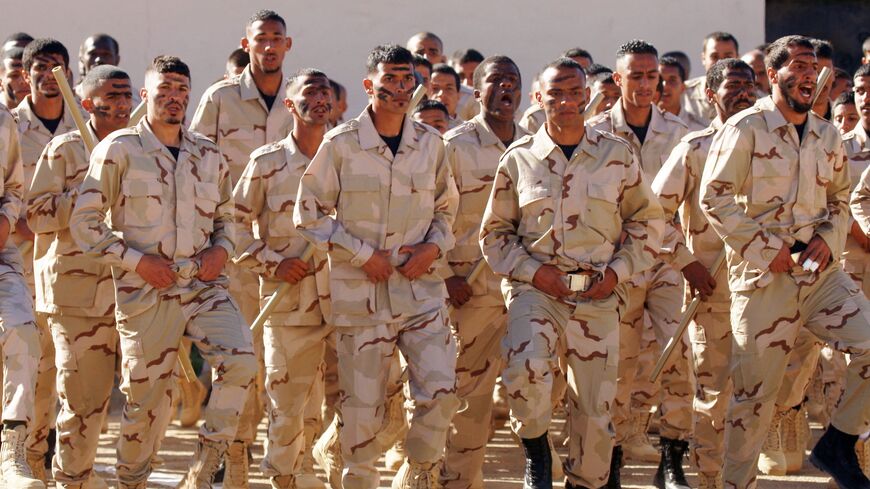
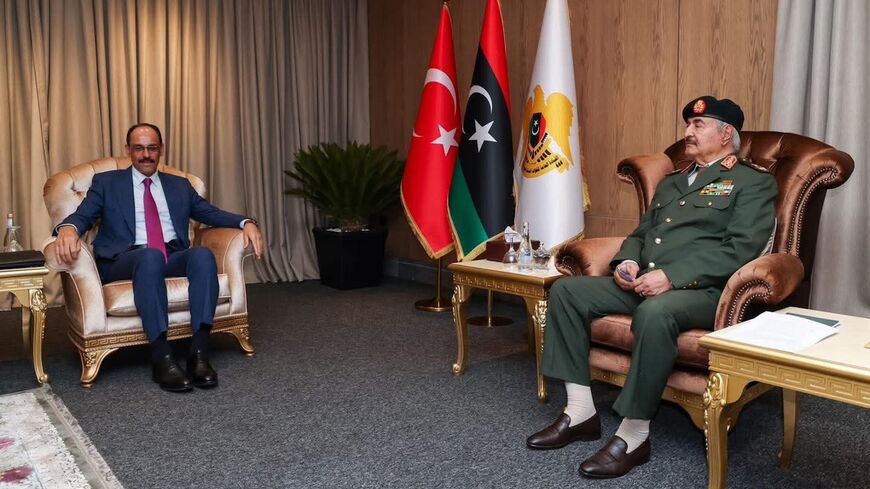
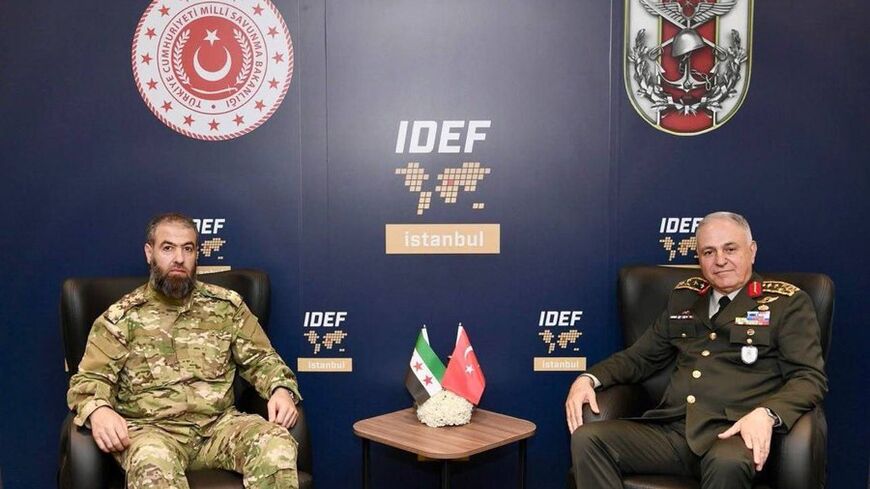
On the military track, rival Libyan forces joined AFRICOM’s Operation Flintlock 2026 in April and Turkey’s EFES-2026 in May. Meanwhile, Turkish Defense Minister Yasar Guler hosted Tripoli’s Deputy Defense Minister Abdul Salam Al-Zoubi and Saddam Hifter for meetings earlier this month.
On the political front, the outreach has included direct contacts between rival camps outside Libya as part of broader reconciliation efforts led by Massad Boulos, US senior adviser for Arab and African affairs. Most recently, Saddam Hifter, son of Khalifa Hifter, and Ibrahim Dbeibah, an adviser and relative of Tripoli-based Prime Minister Abdul Hamid Dbeibah, most recently met in Tunis in early April.
Strategic stakes
A unified Libyan framework would reshape the balance between Tripoli and the east, and determine whether Ankara can preserve the strategic gains it secured during the war, above all its 2019 maritime agreement with Tripoli.
Turkey intervened in Libya’s civil war in 2019 to back the Tripoli government against Hifter’s eastern forces, establishing a foothold it later used to secure a maritime delimitation agreement to expand Ankara’s claims in the eastern Mediterranean Sea.
The deal allows Ankara to assert rights over potentially energy-rich waters. Greece and Egypt strongly oppose the agreement, saying it encroaches on their maritime jurisdiction areas.
After the 2020 ceasefire that halted major fighting between Libya’s rival eastern and western armed forces, Ankara began engaging the eastern authorities while maintaining its ties with Tripoli. Libya’s eastern-based parliament later began discussing possible approval of the maritime deal in June 2025.
According to Gonul Tol, founding director of the Middle East Institute’s Turkey program, Ankara’s current outreach to Libya’s eastern camp is closely tied to its efforts to reinforce the standing of the 2019 maritime agreement.
“Turkey has a series of priorities in Libya, but one of the most important is the approval of the agreement it signed in 2019 by the eastern parliament,” Tol told Al-Monitor.
That approval would allow Ankara to argue that the deal has broader Libyan institutional backing, rather than solely Tripoli's.
Increasing US-Turkey coordination on Libya comes a critical time for Turkey as it is seeking to reinforce its posture in the eastern Mediterranean as increasing cooperation between Israel, Greece and Cyprus fuels Ankara’s concerns of encirclement.
But Turkey’s stakes in Libya go well beyond the maritime accord. Maintaining a military presence on the Mediterranean’s southern coast gives Ankara reach into North Africa and the wider eastern reaches of the sea. The Turkish Parliament extended the Libya mission for another two years starting from January 2026.
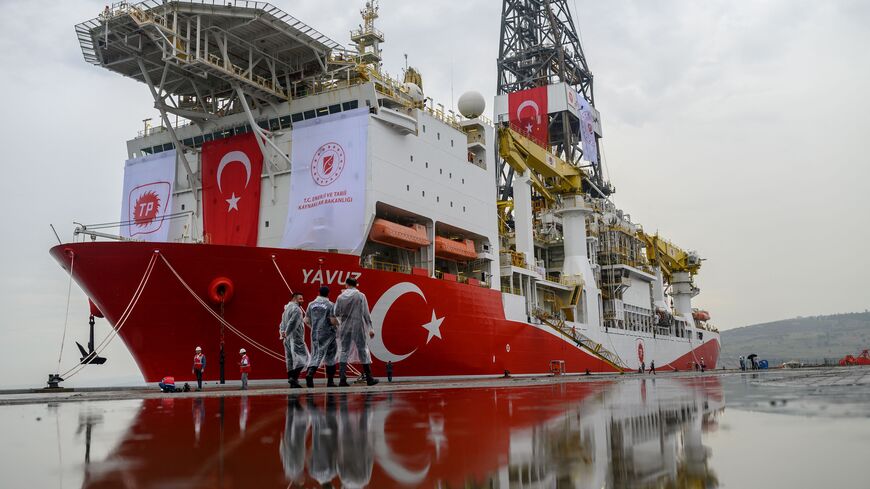
Libya’s energy wealth is another draw for Turkey, which imports more than 70% of its energy needs. In June 2025, Libya’s National Oil Corporation and Turkey’s TPAO agreed to conduct geological and geophysical studies in four offshore areas. Turkish contractors also have a major stake in Libya’s reconstruction, with projects worth about $29 billion before the 2011 civil war.
For Washington, Libya offers both an energy opening and a low-cost diplomatic win.
Karim Mezran of the Atlantic Council said that “renewed interest from US and international energy companies” has made Libya more attractive to Washington, which may see influence there as relatively easy to obtain.
Gazzini said Boulos appears to see Libya as a relatively manageable file compared with other regional crises.
“I think Boulos thinks this can be a quick deal that this could be an easy win,” she said.
Libya also gives Washington a way to counter Russia’s entrenched military presence in eastern and southern Libya. Following the US-led Flintlock exercises, Moscow moved military assets from Sirte toward southern hubs including Jufra and Brak al-Shati, Agenzia Nova, an Italian news agency specializing in international politics, reported last month.
Risks of elite bargain
Yet the growing coordination does not mean Libya is close to reunification.
Of the three tracks, the military component appears most straightforward. “It’s working well,” Gazzini said, referring to US- and Turkish-hosted drills and meetings between rival Libyan security officials.
The financial track has also gained momentum because Washington has leverage over Libya’s dollar-exposed oil sector, allowing it to press rival authorities toward a common spending framework after years of parallel financial practices, Gazzini said.
But she cautioned that the unified budget is an incomplete process. Neither US nor Libyan officials have disclosed its full details, leaving unclear what was actually agreed and whether both sides interpret the arrangement in the same way.
Mezran echoed similar caution, warning that a budget deal alone cannot hold without a political framework behind it. “I’ve never seen an economic agreement or an economic reform that goes well without its political support,” he said.
The political track is the most combustible. One reportedly floated formula would place Saddam Hifter in the presidency while keeping Abdul Hamid Dbeibah or Ibrahim Dbeibah as prime minister.
Gazzini said it remains unclear whether Washington is seriously pursuing the idea or using it to keep rival camps engaged. Either way, she warned, “Any new governing structure that officially gives senior positions to Dbeibah and to Hifter families will mean that they will stay in power for the long term.”
That would push Libya’s long-delayed elections, originally scheduled for December 2021, further out of reach. Gazzini said such a formula has drawn criticism that it would reward corruption and poor governance, entrench leaders who have little incentive to leave office and contradict years of international promises to move Libya toward elections. Libya ranked 177th out of 182 countries in Transparency International’s 2025 Corruption Perceptions Index.
Mezran warned that imposing Saddam Hifter or another Hifter figure on western Libya could trigger backlash in Misrata, Zawiya and Sabratha, where anti-Hifter sentiment was shaped by the 2019-2020 assault on Tripoli and abuses linked to Hifter-aligned forces.
UN officials documented mass graves in Tarhuna after Hifter-aligned forces withdrew in 2020.
“You cannot support those who attacked Tripoli and massacred its population, and then demand that the people accept them as the new leaders of Libya,” Mezran said. “Such a deal would be sustainable for 10 minutes.”