US, Iran weigh de-escalation declaration as first step of talks
Behind the scenes, Iran and the United States are exploring a cautious diplomatic track centered on de-escalation rather than immediate concessions.


TEHRAN — Plans for a potential face-to-face meeting between Iranian and US officials aimed at de-escalating tensions face growing uncertainty, as conflicting messages from Washington, Israeli pressure and US military signaling complicate a fragile diplomatic track.
Behind the scenes, Iran and the United States are cautiously exploring diplomacy centered on de-escalation rather than immediate concessions, beginning with a mutual declaration renouncing hostile actions as a way to reduce the risk of miscalculation and open space for sequential talks on nuclear, regional and other issues.
According to a regional diplomatic source, preparations had been underway for talks to take place within days, possibly hosted by Turkey, with Oman, Qatar, Egypt, Saudi Arabia and Pakistan involved as regional facilitators or guarantors. The objective was limited but urgent: to prevent further escalation at a moment of heightened military and political tension across the region.
Public messaging from Washington, however, has continued to emphasize pressure alongside diplomacy. The White House has reiterated that President Donald Trump retains “all options,” including military force, and that Iran understands this reality well. While intended to reinforce deterrence, such statements have added to uncertainty over Washington’s diplomatic ceiling and the scope of any potential talks.
Israeli media reports have further complicated the picture. Channel 12 reported that Israel has been exerting intensive efforts to prevent any agreement between Washington and Tehran, amid Israeli concerns that a limited deal focused on the nuclear file would leave Iran’s missile capabilities and regional posture largely intact. Israeli political discourse in recent days has increasingly pointed toward a military option rather than renewed diplomacy.
Military friction and competing narratives
At the same time, maritime and aerial incidents underscored how thin the margin for error remains. Reports emerged that fast boats belonging to Iran’s Islamic Revolutionary Guard Corps briefly surrounded a US-flagged tanker early Tuesday before disengaging. Also on Tuesday, an Iranian drone was downed as it approached a US aircraft carrier operating in the region.
Iranian media offered a sharply different account following the incidents. Iran’s pro IRGC Fars News Agency, citing informed sources, said that an Iranian reconnaissance and surveillance drone had successfully completed its mission in international waters. According to the report, the drone’s primary task was to monitor and track military movements in areas surrounding Iran, with data transmitted in real time to ground control stations. The report did not acknowledge any interception or loss of the drone, framing the operation as part of routine intelligence-gathering amid heightened regional deployments. Tasnim, a semi-official agency, did acknowledge the downing of the drone.
The competing narratives highlight the information fog surrounding military encounters in the region, where limited transparency and rapid reporting often produce conflicting accounts. For diplomats involved in the de-escalation effort, such incidents underscore the urgency of establishing stabilizing mechanisms to prevent miscalculation, particularly as military activity continues alongside diplomatic preparations.
Diplomatic groundwork
The current diplomatic activity builds on a series of engagements and statements made over the past week.
On Jan. 31, Qatari Prime Minister and Foreign Minister Sheikh Mohammed bin Abdulrahman bin Jassim Al Thani met Ali Larijani in Tehran, according to a statement from Qatar’s Foreign Ministry. The talks reviewed ongoing efforts to de-escalate regional tensions and reaffirmed support for diplomatic and peaceful solutions, underscoring Doha’s continued role as a regional interlocutor.
Following the visit, Larijani — secretary of Iran’s Supreme National Security Council — wrote on X that “contrary to the artificially manufactured media atmosphere of war, the formation of a structured framework for negotiations is moving forward.”
Speaking to Fox News, Trump offered a more ambiguous assessment. “Iran is talking to us, and we’ll see whether we can do something. Otherwise, we’ll see what happens,” he said.
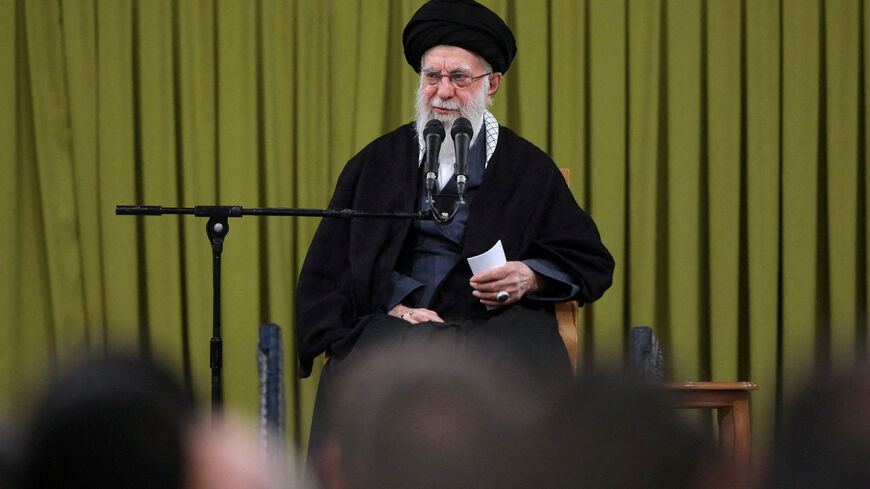
A day later, Iran’s Supreme Leader Ayatollah Ali Khamenei struck a markedly firm tone in a public address in Tehran. He warned that if the United States were to ignite a war, it would no longer be limited in scope. “This time it will be a regional war,” Khamenei said, referring to repeated US statements that “all options are on the table,” including military action.
Taken together, these statements suggested a narrow window in which diplomacy and deterrence were advancing in parallel. Several regional observers immediately concluded that a military strike was not imminent. If a structured negotiating framework is indeed moving forward, diplomats say, an announcement would likely follow in the near future.
Inside the proposed talks
Despite the pressure, diplomatic engagement behind the scenes has continued.
According to a regional diplomatic source familiar with the talks, the proposed negotiations were designed to begin with a de-escalation declaration rather than immediate bargaining over contentious issues. Under the plan, Iran and the United States would issue a declaration stating that neither side intends to engage in hostile exchanges against the other and that both are committed to pursuing diplomacy as the preferred path forward. The declaration was conceived as a risk management tool, not a political breakthrough.
On the nuclear file, the source said, Iranian negotiators signaled flexibility. Several scenarios were discussed, including transferring Iran’s stockpile of uranium enriched to 60% to a trusted third party, or downblending uranium enriched to 60% and 20% to levels considered nonthreatening before transferring it to a regional or international consortium.
To be sure, Ali Shamkhani, senior political adviser to Iran’s Supreme Leader Ali Khamenei, said Tuesday there is “no reason” for Iran to transfer enriched uranium outside its territory.
These ideas were framed as confidence-building measures rather than concessions, aimed at addressing immediate proliferation concerns while preserving Iran’s long-standing position that its nuclear program is peaceful. The concept of a regional consortium was also intended to embed the nuclear issue within a broader cooperative framework, rather than treating it solely as a bilateral US-Iran dispute.
By contrast, discussions on Iran’s ballistic missile program remained limited. According to the source, there have been no clear or agreed-upon mechanisms for addressing missiles at this stage, reflecting Iran’s position that its missile capabilities constitute a core element of national defense and fall outside the scope of nuclear negotiations.
On regional influence, the source said Tehran expressed readiness to show “positive signs” in the region, particularly following shifts that have taken place over the past two years in the wake of the Gaza war.
Skepticism and maximalist demands
These behind-the-scenes discussions align with public remarks from Tehran.
Speaking to Iran’s official IRNA news agency, Foreign Ministry spokesperson Esmail Baghaei confirmed that planning for negotiations between Iran and the United States is underway, and consultations are ongoing to determine the venue. He stressed that timing and location should not become a media-driven controversy, noting that Turkey, Oman and several other regional countries have expressed readiness to host.
Iranian skepticism, nonetheless, remains pronounced. A source quoted by the outlet Iran Nuances warned that procedural maneuvering could signal deeper problems. “If the American side intends to play games with seemingly simple issues like the venue and timing of negotiations and potentially resort to a blame game, one must doubt their intentions and sincerity for diplomacy more than ever,” the source said.
Meanwhile, Israeli reporting has raised further questions about Washington’s negotiating posture. According to Israel Hayom, citing a source close to the US administration, Trump remains firm on four core demands: Iran’s renunciation of its nuclear program, a halt to its ballistic missile project, an end to funding proxy organizations, and improved treatment of protesters who participated in demonstrations against the Iranian system.
The report added that senior US officials are aware Iran is unlikely to comply with these demands in full and that the prospects for reaching an agreement under such conditions are limited. According to the source, the administration’s objective may be to build internal and external legitimacy ahead of possible military action rather than to secure a negotiated settlement.
For regional diplomats, the coexistence of exploratory diplomacy and rigid end goals raises concerns that talks could function less as a pathway to compromise and more as a procedural step preceding escalation.