



Syrians decry soaring electricity prices


When Hani Massalkhi went to pay his electricity bill in Damascus this week, he discovered that, under the new tariffs, the amount due was higher than his monthly income.
Massalkhi, a retired agricultural engineer who lives on a $70-a-month pension, left without paying.
"My bill used to vary between 15,000 and 20,000 pounds (less than $2). Now, it has surpassed 800,000 pounds", or $72, he told AFP.
In October, Syria's energy ministry hiked prices by up to 6,000 percent, sending shockwaves through a population already reeling from more than 13 years of war.
"Where are we supposed to get this money from?" Massalkhi wondered.
"People are emerging from a crisis, exhausted...they can't even put food on the table."
Authorities said the increase comes "within the framework of a project to reform the electricity sector, achieve sustainability, and improve service".
But, with most of Syria's population living below the poverty line and the minimum wage at around $75, many have found themselves unable to pay the new tariffs.
An official at the energy ministry did not respond to an AFP request for comment on the new prices.
- 'Electricity is a right' -
Since the ousting of longtime ruler Bashar al-Assad in 2024, the new Syrian authorities have repeatedly vowed to increase electricity production in a country where power cuts can last up to 20 hours a day.
Over the past year, they have signed contracts and memoranda of understanding to import gas from Turkey and Qatar to increase production.
They also hope to attract funding and investments to rehabilitate Syria's dilapidated infrastructure.
The World Bank estimates that post-war reconstruction will cost more than $216 billion.
However, citizens have yet to feel noticeable changes in their living conditions.
Damascus residents now receive up to six hours of state-provided electricity daily, but those outside the capital remain mostly in the dark.
Mohamad Ahmad, an economist and energy specialist at the Syria-focused consultancy Karam Shaar Advisory, told AFP that the price increase "primarily aims to prevent the financial collapse of the electricity sector".
"The core problem is not the tariff increase itself, but rather the erosion of wage purchasing power, particularly given that some employees earn less than $100 per month," he added.
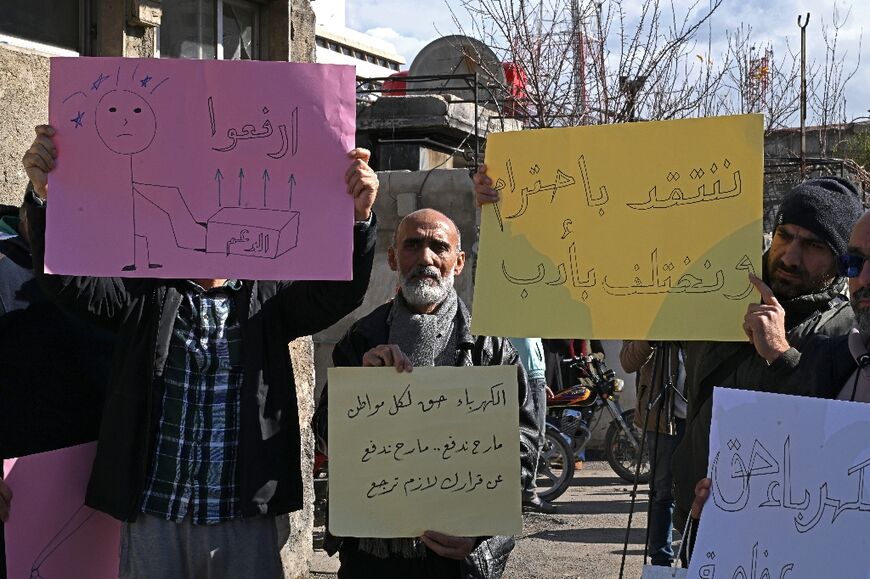
On Thursday, a handful of people gathered outside the energy ministry in Damascus to protest the new tariffs, something unimaginable under the former government.
They held placards that read "we won't pay", condemning the widening gap between incomes and bills.
Protester Mohammed Daher, a retired public employee, told AFP that he now receives only two hours of electricity a day in the Tadamon suburb of Damascus.
He said that although he carefully rations his power use at home, he was "shocked to find out that my bill has surpassed 350,000 pounds ($31)," when it used to be less than $2.
"Where am I supposed to get that money from?" he added, saying his income was just $62 a month.
Feminist activist Sawsan Zakzak, 65, said she had been limiting her electricity consumption because she and her husband live on low pensions.
"We do not use air conditioning, and this year we did not use the boiler," she said as she held a placard that read "electricity service is a right".
"We also only watch television for a short period of time, fearing high tariffs."
This one's on us.
The story doesn't end here.
Our correspondents are already on the next chapter. Read everything they file, from $2/week.
See Offers