



Syria’s Kurdish artists defy ISIS mentality through music, dance
In northeast Syria, Kurdish women are using music and performance to assert cultural identity, promote female empowerment and navigate postwar challenges.

Seven women swathed in chadors, their eyes barely visible through netted apertures, stride purposefully toward seven marble headstones in a forest clearing. A lone woman in traditional Kurdish garb stands in the distance. A low wind hisses as she raises her head and croons softly in the purest of voices. Her face is tattooed with symbols of matriarchal power and fertility. The others caress the headstones marking the mock graves of exalted Kurdish women fighters who perished in battles against Turkey or the Islamic State.
Then, as one, the women tear off their shrouds to reveal Kurdish guerrilla clothing. Their waists are bound with the floral printed scarves popularized by the Women’s Protection Units (YPJ), the all-women Syrian Kurdish fighting force that awed the world with its steely courage in the fight against the Islamic State. The women break into a martially inspired dance as the singer carries her melody to an impassioned, pulsating pitch.
The song in the YouTube video is called "Vejin" (“Resurrection”), and is performed by Mufide Hemdi, a much-beloved singer from Afrin, a bastion of Kurdish nationalist sentiment in northwestern Syria. Vejin aims to convey the indomitable spirit of resistance of a people who have survived centuries of brutal repression to emerge as indisputably influential actors in the geopolitics of the Middle East. Above all, it telegraphs the empowerment of women, a cornerstone of the Kurdish-led Autonomous Administration in Northeast Syria, which sets it at ideological odds with the country’s former jihadi rulers who overthrew the country’s long-time dictator, Bashar al-Assad, a year ago.
"Vejin," or "Resurrection," performed by Mufide Hemdi and organized by the Hunergeha Welat Center.
As US-brokered talks to integrate the Kurdish-run entity with Damascus continue in fits and starts, bridging differences over the role of women in society stands out as one of the biggest challenges, said Sero Hindi, a Kurdish Syrian documentary filmmaker and co-founder of Hunergeha Welat, the arts and culture commune in Qamishli that produced Vejin.
That reality was driven home on the night of Sept. 29, when the troupe performed "Vejin" in Sulaimaniyah, the second-largest city in the neighboring Iraqi Kurdistan region. As an electrified audience began sharing footage of the dance online, a tidal wave of insults and threats from enraged Islamists ensued, Hindi recalled in a recent interview with Al-Monitor at Hunergeha Welat.
The American University in Sulaimaniyah, where the event was staged, was forced to issue a statement in the face of angry condemnations from Islamic scholars saying that the dance symbolized women being rescued "from the Islamic state."
Inano Genco, a 24-year-old English teacher from Qamishli, danced in the video and on stage that night. As the death threats poured in, her mother got on the phone and ordered Genco to come back immediately. “She told me that now my face was all over the internet, I would never be safe performing again. She wanted me to stop,” Genco told Al-Monitor. “I told her to relax and told her, 'No. I want to remain part of the revolution.'”
“None of these girls are scared,” said Delil Mirzaz, who wrote the lyrics for Vejin and has been involved in efforts to keep Kurdish culture alive for more than three decades as it was being determinedly erased in assimilation campaigns in Turkey, Iraq and Syria. He said he was acting on orders from Abdullah Ocalan, the Kurdish rebel leader who founded and led the Kurdistan Workers Party (PKK) from Syria until his ejection by the Assad regime in 1998. Ocalan was captured soon after by Turkish special forces in Kenya in February 1999 and has remained on an island prison off the coast of Istanbul ever since.
He continues to hold sway over millions of Kurds, which is why the Turkish government is negotiating with him yet again in the hopes of getting him to demobilize the PKK once and for all and getting its Syrian Kurdish arm to fold into Syria’s national army.
Ocalan is widely credited here for his efforts to smash the Kurdish patriarchy, enlisting thousands of women to join and fight with the PKK. Political parties in Turkey and Syria that acknowledge him as their leader strive to enforce his radical feminist philosophy, appointing a female peer for every prominent position held by a man. “Ocalan gave us this feeling of freedom,” said Rukan Omar, a 20-year-old computer science major who danced in the video.
"Vejin" is part of a trilogy called "Keziya Sor" (“Red Braid”). Braiding hair is a way of setting aside one’s femininity to concentrate on resistance in Kurdish female warrior lore, Omar explained. Rohelat Afrin, the commander-in-chief of the YPJ, proudly wears one, jazzing it up occasionally with a red ribbon.
Hunergeha Welat, which means “Atelier of the Homeland,” was founded in 2014 at the height of the US-backed war against ISIS, in part to document the horrors but also to create music to capture and propagate the valor of the Kurdish resistance. In an ironic twist, the academy is located next to a rehabilitation center for so-called Cubs of the Caliphate — underage boys who were trained and forced to fight by ISIS.
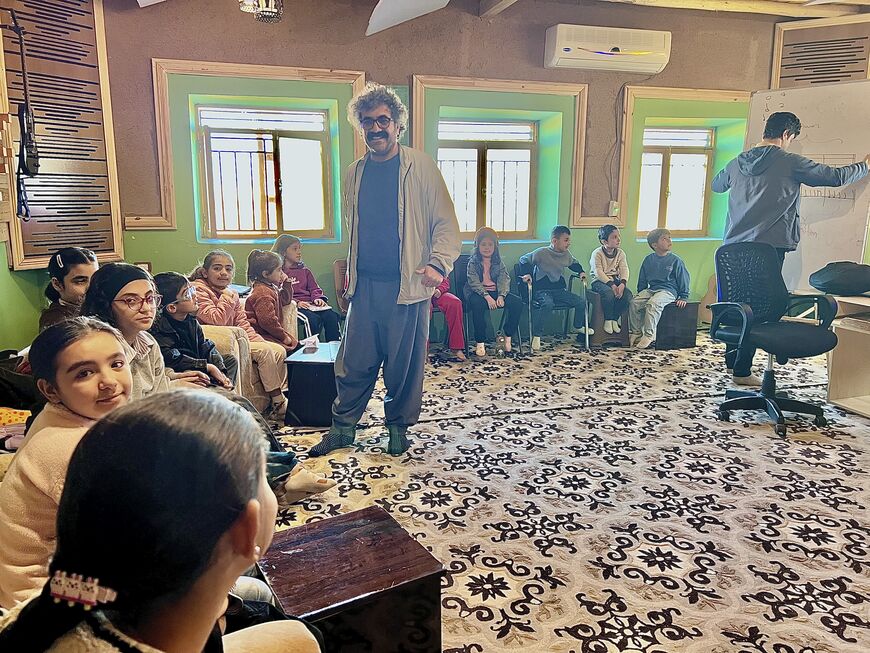
Filmmaker Sero Hindi teaches music to children at the Hunergeha Welat arts academy in Qamishli, Syria, Nov. 22, 2025. (Amberin Zaman/Al-Monitor)
They may have overheard a group of their contemporaries gathered on a recent afternoon at Hunergeha Welat, lustily singing a Kurdish song about the cereal leaf beetle, a species that is seen on grain crops like the barley and wheat grown in the region.
The aim is to create a safe space for adults and children alike amid the atmosphere of violence and instability that has gripped much of Syria since the civil conflict erupted in 2011 and “naturally to teach them our culture,” Hindi said.
The mission appears to have succeeded. Not a single one of the two dozen-plus girls and boys gathered here had ever heard of Taylor Swift. Asked who their favorite star was, several responded Aram Dikran, a celebrated Syrian-Armenian oud player from Qamishli who sang mainly in Kurdish until his death in 2009.
“They love to sing about animals,” said Kawa Khaled, a young musician who composes songs for the children.
More recently, the academy has begun focusing on building bridges with the rest of Syria, gathering and digitizing music from Syria’s diverse ethnic and religious groups including Arabs, Alawites, Turkmens and Druze. “This would be a great way of integration, of creating trust and unity,” Mirzaz observed.
Even before Assad’s fall, Hunergeha Welat managed to produce a video clip featuring singers and dancers from different backgrounds that was filmed at the ruins of Qalaat Jabaar, the ancient fortress overlooking the Lake Assad reservoir in Raqqa province where ISIS based its so-called caliphate.
The project continues to excite interest across Syria, Mirzaz said, adding that plans to open a center in Damascus are underway. Yet, when a group of performers from the Syrian capital recently sought to travel to the northeast to shoot a new video with Hunergeha Welat, they were stopped by Syrian government forces on the way.
The video, titled "Make Syria Beautiful," was shot and premiered in March nonetheless.
"Make Syria Beautiful," by Hunergeha Welat Center, Nov. 24, 2025.
The views of Syria’s interim president, Ahmed al-Sharaa, who was a jihadi for most of his adult life, are hardly representative of Syria, where many, including Sunni Arabs, espouse a secular lifestyle.
“But these people in the government, they have an ISIS-like culture,” Hindi said. “They are one color, whereas we are multi-colored.”
To be sure, despite his moderate makeover, there is little evidence that Sharaa is anywhere close to ascribing to Ocalan’s preachings on gender equality. There is only one woman in his 23-member cabinet, the minister of labor and social affairs, Hind Kabawat.
Still, he deserves credit for the distance he has traveled, observers say. Hediye Levent is a Turkish commentator who spent long years in Damascus. “The world focuses on how Sharaa swapped his combat fatigues for suits and shortened his beard. The most dramatic change is how his wife and daughters dress and how he interacts with them in public in ways that would clearly offend his radical base,” she told Al-Monitor. Sharaa’s wife, Latifa al-Droubi, does not cover her face and wears stylish if modest gowns. Syria’s first lady sparked astonishment — and admiration — when she received her university diploma in September from the hands of her husband at Idlib University, a clear endorsement of women’s education.
Moreover, during his first official visit to the White House last month, Sharaa announced that his government had joined the US-led global coalition against ISIS. He reiterated its commitment to the fight against the jihadis following the Dec. 13 attack in the Syrian desert that killed two US soldiers and their interpreter by a lone gunman with known ISIS sympathies.
In fact, Sharaa has been at war against ISIS since 2013 and renounced global jihad in 2016.
None of this appeared to impress Hindrine Idris, a 20-year-old Kurdish student of political science who wears the hijab. Did her piety make her feel close to Syria’s new president? “Of course no,” she responded. “I know he is [religious] and I am a hijabi girl but our minds are never the same. We are open-minded,” Idris told Al-Monitor. “Our hero is Rohelat Afrin.”
This one's on us.
The story doesn't end here.
Our correspondents are already on the next chapter. Read everything they file, from $2/week.
See Offers