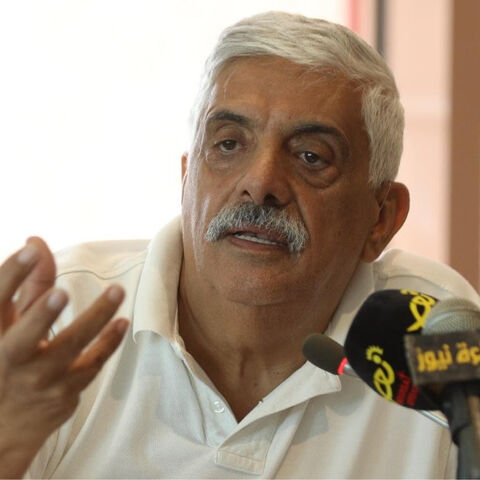
Nabil Amro, a former Fatah minister, argued that things could get worse for Palestinians under Trump. The former president’s proposed plan would grant Israel more than a third of the West Bank, including Jerusalem. However, Democrats “are not working sufficiently to reach a solution that satisfies Palestinians,” he said. The options for a new administration “range from bad to worse," he said. "In this case, the worst is Trump.”
Hazem Kawasmi, a political economist, contends that if the Democratic party wins, US policy in the Middle East will not change and instability accompanied by small-scale wars will continue for some time. On the other hand, he said, if Trump becomes president, “things will become much clearer due to his clearly stated vision of the region. With his blessings, Israel will annex what is left of the Palestinian land."
Wadie Abu Nassar, who is based in Haifa and heads the International Center for Consultations think tank, told Al-Monitor that in recent decades, most American politicians have been strongly allied with Israel and have ignored the Palestinian people's quest for self-determination. He said, “Regardless if it will be Donald Trump or Kamala Harris who will lead the United States for the next four years, American policies in the Middle East will continue contributing to the region's instability due to failure to push Israel to make concessions that would enable peace with its Arab neighbors, especially the Palestinians."
Yet others say that while the Democratic Party’s current policies neglect their interests, they see some hope for a shift.
Nazareth-based lawyer and political commentator Botrus Mansour said that Harris will be under some pressure from her left flank — including lawmakers Bernie Sanders, Alexandria Ocasio-Cortez and Rashida Tlaib — to take Palestinian concerns more seriously. Trump would not face pressure from any source to moderate his views, Mansour said.
Others disagree with this take. Dimitri Dillian, spokesperson for the reformist Fatah democratic faction, decried the corrosion of American democratic values and the degradation of its global standing. He said, “As Palestinians, whose lives are significantly impacted by US foreign policy, we observe with deep frustration the American electoral landscape reduced to a choice between two candidates entrenched in complicity. One is part of an administration that is complicit in Israel’s genocide in Gaza, while the other candidate demonstrates shameless allegiance to Israel’s most fascist, supremacist political powers.”
Talal Abu Afifeh, the head of the Palestinian Writers Association based in east Jerusalem, said that although he sees minor differences between the leaders of both parties, he prefers Trump because he has said that he will end the wars in Ukraine, Gaza and Lebanon. “Of course, this is dependent if he is truthful,” he noted.
Samir Hulileh, chairman of the Palestinian Stock Exchange, said that from the Palestinian perspective, “For sure Mr. Trump is not an option.” He argued that Trump would look at the century-old conflict through the lens of a business deal and decide that the side with more leverage — Israel — should win.
He said that while the Democratic party has shown full support for Israel in its wars against Palestinians.
“There has to be a third way. We cannot rely on either of them,” Hulileh said.
Hind Shreideh, a Jerusalem-based activist and writer who focuses on Palestinian prisoner issues, laments the absence of political alternatives. “Americans are debating between two evils that literally control the destiny of our people and the continuation of the genocide in Gaza," she argued. "It is strange that the US for all these years has not been able to create a third option that has weight.”
Palestinian-American pastor Bassam Bannoura, who lives in Beit Sahour, said that as an American citizen from the Middle East, he hopes that “our next president will dedicate quality efforts and time to reach a just and lasting agreement between the parties in the area.”
Bannoura said that Palestinians deserve to live in dignity and freedom, adding, “Whoever the next president will be, he or she has a moral obligation to work with all of the people who look for a peaceful life.”