



Hagia Sophia’s newly unveiled tunnels cloak Istanbul mystery
Researchers have identified a tunnel network beneath the historical landmark, but where it will take them remains unknown.


ANKARA — A newly unveiled network of tunnels beneath Hagia Sophia has produced an underground mystery, with researchers trying to trace the water trickling through it to its source.
Turkish Culture and Tourism Minister Mehmet Nuri Ersoy showcased the network of tunnels and chambers beneath the grounds of the Istanbul landmark during an official ceremony and press tour on Nov. 20.
Turkish researchers using non-invasive techniques mapped parts of a tunnel network under the compound in 2020, but its full extent was still unknown when excavation of the tunnels beneath Hagia Sophia’s courtyard began in early 2025. During the excavation, crews discovered more tunnels while clearing vaulted chambers.
Ersoy said crews have so far identified nine tunnels and six underground chambers and have cleared roughly 420 meters (a quarter of a mile) of passageway.
🔴Ayasofya Camii'nin altında bulunan tüneller görüntülendi. pic.twitter.com/TRYonxSeI0
— Selâmi Haktan (@slmhktn) November 20, 2026
Researchers have yet to determine when the tunnels were built. Ersoy told those in attendance, “We have also reached historic layers underground at Hagia Sophia that we believe date back to a period earlier than the existing structure.”
Some passages are deeper than neighboring underground structures, leading researchers to believe that they may predate Hagia Sophia, which opened in 537.
Originally built as a cathedral by the emperor Justinian I (r. 527–565), Hagia Sophia served for centuries as Constantinople’s main church and as the center of the Eastern Orthodox Church during the Byzantine Empire. After the Muslim conquest in 1453, the Ottomans converted the massive structure into a mosque.
A little more than a decade after the Republic of Turkey's founding, Hagia Sophia and its grounds were turned into a museum. In 1985, the compound became part of the Historic Areas of Istanbul, a UNESCO World Heritage site. The Turkish government’s decision in 2020 to reconsecrate Hagia Sophia as a mosque drew widespread international criticism. Attention continues to be focused on its status as a working mosque and on how visitors should dress and behave.
News of the tunnel network, however, has turned attention underground, where archaeologists are piecing together what lies beneath Hagia Sophia and what purpose the spaces served over the centuries.
Follow the water
Video and still images from the site show a trickle of water flowing through part of the tunnel network, offering a potential clue to the purpose behind the passages' construction.
İstanbul'un simge yapılarından Ayasofya-i Kebir Cami-i Şerifi'nin altında, tarihin izlerini taşıyan tüneller ve gizli mekanlar gün yüzüne çıkarılıyor
— AA Kültür Sanat (@aakultursanat) November 20, 2026
🔎 Restorasyon çalışmaları kapsamında yaklaşık 420 metrelik tünel hattı temizlendi, 6 mekan ve 9 tünel tespit edildi
💧… pic.twitter.com/qT0NbEjsO4
"This underground network has played important roles throughout history in terms of water distribution and rainwater drainage,” Ersoy said during the ceremony.
Ahmet Gulec, a member of Hagia Sophia’s scientific committee who is involved in investigating the underground passages, told reporters during the Nov. 20 tour that one of the tunnels runs toward the nearby Basilica Cistern, but crews have not yet excavated its entire length. Also built in the sixth century under Justinian I, the cistern supplied water to the imperial palace and surrounding buildings.
When Constantinople became the capital of the Roman Empire in 330, it already had a second-century aqueduct that carried fresh water from the hills north of the city. In the fourth and fifth centuries, engineers expanded the city’s water supply by building channels that tapped springs in what is now Istanbul’s city center, on the European side. The most distant springs lay more than 120 kilometers (75 miles) west of Constantinople, roughly twice the distance between Rome and the source of water supplied by its farthest-reaching aqueduct. Collectively, the fourth- and fifth-century channels covered about 426 kilometers (265 miles), forming what a 2021 study in the journal Geoarchaeology called "the longest water supply line of the ancient world."
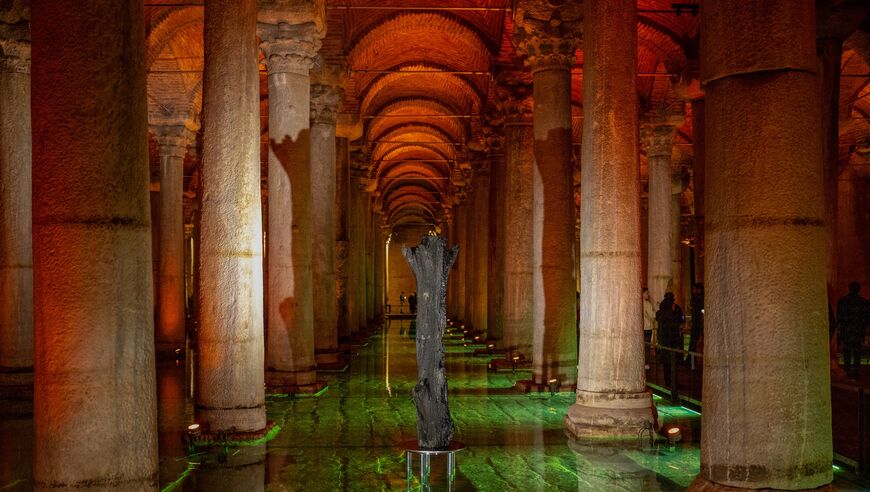
Once water reached the city, it was stored in cisterns, some built underground and others as open-air reservoirs. Researchers have documented at least 211 Byzantine-era cisterns in Istanbul.
The mystery
The aqueducts and cisterns of Constantinople are well documented, but the small stream flowing beneath Hagia Sophia poses a question researchers have yet to answer. Where is the water coming from?
Gulec told reporters that the water might be from a local spring or from the water network linked to the fourth-century Valens Aqueduct, in Turkish known as the Bozdogan Kemeri. The aqueduct — whose surviving stone arches span the valley between two hills in Istanbul’s Fatih district — was part of a network that carried fresh water to Constantinople.
Bozdoğan Kemeri, 1907-12 pic.twitter.com/gZtWE3FHpi
— Nadide Fotoğraf (@nadidefotograf) May 26, 2024
Whether the trickle of water in the tunnel comes from the Valens Aqueduct and whether the tunnel itself once carried water to the nearby Basilica Cistern are among the questions researchers are still trying to answer. For now, they can trace the flow only as far as they have cleared passage.
This one's on us.
The story doesn't end here.
Our correspondents are already on the next chapter. Read everything they file, from $2/week.