


Egypt uncovers sprawling ancient necropolis filled with coffins, gold artifacts
Officials have recently sought to stress the promotion of ancient Egyptian history and civilization through locally led excavations and traveling exhibitions.


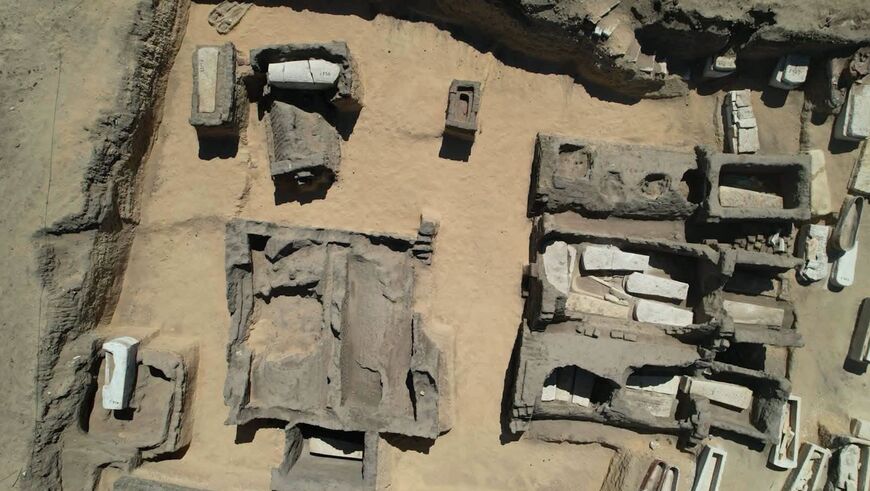
An Egyptian archeological excavation in the northern province of Menoufia has found an ancient cemetery containing hundreds of coffins, a discovery that officials describe as the first of its kind in regard to the unusually large number of burials and sarcophagi in an open burial courtyard.
Details: The Ministry of Tourism and Antiquities announced on Wednesday that the excavation by the Supreme Council of Antiquities had found the large necropolis at Kom Abu Billo, also called Tarrana, formerly the ancient city of Terenouthis, some 43 miles northwest of Cairo, at the eastern entrance to Wadi el-Natrun. The region is historically known for natron salt, which ancient Egyptians used in the mummification process.
The contents of the ancient burial site date from the end of the Egyptian Late Period (664–332 BC) through the Ptolemaic era (332–30 BCE) and into the early Roman period (30 BCE–284 CE), according to the ministry statement.
Archeologists discovered a large number of stone and pottery sarcophagi at the site as well as remnants of wooden coffins. Poorly preserved human remains along with traces of mummification materials were found in some of the coffins.
Among other finds were faience ushabti (small figurines placed in tombs to act as servants for the deceased in the afterlife), small limestone heads from statues, small sphinx and Horus figures, amulets, scarabs, and terracotta figurines depicting Isis-Aphrodite.
The excavation also revealed two offering tables and two falcon burials along with gold jewelry, gold foils, and gold tongue-shaped pieces placed in or over the mouths of the dead to allow them, according to ancient Egyptian belief, to speak in the afterlife.
The cemetery also contains several vaulted mudbrick tombs and a tomb with an interior lined with limestone.
The Ministry of Tourism and Antiquities cited Hisham el-Leithy, secretary-general of the Supreme Council of Antiquities, as saying that preliminary studies of the archaeological finds suggest that the necropolis had likely been built for deceased members of the middle class.
Additional fieldwork is slated for the site, according to the ministry.
Why it matters: Egypt's tourism and antiquities minister, Sherif Fathy, has stressed his office's commitment to continue exploration and documentation of archeological sites to promote the country’s history and civilization.
In Wednesday's ministry statement, Fathy hailed the initial findings at Kom Abu Billo as “a testament to the site’s richness and its historical and archaeological significance.”
Terenouthis, a rural town situated in the western Nile Delta, is thought to have been founded during the Old Kingdom (2700–2200 BCE); some experts argue for its even earlier establishment. During the Greco-Roman period (332 BCE–641 CE), the ancient city became a major exporter of the natron extracted from nearby Wadi el-Natrun.
The first recorded excavations at Terenouthis, in the 19th century, uncovered the ruins of a temple dedicated to the goddess Hathor and erected during the reigns of Ptolemy I Soter (305/4–282 BCE) and Ptolemy II Philadelphus (282–246 BCE).
Various archaeological finds have since been made at the site, including the discovery of hundreds of funerary stelae from the Roman era.
Know more: Egypt has stepped up efforts in the past few years to revitalize its archaeology sector through locally led excavations, the opening of new museums and the organization of overseas archaeological exhibitions. Archaeological excavations have resulted in major discoveries across the country.
In August of this year at the Kom el-Khalgan archaeological site in Dakahlia governorate, Egyptian archaeologists unearthed an ancient cemetery whose history stretches from in the Greco-Roman era into the predynastic period (ca. 5000–3000 BCE)
In August 2025, the Ministry of Tourism and Antiquities, in cooperation with the army and navy, conducted a recovery operation to lift three massive artifacts from the ancient sunken city of Canopus, which dates to the 4th century BC, off the coast of Alexandria in the Mediterranean Sea.
Shortly thereafter, in November 2025, the Grand Egyptian Museum fully opened its doors to the public two decades after construction began near the Giza Pyramids. Covering some 500,000 square meters, the museum boasts a collection of more than 100,000 artifacts spanning prehistoric times to the Greco-Roman era. Also of note, it is the largest archaeological museum dedicated to a single civilization and features the complete, spectacular collection of Tutankhamun artifacts, which consists of more than 5,000 objects.
In tandem with the above projects, Egyptian authorities are also working to repatriate thousands of antiquities and artefacts believed to have been smuggled out of the country over the years. In August, the FBI returned 48 trafficked cultural artifacts to the Egyptian government at a ceremony in Los Angeles.
Last year, the Ministry of Tourism and Antiquities launched “Treasures of the Pharaohs,” a traveling exhibition showcasing more than 130 artifacts borrowed from the Egyptian Museum in Cairo and the Luxor Museum, many of them being displayed outside Egypt for the first time.
The exhibition made its first stop in Rome, where it ran from October 2025 to May 2026, and for the second leg, it traveled in July to the de Young in San Francisco, where it remains until January 2027. The third US stop is planned at the Kimbell Art Museum in Fort Worth, Texas, for six months, from March to September 2027.
While in China on Monday, Fathy said his ministry is looking into organizing temporary exhibitions of Egyptian antiquities in several Chinese cities. He and officials from Chinese museums and other cultural and heritage institutions discussed the possibility during his visit to Hainan province to inaugurate the Egyptian pavilion at the 11th Chinese Exposition of Museums and Relevant Products and Technologies.
This one's on us.
The story doesn't end here.
Our correspondents are already on the next chapter. Read everything they file, from $2/week.