


Syrian women easy target in Sharaa’s drive to consolidate power
Syria’s interim president is balancing Western demands for inclusion with pressure from Islamist hard-liners as he seeks to consolidate power and shed his jihadi past.

DAMASCUS — The Syrian interim government led by President Ahmed al-Sharaa quietly imposed admissions rules in late September that bar women from most programs at two new state universities that focus on defense and security affairs. Just days earlier, on Sept. 23, Syria’s First Lady Latifa al-Droubi and Interior Minister Anas Khattab attended the graduation ceremony for the first group of female police officers at the newly minted Women’s Police Academy in Damascus.
The apparent contradiction reflects the precarious balance that Sharaa, formerly the leader of an al-Qaeda offshoot, is seeking to strike nearly two years after he toppled Syria’s long-time dictator Bashar al-Assad in December 2024.
Sharaa’s drive for international legitimacy has seen the former jihadi refashion himself as an Islamist moderate eager to become a top Western ally and to pursue a now-shelved deconfliction deal with Israel.
In a sign of his purported openness, the president personally handed his wife her university diploma at Idlib University in September last year.
This September, Syrian pop icon Assala Nasri returned to Damascus to perform at a sold-out concert despite an organized campaign by the Egyptian cleric Hani Dahab for the faithful to shun “this sinful” event. Scores of fellow Salafists signed a petition for the concert to be cancelled altogether.
When the government ignored his wishes, an incensed Dahab dispatched his disciples to the concert venue to prevent concertgoers from getting in. Columns of government security forces held them at bay.
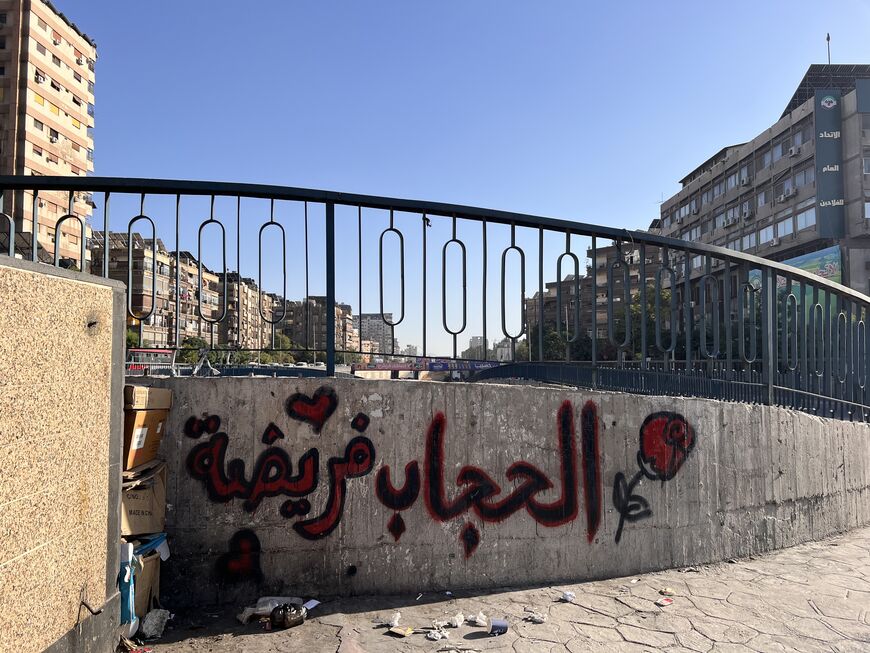
Graffiti declaring “the hijab is mandatory” in Damascus, Sept. 22, 2026 (Amberin Zaman/Al-Monitor)
Critics dismiss such actions as more theater designed to allay Western fears. Why else does Syria’s interim constitution that was unilaterally declared by Sharaa in March 2025 say that Islamic jurisprudence is the primary source of legislation? That, in fact, hardly amounts to a change. The 2012 constitution promulgated by Assad called Islam the “main” source of laws and, like the current document, said that the country’s president had to be a Muslim. Assad, an Alawite, was like Sharaa, trying to be pragmatic. His stabs at pacifying the country’s oppressed Sunni majority, however, did not last long.
Could disgruntled Islamists take up arms against Sharaa as well? The odds are slim—for now. Sharaa has proven adept at neutralizing his opponents, regardless of their ideology. Sharaa’s battles against former jihadi allies and the Islamic State were key to winning the confidence of some of his Western backers when he was running his self-declared Salvation Government in the northern province of Idlib.
If anything, Sharaa’s actions need to be read through the lens of power consolidation and self-preservation rather than that of a secular religious divide. At the Ministry of Education, Sharaa loyalists from Idlib with clear Islamist leanings have been appointed to senior positions. But during a recent visit to the ministry, this reporter saw a woman in tight-fitting jeans serving tea to guests.
“Sharaa cares about two things: to get rid of his [extremist] past because it's a rope around his neck that the international community can use against him. The other is to rule the country absolutely," Mounir Fakir, the deputy chair of the New Syria Movement and an opposition activist who was jailed and tortured by the Assad regime, told Al-Monitor.
It’s a pattern observed elsewhere, as in Turkey, where the country’s Islamist president, Recep Tayyip Erdogan, won over Western governments when he first rose to power in 2002 with his overtures to feminists and secular liberals, only to turn his back on them once he secured his rule, now in its 24th year.
“Women have always, throughout the history of the modern Middle East, represented easy initial targets for men’s efforts to consolidate power. This has been especially true in moments of regime change and disruption, when conservative Arab nationalist and Islamist forces have rallied for greater Arabo-Islamic cultural unity after periods of struggle,” said Monica Marks, a scholar of Islamist movements who has closely studied Tunisia.
Kurds who fearlessly fought the Islamic State under the banner of the Women’s Protection Units, or YPJ, are feeling the discrimination, both as non-Arabs and as females. Sharaa refused their demands to be integrated with the Syrian National Army along with thousands of their male counterparts from the now-dissolved Syrian Democratic Forces and told them they could join the interior ministry’s counterterrorism units instead.
“There is no genuine representation of women in any sector of the Syrian interim government. Women’s roles are being marginalized, their capabilities and qualifications are called into question and gender-based restrictions are imposed on them, depriving them of the ability to exercise their rights,” said YPJ spokesperson Ruksen Mohamed.
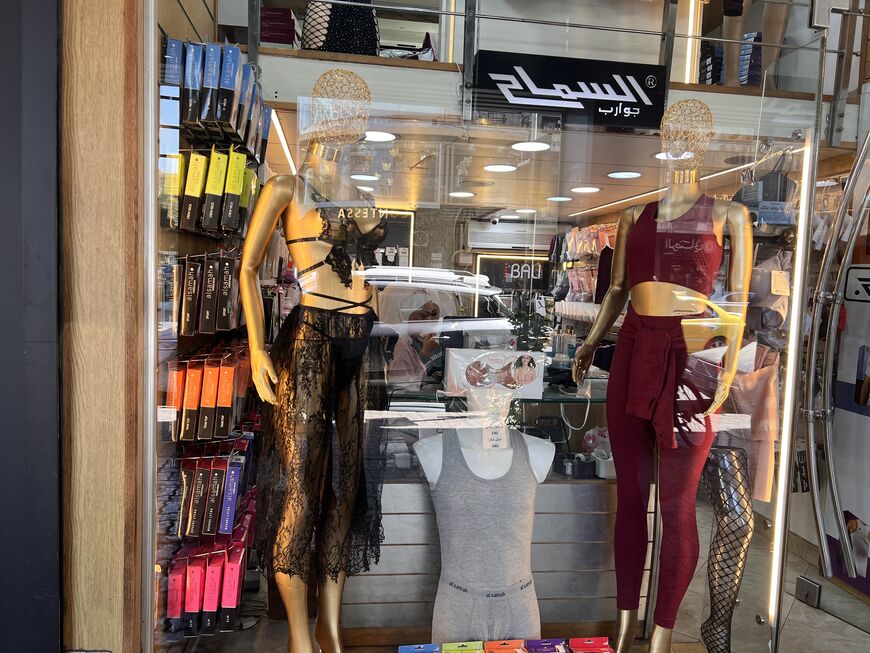
A women’s lingerie shop in Damascus, Sept. 20, 2026. (Amberin Zaman/Al-Monitor)
Despite pledges of inclusion, only 22 women sit in Syria’s 206-member parliament. Only one woman, Hind Khabawat, the minister for social affairs and labor, is part of the 23-minister cabinet. Conveniently, Khabawat checks the non-Muslim minority box as its sole Christian member.
“The exclusion of women undermines progress, democracy, justice and equality, all of which depend on women as genuine partners in building them. This is a matter of serious concern,” Mohamed told Al-Monitor.
International rights groups agree. “Syria’s authorities are rebuilding the army without women,” said Hiba Zayadin, senior Syria advisor at Human Rights Watch, of the rules restricting women’s attendance at the new universities.
The establishment of the Women’s Police Academy is seen by many Kurds as a cynical ploy calculated to prove to the outside world that women are not discriminated against regardless of their ethnicity. Yet to Islamist puritans the sight of Muslim women goose-stepping with guns — no matter that the first batch of graduates all seem to cover their hair if not their faces — is pure blasphemy.
“Our government is very cute. Our President is very cute. They do not do enough Islam in government because of Western pressure. They are so pragmatic,” Fuad Naal, a prominent Syrian preacher, told Al-Monitor in fluent English that he taught himself during 21 years in Assad’s prisons.
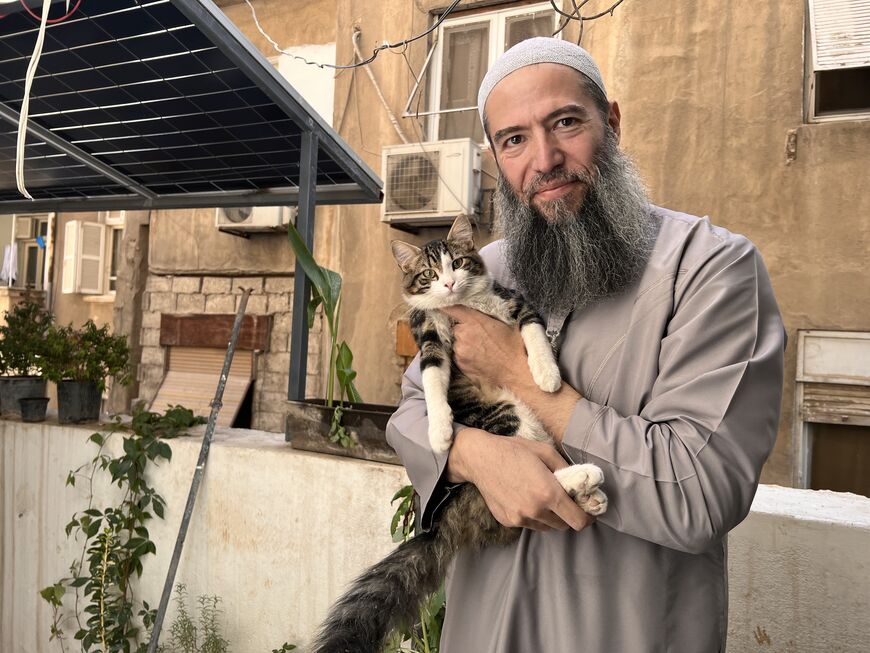
Fuad Naal, a prominent Syrian preacher, outside his home in Damascus, Sept. 21, 2026. (Amberin Zaman/Al-Monitor)
In February, the Ministry of Religious Endowments, which oversees mosque activities, religious endowments and other aspects of Sunni Muslim practice, convened around 1,500 clerics and launched the so-called “Charter for the Unity of Islamic Discourse.” The purpose was to promote dialogue and create a space for Muslim scholars of all stripes to thrash out their ideas peacefully. But above all, it is seen as a vehicle for state control.
Naal’s own journey during the past 22 months sheds light on Sharaa’s approach. The charismatic sheikh would lead hundreds of fellow inmates in prayer in his cell block every day. “Sometimes the prison guards would join,” he recalled. He was assigned a mosque by the government to deliver a monthly sermon. The arrangement didn’t last too long. “They didn’t want me to stand on a minbar and criticize Ahmed al-Sharaa,” Naal said with a rueful grin. What had he said?
“I criticized him in general terms.”
That Naal should feel free to share such thoughts with a foreign journalist sets Sharaa squarely apart from the dictatorship that preceded him. Will Sharaa be as magnanimous once his grip over the country is assured?
“For now he cannot silence us,” Fakir, the activist, said. Like many, he believes the greatest challenge to Sharaa’s authority is the continued fragility of the economy despite the lifting of international sanctions. The biggest protests since Assad’s ouster erupted last month when the government raised fuel prices by as much as 40%. There are few signs of relief amid a global downturn triggered by the Iran conflict, and there is a growing perception among ordinary Syrians that a select few with ties to Sharaa are benefiting from the spoils of power. Allegations of corruption abound. “Hope is dimming among the people because Sharaa did not show he is building a real government for the people, but rather one for himself,” Fakir said.
The United Nations estimates that 90% of Syrians live below the poverty line. Some 66% live in extreme poverty. Women do not protest against discrimination because “they are more concerned about how to provide their children with their next meal,” Lama al-Jamal, a corporate lawyer in Damascus, said.
This one's on us.
The story doesn't end here.
Our correspondents are already on the next chapter. Read everything they file, from $2/week.
See Offers