Analysis

How militias in Anbar could complicate Iraq’s energy ambitions

Securing western Anbar is emerging as a key test of Iraq’s ability to curb armed factions, attract foreign investment and unlock the province’s vast energy potential.
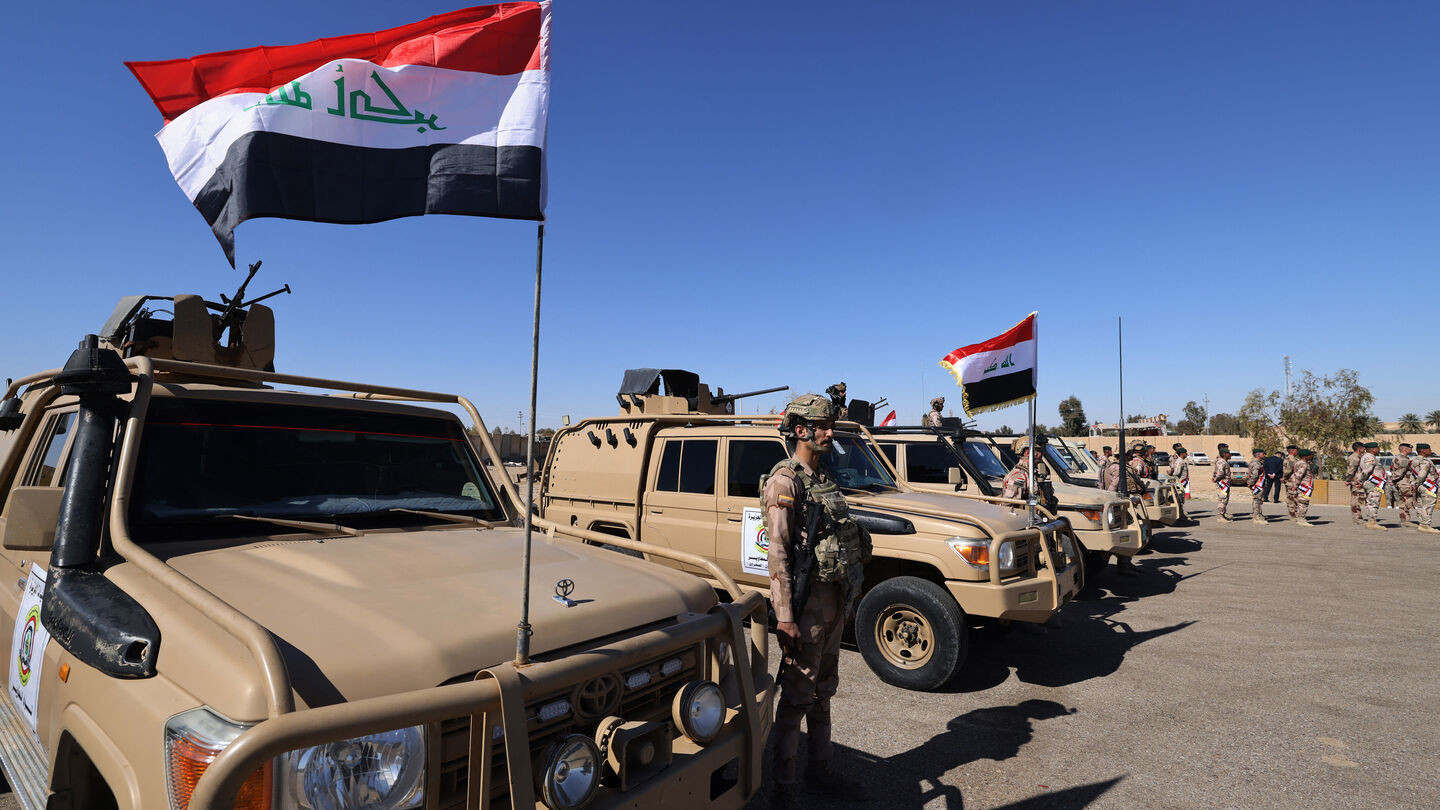
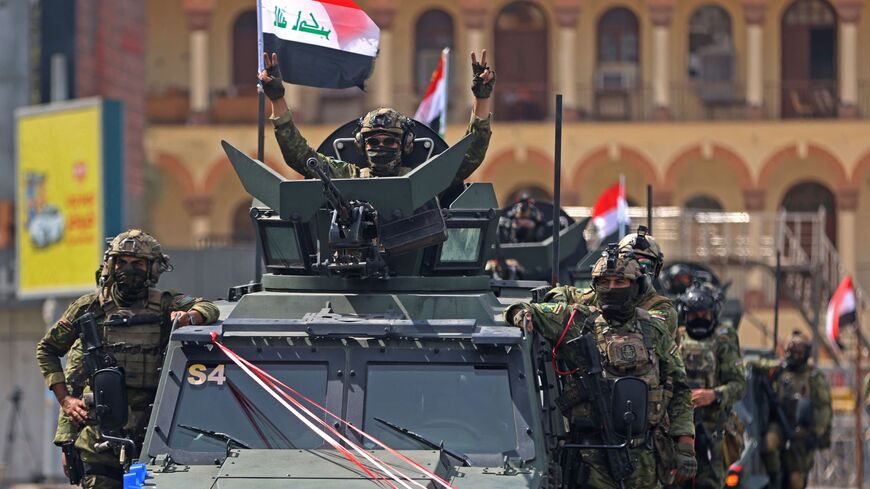
Iraqi soldiers from the new 'desert battalion' special forces stand next to military vehicles as the take part in a graduation ceremony, after months of training by the French military, at the Ain al-Asad air base in Anbar west of Baghdad on February 29, 2024. (Photo by Ahmad AL-RUBAYE / AFP) (Photo by AHMAD AL-RUBAYE/AFP via Getty Images)
Iraqi soldiers from the new 'desert battalion' special forces stand next to military vehicles as the take part in a graduation ceremony, after months of training by the French military, at the Ain al-Asad air base in Anbar west of Baghdad on February 29, 2024. — Ahmad Al-Rubaye / AFP via Getty Images

AMMAN – Securing Anbar, Iraq's largest and sparsely populated province, will play a key role in ensuring the country can develop greater energy self-sufficiency and improve relations with both Syria and the US, local residents say. 

Almost nine years after the Islamic State was pushed out of its last strongholds in western Anbar, Iran-backed Shia armed factions continue to wield power and weapons in this Sunni-majority province, including the more hard-line factions involved in the Islamic Resistance in Iraq. These factions have vowed to “never” give up their weapons to the central government. 

"We saw a sharp drop in drugs smuggled in after the [former Syrian President Bashar al-Assad] regime across the border fell" in December 2024, one resident of al-Qaim told Al-Monitor during a visit to the Iraqi city on the border with Syria in early March when asked about the security situation.

"Before, Iran-backed groups including parts of the [government-salaried] Popular Mobilization Units were involved," he said. "Most of them we don’t have any contact with — just Brigade 13, Liwa al-Tafuf. And they are sort of OK."

"But we don’t know what happens south of al-Qaim," he said, referring to an area encompassing the Akkas gas field and the Akkashat phosphate mines further south on the road to Ar-Rutba, "where there are a lot of the Iran-supported factions. They have full control there."

He said that many of al-Qaim’s residents still complain of land grabs by "the militias," but that there had not been as many "killings and disappearances" in western Anbar as the local community had initially feared in November 2017, when the Iran-backed factions took over vast parts of the province. Iraqi forces — with support from the international coalition — retook al-Qaim and Rawa from IS that month and pushed remnants across the border into Syria, where the group lost its last territorial stronghold in March 2019.

“The residents here are still very afraid" of non-local armed factions, “and even [non-local armed factions] are afraid of us, I think, in some way. This isn’t good for the region or our society in general,” he said.

Rich in natural gas 

Accounting for more than 30% of the country’s territory and sharing borders with Syria, Jordan and Saudi Arabia, Anbar has some of Iraq’s largest natural gas and energy potential. Many of these reserves are concentrated near the Syrian border, as is a heavily damaged phosphates plant visited by Al-Monitor in previous years, for which the Iraqi government is planning a replacement. The “western Anbar desert contains one of the largest phosphate reserves in the world," a spokesperson for Iraq’s Ministry of Industry and Minerals told Iraqi News Agency in December.

On Sept. 18, an electricity transmission tower was blown up along the road between Baiji in Salah al-Din province, the site of Iraq’s largest domestic oil refinery, and Haditha in Anbar, a key distribution hub for pipeline projects. The attack, which cut the main electricity line between the two cities, was likely meant to frighten the community, as well as potential investors, locals say.

Local media outlets claimed that an attempted attack on another transmission tower on the same route carried out by IS had been “thwarted” by security forces. 

The growing difficulties international journalists face reporting from and on Iraq — compounded by bureaucratic complexities long seen under the former Baathist regime and echoed in restrictive practices elsewhere in the region — make verifying claims difficult, if not impossible. By contrast, the media environment across the border in Syria is more open, with free media visas and permissions that are easy to obtain.

On July 25, the Iraqi government authorized the oil ministry to sign a memorandum of understanding (MoU) for the exploration and development of the Akkas gas field and the surrounding areas in western Iraq with a consortium of ConocoPhillips, the US investment firm TI Capital and the UK-incorporated Novaterra Energy. 

The gas field has been the site of attacks in previous years, including one in October 2018. Al-Monitor reported on the attack at that time, noting that the attack had killed at least two Iraqi army officers and had allegedly been perpetrated by IS. 

“A freshly planted IED on a road near the gas field killed another officer and a soldier and injured two others on Oct. 16 when Al-Monitor was in al-Qaim,” Al-Monitor reported from the ground, noting that the gas field “had been under PMU Kataeb Hezbollah control after being taken from IS until recently when it was handed over to Iraqi army control. The western Anbar commander for the PMUs, Qassim Musleh, told Al-Monitor in an interview in his office in the Karbala shrine complex on Oct. 11 that ‘this only happened because they took it away from us and gave it to the army, which is under the Americans.’”

Local sources claimed to Al-Monitor at that time that the attack was instead perpetrated by members of Shia non-local armed factions in the area, and that it was “in retaliation for cutting the route used by PMU fighters and supplies into Syria and to prevent investment in a crucial period for the region.”

Many in the country and abroad now hope that such attacks will not resume, regardless of who carries them out or for what reason. 

An AL-MONITOR subscriber gifted you this article. Gifted by an AL-MONITOR subscriber.

A gift worth sharing.

This one's on us. Subscribe for unlimited access to everything we publish, plus gift articles for your inner circle. As low as $2/week. This one's on us. Get unlimited access, plus gift articles for your inner circle, from $2 a week.

See Offers

Related Topics