



On Israel-Lebanon border, 'everyone is tense' as fighting with Hezbollah flares


Despite renewed fighting with the Lebanese armed group Hezbollah just over the border, the mood was almost normal Thursday on the main street of Kiryat Shmona, a small town in northern Israel.
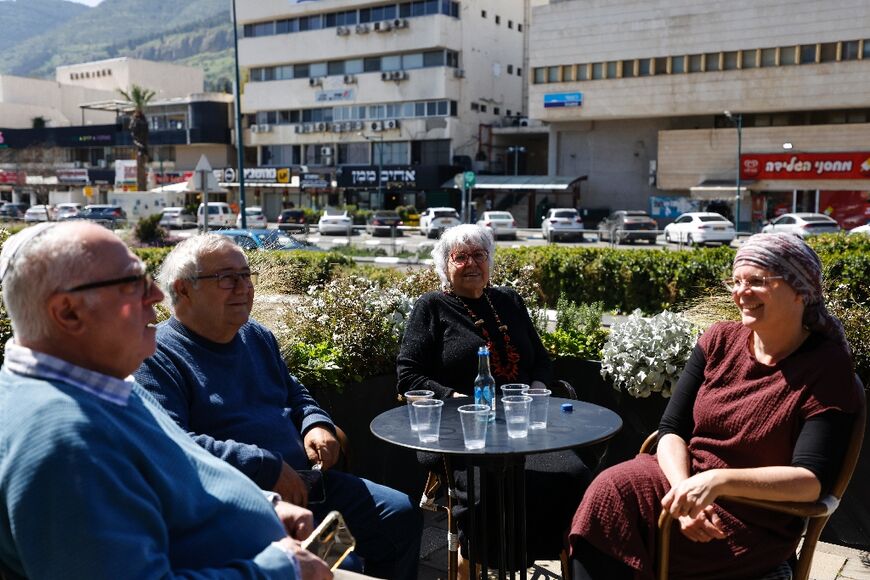
Unlike during the last war with the Iran-backed movement, when the town was evacuated over fears of rocket fire, most shops are still open and customers sit on terraces of neighbourhood cafeterias.
But when sirens suddenly wail, warning of incoming fire from the militants across the frontier, visibly scared residents scramble to get to shelters downstairs.
In other parts of Israel, air raid sirens signal Iranian missiles that take about 10 minutes to travel thousands of kilometres, but Kiryat Shmona and other communities along the border with Lebanon have a matter of seconds to react before rockets make impact.
"Everyone is tense. But there's nothing else to do," said Israel Raziel, a retired taxi driver who was enjoying the sun as a military jeep rolled past northbound towards Lebanon.
Raziel, 64, said he was not afraid, having lived through Israel's 1982 war with Lebanon.
He has also dealt with rocket alerts since the 1970s, back when aerial defences were almost non-existent.
Though Raziel said the new war with Hezbollah felt the same as the one that officially ended in September 2024, like other residents of the area, he said he hoped this would be the last.
"I think it needs to be finished," he told AFP.
"There needs to be an end to it."
- Tanks, bulldozers, artillery -
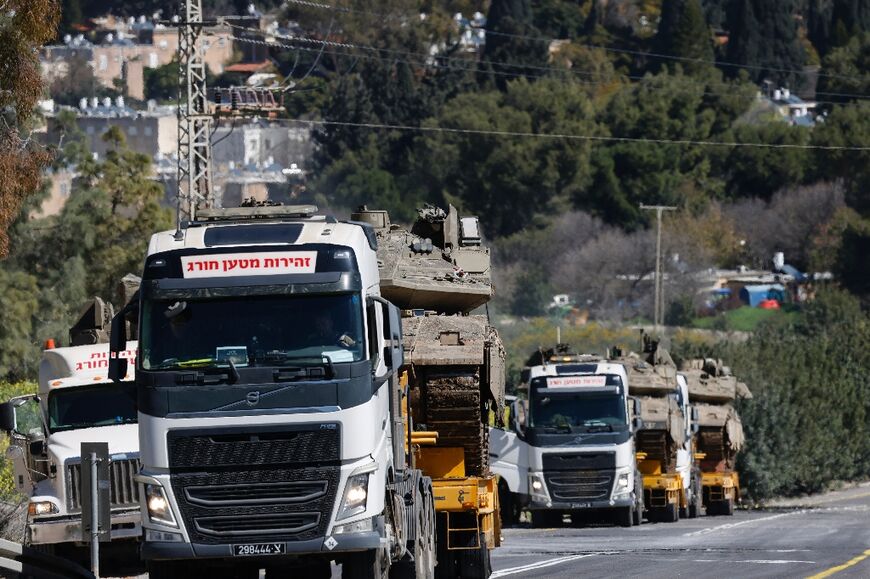
After Hezbollah launched new rockets to avenge the killing of Iran's supreme leader Ali Khamenei in a wave of US-Israeli attacks, Israel responded with air strikes and sent troops into villages across the border with the aim of creating a buffer zone.
Now, signs of Israel's redeployment abound on the roads of the Upper Galilee.
Flatbed trucks carrying tanks and the D9 armoured bulldozers Israel's military uses in urban areas, head northwards towards Lebanon, returning empty an hour later.
Groups of soldiers awaiting instructions hang around gas stations with the snow-capped Mount Hermon, or Jebel al-Sheikh, on the border with nearby Syria in the background.
In the Houla valley, where Kiryat Shmona sits, the sound of Israeli artillery pounding Lebanon echoed in the skies above the region's famous peach and cherry orchards.
Explosions from Hezbollah rockets intercepted by Israel's air defences also rang out.
Shortly after alarms sounded in Kiryat Shmona, a loud boom indicated one such interception, accompanied by a small white cloud over Margaliot, a village above Kiryat Shmona on the heights that constitute the border.
"There are attacks from our side, and attacks from their side. It seems to me like a very long love story," Igor Solokov, a chef who moved to Kiryat Shmona in 2019, told AFP.
"I hope that one day it will end, that we'll achieve our goals, and live in peace," added the 37-year-old, who served on the border after Hezbollah joined its ally Hamas against Israel following the Palestinian group's attack that sparked the Gaza war.
- No more evacuations -
In that war, tens of thousands of residents of Israel's north were evacuated, but the military said this time there would be no such measures.
To people in Kiryat Shmona, the decision made sense.
"Evacuate where? Tel Aviv is worse," said Shlomi Aboudboul, a shawarma shop owner, noting the Iranian missiles that have been launched towards the coastal hub over the past week.
Aboudboul, 52, said that while some other restaurants preferred not to take the risk, he had remained open to serve food to soldiers passing through.
Further north, right on the border with Lebanon, the streets of Metula were empty, the silence only broken by the sounds of war.
Sounds of artillery strikes on the other side of the border were interspersed with gunshots echoing from the Lebanese village of Khiam, where the previous day Hezbollah said it had clashed with Israeli troops.
Closer to Metula, the Lebanese villages of Marjayoun and Kfar Kila lay empty and in ruins, most houses destroyed by Israel during the last war with Hezbollah.
This week, Israel urged residents of more than 80 villages in south Lebanon to evacuate.
Back in Kiryat Shmona, Toni Maloul, a retired schoolteacher who was evacuated in 2024, said that though she slept every night in the shelter under her house, she would stay in her hometown this time no matter what.
"I was born here, no one will tell me to get out of Kiryat Shmona," the 69-year-old said.
Behind her, another flatbed truck laden with cement fortifications drove past towards Lebanon.
This one's on us.
The story doesn't end here.
Our correspondents are already on the next chapter. Read everything they file, from $2/week.
See Offers