Israel anticipates anti-regime protests in Iran, unlikely to invade Lebanon
Israeli diplomats and military officials are concerned that the surge in oil prices will prompt the US leader to end operations against Iran before regime change is reached.


TEL AVIV — As the war against Iran enters its third day, Israeli officials are expressing concern that US President Donald Trump may halt the joint American-Israeli operation before the regime is overthrown and the country’s nuclear and ballistic missile programs are dismantled.
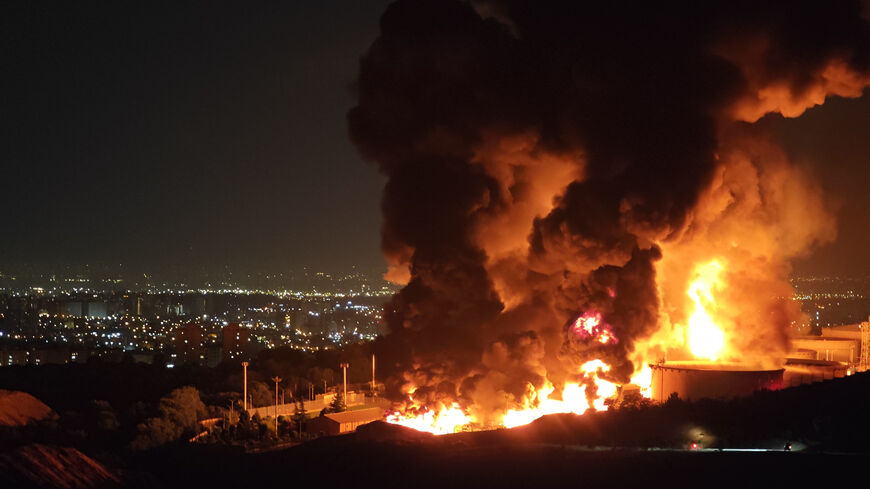
Israeli diplomats and military officials who spoke to Al-Monitor pointed to several red flags. One of them is the surge in the price of oil following Iran’s attacks on oil facilities in the Gulf and Israeli and American strikes on Iran’s oil infrastructure.
"This is what we fear most of all," a senior Israeli diplomatic source told Al-Monitor on condition of anonymity. "Trump is focused on the stock market. He doesn't want a weak dollar; he doesn't want expensive goods; he doesn't have public support for the war in Iran anyway. These things could make it very difficult for him."
Could Trump cut Iran operation short?
“For now, it’s going according to plan and with wonderful results," said the source. But Trump's comments about resuming negotiations with Iran suggest that he could order a ceasefire at any moment. Trump had said Sunday, “They want to talk, and I have agreed to talk, so I will be talking to them."
Former Israeli national security adviser Eyal Hulata said in a Channel 12 interview on Monday that the decision to assassinate Iranian Supreme Leader Ali Khamenei was made by Trump himself, with Israel serving as a “subcontractor." The questions troubling Israel are when Trump will halt the attacks on Iran, whether he has an exit strategy and how closely he is coordinating with Israeli Prime Minister Benjamin Netanyahu on these matters.
The Israeli-American attack on Iran shocked commentators and observers after both countries leaked reports of disagreements and contradictory information, obscuring their highly coordinated preparation.
Israel’s attacks on Iran are far more intense than its 12-day strikes on Iran’s nuclear facilities in June 2025, which the United States joined with its bombers. Israeli pilots fly three sorties a day, compared to two at most last time. "This is made possible thanks to dozens of American refueling planes," a senior Israeli military source told Al-Monitor on condition of anonymity.
Meanwhile, American efforts are underway to persuade some of the Gulf states to join the attacks on Iran. The Gulf states have condemned Iran’s missiles and drone attacks on them and Qatar’s Foreign Ministry told CNN that Iran must pay for its attacks on its territory.
"The Gulf states are sitting on the fence for now, even though they are clearly on America's side and ours," a top Israeli diplomatic official told Al-Monitor on condition of anonymity. "The question is if and when their barrier of fear will be broken and they will understand that sovereignty is something that needs to be protected."
Missile arsenal poses existential threat
According to the Israeli security sources, if Trump does decide to resume negotiations, Israel hopes that Iran's desperate situation will result in far-reaching concessions including an agreement that permanently prevents Iran from enriching uranium to weapons-grade levels and limits Iran's ballistic missile project.
Netanyahu has made it clear to Trump that Iran's missile arsenal is an existential threat that must be removed. Israel also insists that the agreement include strict limits on Iran’s support of militias in Iraq, Yemen, Lebanon and elsewhere that serve as proxies for Iranian terror attacks against Israeli and Western targets. Israel has significantly weakened these proxies in the war that followed the 2023 Hamas massacre in southern Israel.
"As things stand, Iran's proxies have weakened significantly, and as long as Israel's freedom of action to deal with them separately is maintained, they no longer pose an existential threat," said the top Israeli diplomatic official, adding that Israel will not give up on the military nuclear project or the ballistic missiles. "Anything else would be a bonus."
According to Israeli estimates, Iran still has about 2,000 ballistic missiles after starting the current round of fighting with about 2,500. Al-Monitor's Israeli security sources noted that unofficial estimates find that Iran has fired several hundred missiles at Israel so far and several hundred more at other targets, mainly in the Gulf. Iran has a sufficient arsenal to maintain its current rate for many more days.
"The current rate of launches is much lower than in the previous round," an Israeli military official told Al-Monitor on condition of anonymity.
Hezbollah targets Israel
Israeli reactions to the rockets and UAVs from Hezbollah on Sunday night were mixed. It had initially assessed that Hezbollah, under external and internal siege, would stay on the sidelines. "The previous round was enough for them. It left them with almost no assets, leaders or commanders," a senior Israeli security source told Al-Monitor on condition of anonymity.
But the Iranian pressure was decisive, noted the top Israeli diplomatic official. According to Israeli security sources, over the weekend, ahead of Israel’s strikes and immediately afterward, Israel was debating whether to launch a broad preemptive strike on Hezbollah as well to prevent it from joining the fray. Ultimately, it was decided to hold off and deal with specific threats as needed.
Israel is torn between reluctance to subject its northern population to another war and the opportunity to once and for all disarm the organization. Under US pressure, the Lebanese government has been working to disarm Hezbollah but the results have been disappointing.
"Hezbollah made a mistake that is reminiscent of the mistakes they made after Oct. 7, 2023, that ultimately led to the assassination of Hassan Nasrallah. It's strange that they don't learn from experience," the top Israeli diplomatic official told Al-Monitor.