



Iraq's complicated role in the Middle East war, explained


Iraq, which had recently regained some stability after decades of conflict, was immediately dragged into the Middle East war triggered when the United States and Israel attacked Iran last weekend.
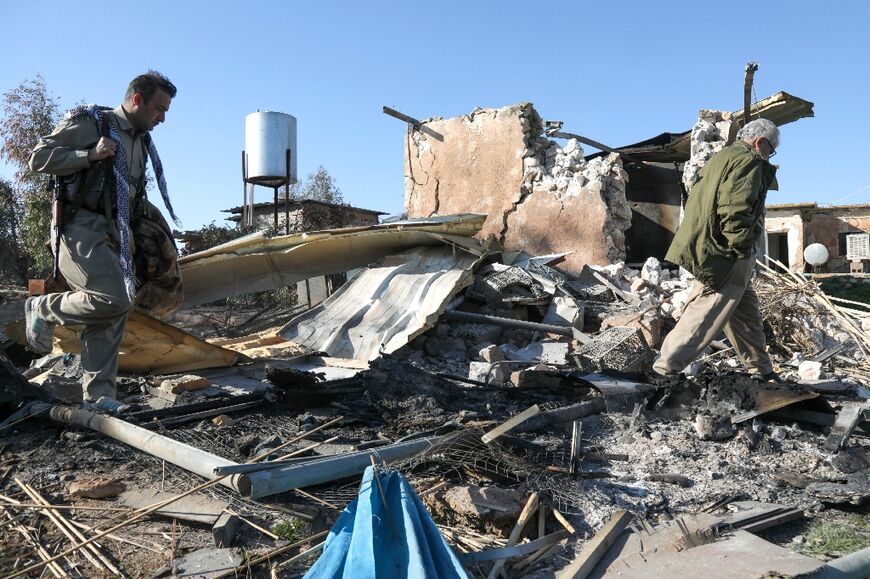
Within hours, warplanes filled Iraq's airspace. Air strikes pounded bases hosting Tehran-backed groups across the country. Iran-backed groups in turn launched attacks on US interests in Iraq, while Tehran struck Kurdish militants in the north.
Iraq has long been a proxy battleground between the United States and Iran, with the country's successive governments struggling to balance relations between the two rivals.
Neither the US nor Israel has announced launching strikes in Iraq, but they have been accused of doing so.
Iran-backed groups claim dozens of attacks on the "enemy", but rarely name their targets.
Here is an AFP guide for understanding the main actors -- and their targets -- in Iraq during the Middle East war.
- Tehran-backed groups -
Iran holds significant sway over Iraq's politics and also backs armed groups that are blacklisted by the US as terrorist organisations.
Some of these groups hold seats in parliament and have seen their political and financial clout increase.
When the drums of war began to beat, these groups vowed to defend Iran. When it broke out, they were the first targets of strikes blamed on the US and Israel.
The Tehran-backed groups have brigades that operate within the Hashed al-Shaabi, or the Popular Mobilisation Forces, which is a former paramilitary alliance created in 2014 to fight jihadists and is now integrated into the Iraqi armed forces.
But these factions have a reputation of acting on their own. They unite under a loose alliance called the Islamic Resistance in Iraq.
These groups include Kataeb Hezbollah, the al-Nujaba movement, Kataeb Sayyid al-Shuhada and Kataeb Imam Ali, among others.
Bases belonging to Hashed hosting these groups, mostly Kataeb Hezbollah, have been hit several times across the country since war broke out.
The factions vowed to target US bases.
- Their US targets? -
Every day, the Islamic Resistance in Iraq claims it carried out dozens of attacks against the "enemy" in Iraq and the region, without specifying its targets.
Baghdad's international airport, which houses a US diplomatic facility, has been targeted several times with drones and rockets.
A week into the war, the US embassy also came under rocket fire.
Oil fields operated by foreign companies have been struck in the southern Basra province and the northern Kurdistan region.
The autonomous Kurdistan region -- which hosts US troops, including at the airport in its capital Erbil -- has been a primary target.
US air defences now intercept drones almost daily over Erbil, which also hosts a US consulate complex.
At least two hotels have also been targets of drones in Kurdistan.
- Kurdish militants vs Tehran -
The autonomous Kurdistan region also hosts camps and bases operated by Iranian Kurdish rebel groups, which have formed an alliance seeking to overthrow the Islamic republic.
Iran accuses these groups of serving Western or Israeli interests, and it has struck them repeatedly since the start of the war.
They include the leftist Party of Free Life of Kurdistan (PJAK) and the nationalist Democratic Party of Iranian Kurdistan, among others.
The groups hope to secure Kurdish self-determination in Iran, but they disagree on what form this should take if they succeed.
Nevertheless, they may be willing to ally with the US to achieve their goal.
Amir Karimi, co-commander of the PJAK, told AFP that the "Americans are already in the area, and we have had a dialogue."
US President Donald Trump said Saturday that he did not want the Kurds to launch an offensive against Iran. "We don't want to make the war any more complex than it already is."
Tehran has threatened to target "all the facilities" in Kurdistan if militants cross into Iran from there.
- Authorities in the crosshairs -
Authorities in Baghdad and the Kurdistan region have found themselves in the crosshairs.
While they insist that Iraq should not be used as a launchpad for attacks on neighbouring countries, events appear to be escalating beyond their control.
Baghdad has condemned what it described as a "terrorist attack" on the US embassy.
Drones have targeted Kurdish security forces in the autonomous region following reports that Kurdistan may support an incursion into Iran -- claims that authorities firmly deny.
This one's on us.
The story doesn't end here.
Our correspondents are already on the next chapter. Read everything they file, from $2/week.
See Offers