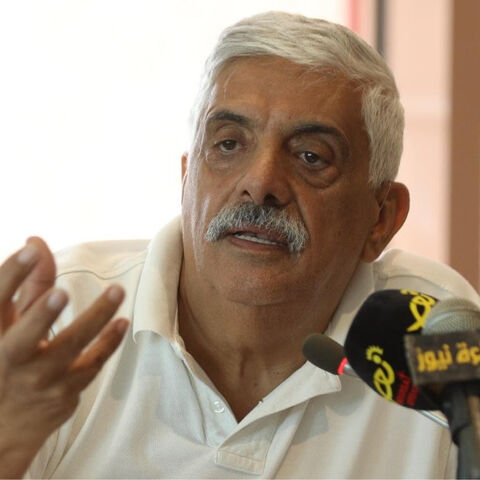
As he was speaking alongside the governor and top security leaders, a large sign hung behind him, with text that read "Jenin's institutions and civil society organizations support the decision of President Abbas with the aim of applying the rule of law, security, order and civil peace.”
Mustafa added, "Enough appeasement and mediation. We have reached a stage where silence is more than negligence, and we do not want to be among those who are negligent.“
The crackdown on the Jenin camp has come after what some leaders and locals say has been a two-year-long absence of the rule of law and accountability. Armed Palestinians from the camp have been accused of bullying the population and have failed to adhere to the orders of the Ramallah-based government.
Militants' dominance in Jenin
Armed members of Hamas and Islamic Jihad operate widely throughout the camp. Israel accuses the groups of being part of Iran’s so-called Axis of Resistance and says Tehran has for years smuggled small arms into the West Bank.
Jenin has long been a flashpoint for tensions between Palestinian security forces and armed factions, but saw a major escalation in December. PA members arrested a prominent member of the Jenin Battalion — an umbrella organization of militant groups — and militants responded by seizing two government vehicles, sparking direct confrontations.
Still, the Palestinian security services continue with demands that the Jenin Battalion hand over all its weapons, while members of the battalion refuse to do so, saying that its weapons are "aimed at the incursions of the Israeli forces and not at the (Palestinian) Authority."
Jenin is the only Palestinian governorate with no Israeli settlers or settlements. While militants say that this absence is because of them, the Ramallah leadership argues that it means there is no need for armed individuals competing with the officially sanctioned Palestinian security forces. For their part, the Palestinian security forces insist that they will continue this operation "until the end."
The city and Jenin refugee camp are considered a stronghold of armed Palestinian factions. Hamas and Islamic Jihad, which are on the US terrorist list, denounced the Palestinian Authority, calling the operation a “full-fledged crime” in a statement on Telegram. Supporters of the Popular Front for the Liberation of Palestine also warned that Palestinian security forces are crossing a “red line” with this operation.
Post-Oct. 7 dynamics
The military operations in Jenin, however, cannot be divorced from what has happened in Gaza over the past 14 months.
Abbas fears that if West Bank militant groups build up capacities, they could carry out a similar attack to Hamas' Oct. 7 attack from the West Bank, prompting a similarly destructive Israeli response.
A more serious ideological schism is also emerging in the background of the current clashes in Jenin. President Abbas and much of the PLO are opposed to the idea of the viability of “armed resistance” — officially dropping the term from its government platform in 2007. Meanwhile, Islamic Jihad and Hamas argue that fighting is the only way to bring about liberation for Palestinians, no matter what the sacrifices are.
Many argue that issues of peace and war should not be decided on by any party but should be directed by the consensus of the people. Though Hamas hasn't sought or won such a consensus, Abbas — who is extremely unpopular and has repeatedly delayed elections that could have given the Palestinian people a voice — hasn't either. In a poll released in September by the Palestinian Center for Policy and Survey Research, 84% of respondents in the West Bank and Gaza said they want Abbas to resign. When asked which political party or movement they support, Hamas came first with 36%, followed by Fatah at 21%.
Abbas and his security forces also have their eyes on the new leadership in Washington: Abbas is worried that the so-called Deal of the Century — President-elect Donald Trump’s 2020 proposal to resolve the Israel-Palestine conflict — will now be imposed and that Israel will be allowed to annex the areas that are not part of the small territory slated for a future Palestinian state in that proposal.
As a ceasefire deal in Gaza is becoming a possibility, everyone is focusing on the day after, and with that in mind, Abbas and his security forces want to show Israel, Trump and the rest of the world that, if needed, they can stand up to armed fighters challenging their status quo.