



How Iran war is giving China an opening in Gulf drone market


Hi readers,
The main focus on China’s role in the US-Israel-Iran war has revolved around its relationship with Tehran, but this obscures a broader story: China's military and defense ties across the Gulf, particularly in drone technology, that have only grown since the conflict began.
As the war spills inside Arab Gulf states through missile threats, proxy activity and attacks on critical infrastructure, it is exposing gaps in Gulf air defenses and accelerating demand for systems that are fast, scalable and relatively affordable.
That plays right into Beijing's strength in a growing industry.
Let’s unpack,

Leading this week
Iran's attacks on its neighbors in the Gulf have injected new urgency into efforts to strengthen and localize air defense systems across Saudi Arabia, the United Arab Emirates, Qatar, Bahrain, Kuwait and Oman.
➡️ Enter China. Systems like the Wing Loong and CH-4 — often compared to US-made MQ-9 Reapers — offer Gulf states armed surveillance and strike capabilities without the political constraints that typically accompany Western arms sales. They are cheaper, faster to acquire and come with fewer end-use restrictions.
Gulf states turned to China for these drones in the past "because they wanted quick drone solutions that could be acquired relatively affordably 'off the shelf' to be used in regional conflicts," according to Seth Frantzman, drone expert and author of "Drone Wars: Pioneers, Killing Machines, Artificial Intelligence, and the Battle for the Future."
🇸🇦 In March, reports indicated that Saudi Arabia and China had reached a $5 billion agreement to establish a production line for Wing Loong-3 combat drones in Jeddah. Under the reported arrangement between the Aviation Industry Corporation of China and Saudi Arabia's General Authority for Military Industries, the facility would manufacture approximately 48 drones annually. Neither Beijing nor Riyadh has publicly confirmed the deal.
Saudi Arabia and the UAE have been among the largest buyers of Chinese drones in the Middle East.

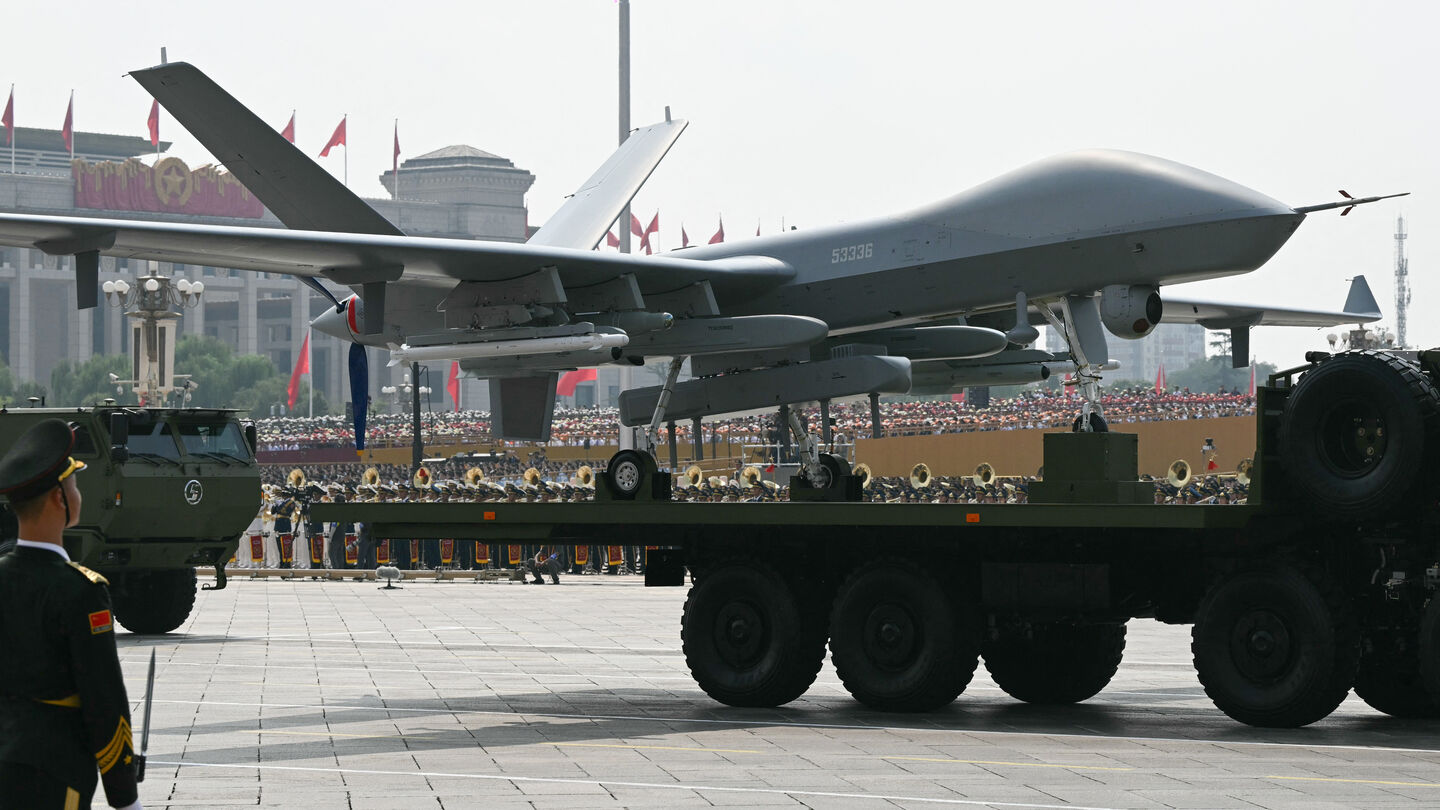
An unmanned aerial vehicle is seen during a military parade marking the 80th anniversary of victory over Japan and the end of World War II, in Beijing's Tiananmen Square on September 3, 2025. — GREG BAKER/AFP via Getty Images
The UAE was one of the earliest Middle Eastern buyers of Chinese drones, acquiring Wing Loong drones in the mid-2010s and later becoming one of the first operators of the more advanced Wing Loong-2. The UAE has also expanded its defense cooperation with Beijing beyond drones. In 2023, it became the first Middle Eastern country to purchase China's L-15 trainer aircraft, acquiring 12 jets. Just last week, the UAE's undersecretary of defense, Lt. Gen. Ibrahim Nasser Al-Alawi, met with Zeng Jixin, China's ambassador to the UAE.
Saudi Arabia has purchased and operates CH-4 drones from China Aerospace Science and Technology Corporation as well as Wing Loong-2 drones.
Chinese weapons have appeared in the latest conflict. In April, Iran shot down a Chinese-made Wing Loong II drone near the southern city of Shiraz. In May, analysts identified what appeared to be a Chinese-made Silent Hunter laser anti-drone air defense system at Dubai International Airport in the UAE.
➡️ More broadly, Gulf states accounted for more than 80% of Chinese defense exports to the Middle East between 2016 and 2025, according to Israel's Institute for National Security Studies. Saudi Arabia was the largest customer, followed by the UAE and Qatar.
China's defense footprint extends beyond the Gulf. Egypt has deepened military cooperation with Beijing, including drone acquisitions and reported discussions on local production, while Morocco has also procured Chinese drone systems, underscoring the broader regional scale of China's defense expansion.
West still holds the strategic advantage
Despite Beijing's gains, Gulf militaries remain deeply integrated with the United States and other Western partners. China's appeal has often stemmed from its ability to provide relatively affordable systems quickly and with fewer political conditions attached; that does not translate into long-term dependence.
"Western drone and defense technology and partnerships, including with Israel, [are] more relevant for the Gulf countries because they are part of US Central Command's area of operations, and they already have large numbers of expensive US and Western military systems such as warplanes and air defenses," said Frantzman.
➡️ The United States is also increasing investment in next-generation drone systems, including lower-cost, more scalable platforms such as the LUCAS system, while Israel and Ukraine continue to drive rapid innovation in both drone and counter-drone technologies. For Gulf states, these ecosystems are likely to remain central to their long-term planning.
Chinese military drones have also produced mixed results in the region.

A military vehicle carrying a Pterodactyl I unmanned aerial vehicle drives past the Tiananmen Gate during a military parade in Beijing on September 3, 2015, to mark the 70th anniversary of victory over Japan and the end of World War II. (Photo by JASON LEE / POOL / AFP via Getty Images)
"China's large military drones have often not lived up to expectations in the region, due to the need for these platforms to be rugged in difficult desert environments," Frantzman said.
In Iraq, a 2019 report by the US Lead Inspector General found that only one of Iraq's 10 CH-4 drones was capable of carrying out missions because of maintenance issues.
The Chinese-made Silent Hunter laser counter-drone system — reportedly procured by Saudi Arabia and the UAE — has also struggled during testing in Saudi Arabia's harsh environmental conditions, according to a 2025 Defence Blog report.
For many Gulf states, Chinese systems have served as a complement rather than a replacement for Western technology. The Silent Hunter system, for example, was reportedly procured by Saudi Arabia in part to help protect its more expensive US-made Patriot missile defense systems. Countries have often turned to Beijing when they needed to move quickly, but Western military technology remains central to the region's security architecture.
➡️ Nor is China the only competitor in the rapidly evolving drone market. Years of war with Russia have turned Ukraine into a leading center of drone innovation and production, with the country now manufacturing drones and counter-drone systems at scale. The Gulf has taken note. In 2026, Ukraine signed cooperation agreements with Saudi Arabia, Qatar and the UAE, and talks are underway with Oman, Kuwait and Bahrain.
China remains part of Iran's supply chain
Tehran, meanwhile, continues to rely on Beijing as an economic lifeline and a source of technology and industrial inputs that can support its defense sector.
In early May, the United States sanctioned multiple China-based firms for providing satellite imagery that enabled Iranian strikes against US forces and facilities in the region.
"Iran doesn't need to rely on China for full drone platforms, given its own indigenous production of drones," Frantzman said. "However, it does appear some components in Iranian drones, from motors to various small technological devices, may have origins in China."
In early May, The Wall Street Journal reported that Chinese companies — despite sanctions and the war — have continued to ship dual-use goods that can be used for military drones to Iran. The goods include engines, batteries, fiber-optic cables and computer chips.
➡️ Our take: The ongoing war has helped China carve out a growing role in Gulf defense by offering cheaper, faster and less restricted drone capabilities. But despite Beijing’s inroads, Gulf militaries remain anchored to US and Western systems for long-term security, with Chinese tech serving — thus far — more as a supplement than a substitute.

Photo of the week
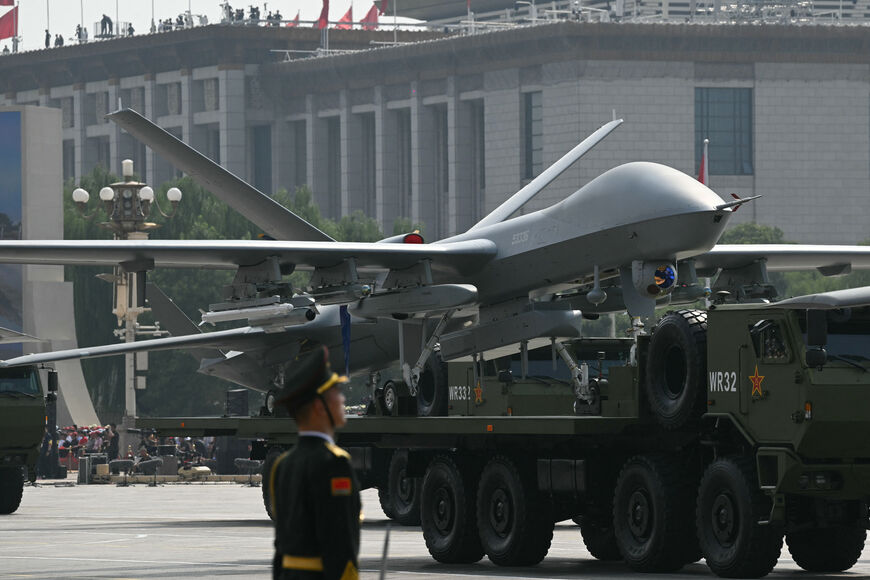
An unmanned aerial vehicle is seen during a military parade marking the 80th anniversary of victory over Japan and the end of World War II, in Beijing's Tiananmen Square ,on Sept. 3, 2025. Photo by GREG BAKER/AFP via Getty Images
Deals and visits ✈️
- Chinese carmaker Chery launches three new vehicle models in Tunisia
- Egypt hosts delegation from China National Tire and Rubber Co. to discuss expanding presence in Egypt
- Libyan Justice Ministry explores prison partnership with Chinese engineering contractor China Huashi Enterprises
- Chinese EV maker XPeng launches operations in Morocco, Tunisia
- Egypt, China extend currency swap agreement
- Visit Qatar signs memorandums with China’s Huawei and Chinese travel platform Fliggy
- Morocco, China hold bilateral meeting on sidelines of UNESCO meeting
- Egyptian youth and sports minister meets officials from Chinese sports company Dafeng
- Hong Kong hosts Saudi-Hong Kong Business Council

What we are reading
- Why it’s nearly impossible to build a robot without China: The New York Times
- Chinese refiners delay projects with Middle East oil supply disrupted: Reuters
- Pentagon restores Alibaba, Baidu and BYD to Chinese military groups blacklist: Financial Times
This one's on us.
The story doesn't end here.
Our correspondents are already on the next chapter. Read everything they file, from $2/week.
See Offers