



UAE's OPEC exit offers China long-term gains, not immediate relief
While the UAE’s exit points to looser supply ahead, China’s near-term energy outlook remains constrained by regional turmoil.

Hi readers,
Amid its rift with Saudi Arabia and the ongoing Iran conflict, the United Arab Emirates said Tuesday it will leave the Organization of the Petroleum Exporting Countries on Friday, citing a shift toward domestic energy production.
For China, more UAE crude could ease prices over time, but disruptions in the Strait of Hormuz will limit China's near-term gains.
Let’s unpack,

Leading this week
The long view
Before the war between the United States, Israel and Iran began on Feb. 28, the UAE was producing about 3.6 million barrels per day, around 12% of OPEC’s output, according to the International Energy Agency.
In 2025, it ranked as the fifth-largest producer within OPEC+, a coalition established in 2016 comprising OPEC and other significant non-OPEC oil producers. The Emirates pumped an average of 3.4 million bpd, behind Saudi Arabia, Russia, Iraq and Iran, according to the US Energy Information Administration.
Leaving OPEC unshackles the UAE from OPEC’s constraints, permitting it to pump beyond the cartel’s production caps. As Al-Monitor’s Jack Dutton noted, Abu Dhabi is one of the few states within the bloc that has substantial spare capacity. Although its current capacity sits at approximately 4.8 million bpd, quotas have historically suppressed output. That roughly 1.2 million bpd unused has been a source of tension with OPEC leader and UAE rival Saudi Arabia.
For China, the world’s largest crude oil importer, the UAE’s greater policy freedom outside OPEC will likely mean a higher supply in the long term, which could mean downward pressure on prices. The UAE’s Abu Dhabi National Oil Company aims to expand production capacity from over 4 million bpd to 5 million bpd by 2027.
Henry Tugendhat, who focuses on Chinese activities in North Africa and the Middle East at the Washington Institute for Near East Policy, told Al-Monitor that China "will view this the same way as the US insofar as it is a net oil importer and will therefore always be interested in the prospect of cheaper oil."
Notably, President Donald Trump also welcomed the move. "I think it’s great," he said at the White House on Thursday, adding, "I think ultimately it’s a good thing for getting the price of gas down, getting oil down, getting everything down." Trump has previously accused OPEC of inflating oil prices and “ripping off” buyers.
A view shows the logo of the Organization of the Petroleum Exporting Countries (OPEC) outside its headquarters in Vienna, Austria, May 28, 2024. REUTERS/Leonhard Foeger/File Photo
Short-term limits
But in the short term, it is unclear that the move will help. The exit comes as Gulf exporters face rising pressure from the near halt of transit in the Strait of Hormuz, a critical chokepoint off the coast of Iran through which roughly 20% of global oil supplies normally flow.
The closure of the strait affects China beyond oil, Tugendhat noted. "The UAE's exit doesn't address the fact that China still needs natural gas, and the UAE alone can't replace all the oil flows from that gulf."
China became the world’s largest LNG importer in 2021, according to the US Energy Information Administration. It imports more than 70% of its oil and around 40% of its natural gas, with the latter split between pipelines and liquefied natural gas shipments. While oil can be sourced from a wider range of suppliers, gas flows are less flexible.
Those constraints are compounded by the scale of current disruption in the Gulf. On Wednesday, just six ships passed through the strait, per S&P Global Market Intelligence, a far cry from the daily average of 138 before the war began, according to the Joint Maritime Information Center.
And despite the UAE's exit representing a small victory for China, Beijing is still hurting in other areas. The closure of the strait, Tugendhat said, "is still a huge problem for China in terms of all the lost trade with that region of the world including EVs, solar panels, steel and construction services."
Uneven dependence
Economic ties between the UAE and China are already strong. Earlier this month, the UAE’s foreign trade minister said that non-oil trade between the UAE and China grew 24.5% in 2025, reaching $111.5 billion. According to Emirati state news agency WAM, the UAE is China’s leading trading partner in the Middle East and Africa, accounting for around 20% of China’s non-oil trade with the region over the past decade.
In energy markets, however, China relies more heavily on other regional suppliers, namely Saudi Arabia and Iran. Data from Columbia University’s Center on Global Energy Policy show Saudi Arabia accounted for roughly 14% of China’s crude imports in 2025, making it the second-largest supplier after Russia. The UAE accounted for about 7%.
While Beijing has not officially reported crude imports from Iran since 2022, data from analytics firm Kpler indicate China imported an average of 1.38 million bpd from Iran in 2025, around 12% of its total crude intake.
In a meeting earlier this month with the crown prince of Abu Dhabi in Beijing, Chinese President Xi Jinping said that the two countries should "enhance cooperation" in energy, according to a readout from China's Foreign Ministry.
"By leaving OPEC, the UAE will be able to sell more competitively, and it's natural to expect a slight downward pressure on oil prices from this," Tugendhat said. "We might therefore expect a slight uptick in Chinese purchases of UAE oil if it's cheaper."
Should Iran's oil exports be taken out of the picture by the war, the UAE’s exit could help shore up Chinese losses, but presently, with traffic through the Strait of Hormuz all but halted, any such shift will remain limited.

Photo of the week
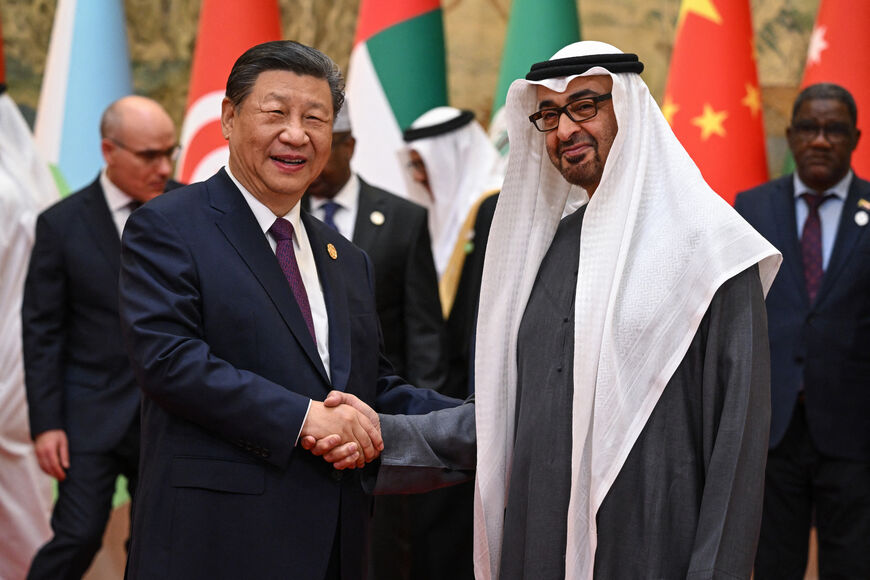
Chinese President Xi Jinping (L) shakes hands with United Arab Emirates President Sheikh Mohamed bin Zayed Al Nahyan ahead of the opening ceremony of the 10th Ministerial Meeting of China-Arab States Cooperation Forum in Beijing on May 30, 2024. (Jade Gao/AFP via Getty Images)

Deals and visits ✈️
- UAE’s Ras Al Khaimah government signs MoUs with Bank of China and the Industrial and Commercial Bank of China
- China hosts Omani, Iraqi, Jordanian representatives at Global Mayors Dialogue
- China’s Lenovo to produce 2 million units annually from Riyadh factory in 2026
- Morocco’s Marita Group, China’s Sinoma Tech sign MoU
- China to implement zero-tariff measures for African nations on May 1
- US sanctions Chinese refinery over Iran oil dealings
- China’s Xi Jinping congratulates new Iraqi president

What we are reading
- US wants to ban China's high-tech cars, but they're already here in El Paso (Wall Street Journal)
- Iran war is starting to expose cracks in China's economy (New York Times)
This one's on us.
The story doesn't end here.
Our correspondents are already on the next chapter. Read everything they file, from $2/week.
See Offers