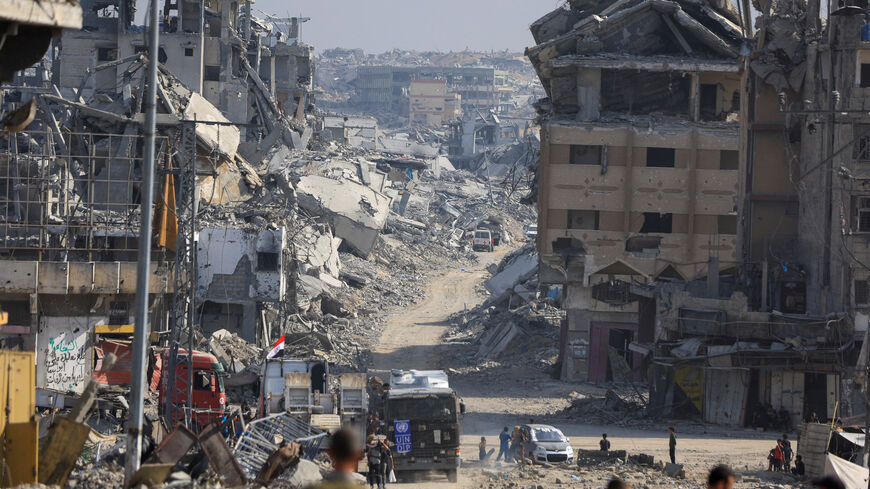
The current war on Gaza is sure to have some unexpected consequences. It will likely weaken the PLO-led Palestinian government and place in hibernation the PLO-Hamas reconciliation agreement.
For years, two contradictory strategies have been considered by the Palestinians. On one hand, the peace route has been endorsed by President Mahmoud Abbas, who has fought hard to keep it going, to ensure that security coordination with Israel takes place and at the same time sought to bring about change in Gaza through elections. On the other hand, Hamas and Islamic Jihad believe that liberation will only come by way of military resistance.
Abbas’ strategy ran into difficulties after the Netanyahu government refused to release the last tranche of veteran prisoners as part of the deal to conduct the recent peace talks, and increased illegal settlement activities. Nevertheless, Abbas kept hopes alive for some kind of intervention from the United States and the international community to get the talks back on track. But before this intervention took place, the Ramallah leadership faced a new problem with the kidnapping of three Israelis followed by the unsupported accusation by Israel that Hamas was behind it.
This led to the suspension of some aspects of the reconciliation, although the unity government has continued to work. Abbas’ strategy for Gaza was bent on the idea of a gradual change from the current Hamas’ military control to civilian control that would be determined through the ballot box. Elections were to take place at least six months after the start of the unity government in May.
AL-MONITOR All-Access gives you unlimited access to all our journalism, the full Daily Briefing, exclusive interviews, premium newsletters, and live events — for less than $2/week.