



Russian Orthodox Church returns to Mideast
Russia's Orthodox Christian heritage in now front and center in Moscow's Middle East policies.
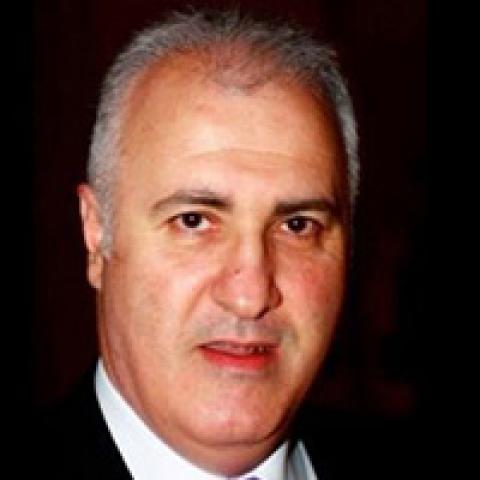

Given the diplomatic and military presence that Moscow has recently established on the Mediterranean and in the Levant, it is only natural that its ecclesiastical role experience a resurgence as well. During the last few days, the Russian banner of the two-headed eagle, representing the church and the state, has been personified in Beirut by the visiting Metropolitan Hilarion, chairman of the Department of External Church Relations in the Russian Orthodox Church. The church’s “foreign minister” met with a number of state, political and religious officials in the Lebanese capital, bringing with him a number of messages. The most important was Russia’s decision to effectively act as the protector of Christians in the Levant and as their defender and legal representative, perhaps the only real one they have on an international level.
In a closed meeting held at Hilarion's Beirut hotel and attended by Al-Monitor, the metropolitan expounded on the reasons and goals of his visit. He began by laying out Russia’s official stance vis-à-vis the Arab Spring. He contended, “It is not a natural process resulting from internal developments that took place in the countries that witnessed its effects. What occurred was more of a foreign plan executed by external factions to control these countries, a plan that began with the Iraq war in 2003.” As a result, “It was not democracy that prevailed in those countries, but utter and total chaos, the price of which was primarily paid by the Christian inhabitants of these countries, who were persecuted, killed and driven out.”
The metropolitan said that according to his church’s information, nine-tenths of Iraq’s Christians were made homeless as a result of the war there. The same type of dispossession also occurred later in Libya, recently in Egypt, and is occurring now in Syria. Wherever opposition militants take control, Hilarion asserted, Christians are forced to either leave or die. It was as if an intersection of interests occurred between the secular administrations of the West and their counterparts in Muslim Gulf states.
Hilarion went on to emphasize that the goals, principles and interests of the Russian Federation are predicated on “the survival of Levantine Christians in their countries, and their peaceful coexistence with their Muslim compatriots, away from external attempts to destabilize those countries.” He further explained that this was of utmost importance to Russia in its capacity as the home to a multitude of Muslim factions as well as to his church, whose territory extends over numerous countries, from Ukraine, Belarus, all the way to Moldova, the Baltic states and Central Asia. The church is present in areas where Christians form the majority, as well as others where they are the minority. Levantine Christians’ successful coexistence with their Muslim countrymen is necessary and of vital importance to nearby Russian church’s subjects, Hilarion said, as well as to the Russian state. While he called on Levantine Christians to remain on the land of their forebears, refrain from emigrating, and maintain their demographic growth and their unity as Christians, he reiterated Moscow’s stance, as state and church, to stand by their side, repeating, “We will not forsake you. You are not alone.”


