Trump plays deft hand with Iran-Israel ceasefire but doubts remain

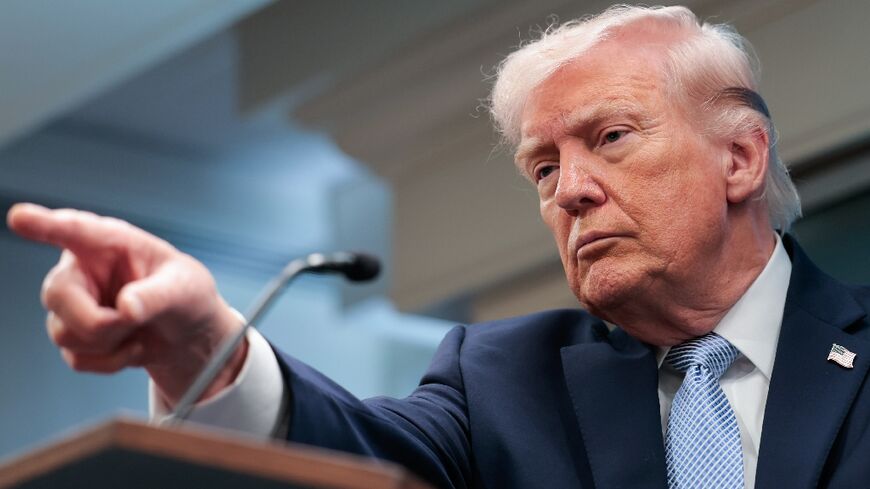
With his surprise announcement of a ceasefire between Israel and Iran, US President Donald Trump has turned his flair for social media into diplomatic deftness, despite continued uncertainty in the Middle East.

Israel, Iran and Trump himself all declared victory after 12 days of conflict that culminated Saturday in the United States bombing Iran's key nuclear sites.

US President Donald Trump adjusts his cap as he exits Air Force One in Amsterdam

US intel says strikes did not destroy Iran nuclear program

A classified preliminary US intelligence report has concluded that American strikes on Iran set back Tehran's nuclear program by just a few months -- rather than destroying it as claimed by President Donald Trump.

US media on Tuesday cited people familiar with the Defense Intelligence Agency (DIA) findings as saying the weekend strikes did not fully eliminate Iran's centrifuges or stockpile of enriched uranium.

The aerial bombardments and missile strikes sealed off entrances to some facilities without destroying underground buildings, according to the report.

Iran's Fordow nuclear enrichment facility seen on June 22, 2025 after US strikes on the site

Israel claims victory as US intel says Iran nuclear sites not destroyed

Israeli Prime Minister Benjamin Netanyahu declared a "historic victory" against Iran despite a US intelligence report concluding that American strikes set back Tehran's nuclear program by just a few months.

Iran and Israel agreed a ceasefire on Tuesday ending 12 days of tit-for-tat strikes, after US President Donald Trump joined the conflict with bunker-busting bombs at the weekend that he said destroyed key Iranian nuclear sites.

Iran and Israel have been in a shadow war for decades, but this has been by far the most destructive confrontation between them

Iran diaspora in Los Angeles dream of 'regime change'

At his grocery store in an Iranian neighborhood of Los Angeles, Mohammad Ghafari is worried sick about his brothers and sisters since the United States bombed the Islamic republic's nuclear sites.

But as he stands among his dates, dried plums and pistachios, he also cherishes the hope of change in his native country.

Iran "is not capable of providing food to the Persian people," said Ghafari, who left to study abroad before the 1979 revolution and never returned.

"If the people (there) were happy about a change of regime, I would be too."

Demonstrators in Los Angeles call for change in Tehran

How Iran's 'telegraphed' strikes on Qatari soil paved way to Israel truce

Iran's unprecedented strikes on a US base in Qatar were carefully calculated to provide an exit from hostilities with Washington and set up a truce with Israel, according to analysts and an official.

Monday's missile launches were signalled well in advance, minimising the risk of injury and giving every opportunity to shoot down the projectiles -- resulting in a fireworks display of booms and flashes above Doha.

Gaza rescuers say 46 killed as UN slams US-backed aid system

Gaza's civil defence agency said Israeli forces killed another 46 people waiting for aid in the Palestinian territory on Tuesday as rights groups and UN agencies slammed the US-backed food distribution system.

Civil defence spokesman Mahmud Bassal told AFP that 21 people were killed and around 150 wounded by Israeli fire near an aid point in central Gaza early Tuesday, and that another 25 were killed in a separate incident in south Gaza.

Mourners cry during a funeral of a person killed while attempting to get aid at a distribution point

Life returns to Tehran, but residents wary ceasefire won't hold

Tehran was far from its usual hustle and bustle on Tuesday, but life was regaining some colour despite concerns from residents that a tentative ceasefire between Iran and Israel may not hold, after nearly two weeks of war.

In Tajrish bazaar in north Tehran, everyone had their own opinion on whether the end to the fighting announced by US President Donald Trump would last.

Business were reopening and residents returning to the streets in Tehran amid the tentative ceasefire

'Nowhere to escape': Israel strike intensifies distress in notorious Iran jail

Alarm has intensified over the welfare of inmates after an Israeli strike on Evin prison in Tehran, one of Iran's most notorious penal complexes which haunts prisoners long after they are released.

Rights groups say that Evin, which is believed to have the capacity for hundreds of inmates, is home to dozens of "political prisoners" innocent of any crime, including foreigners, and women who are kept in a separate wing.

A picture obtained from the Iranian Mizan News Agency on October 16, 2022 shows debris following a fire in the notorious Evin prison, northwest of the Iranian capital Tehran

Shadowy extremist group claims Damascus church attack

A little-known Sunni Muslim extremist group claimed responsibility on Tuesday for a weekend suicide attack against a church in Damascus, while the Syrian government insisted they were part of the Islamic State group.

Sunday's attack killed 25 people and wounded dozens, striking terror into Syria's Christian community and other minorities.

A statement from Saraya Ansar al-Sunna said an operative "blew up the Saint Elias church in the Dwelaa neighbourhood of Damascus", adding that it came after an unspecified "provocation".

Mourners carry the coffins of some of the 25 people killed in a weekend church bombing in  Damascus in a procession through the Syrian capital's Al-Qassaa neighbourhood.

UN condemns 'weaponisation of food' in Gaza

The United Nations on Tuesday condemned what it said was Israel's "weaponisation of food" in Gaza and called it a war crime, urging its military to "stop shooting at people trying to get food".

The head of the UN agency supporting Palestinian refugees also called a new US- and Israel-backed food-distribution system in the Gaza Strip an "abomination".

The Gaza Humanitarian Foundation began handing out food in Gaza on May 26 after Israel completely cut off supplies into the occupied Palestinian territory for more than two months, sparking warnings of mass famine.

The UN condemned what it said was Israel's 'weaponisation of food' aid in Gaza