



At Turkey’s COP31, artists put fossil fuels in the frame


ANTALYA, Turkey — Silver-plated dried plants rotated eerily in their terracotta pots. An old typewriter rose above a hill of shredded paper. There was also a portrait of Enver Pasha, the war minister who led the Ottoman Empire into World War I, by Osman Hamdi Bey, who holds the Turkish auction record with his “Young Woman Reading,” which sold for about $7.8 million in 2019. In an 8,100-square-meter (roughly 2-acre) gallery in the Green Zone of the sprawling COP31 complex in Antalya, COPArt, the summit’s art program, put the ecological angst of artists from Turkey and beyond on display under the title “Still Possible.”
Many negotiators, activists and journalists will remember COP31 for how it ended. Initially scheduled for Nov. 9-20, the summit ran two days over as delegations struggled to reach a deal. It became the first COP since Copenhagen in 2009 to close without a cover decision, the overarching political text known this time as the Antalya Pact. The European Union and dozens of other countries rejected a final draft that made no direct mention of fossil fuels.
For the summit’s cultural organizers, however, the scorecard reads differently. “We did a world first,” Nagihan Ozel, who directed COPArt and curated its contemporary art selection, told the program’s closing panel on Nov. 20. Meanwhile, the Turkish Environment Ministry boasted that the United Nations had recognized COPArt as a legacy of Turkey’s presidency, to be carried forward at future climate summits.
“The work for COPArt started in May,” Samed Karagoz, COPArt’s art director and curator of its Palestinian section, told Al-Monitor. “We organized it in five parts: Ottoman calligraphy, classical Turkish painting, contemporary art, digital art and Palestine.”
“We reached out to galleries in the country and abroad, to private collectors and to artists directly,” Karagoz said. He cited as a major success the loan of Anselm Kiefer’s “Fur Rabbi Low,” in which the German artist uses a pair of scales to weigh what humans can create against what they owe for doing so.
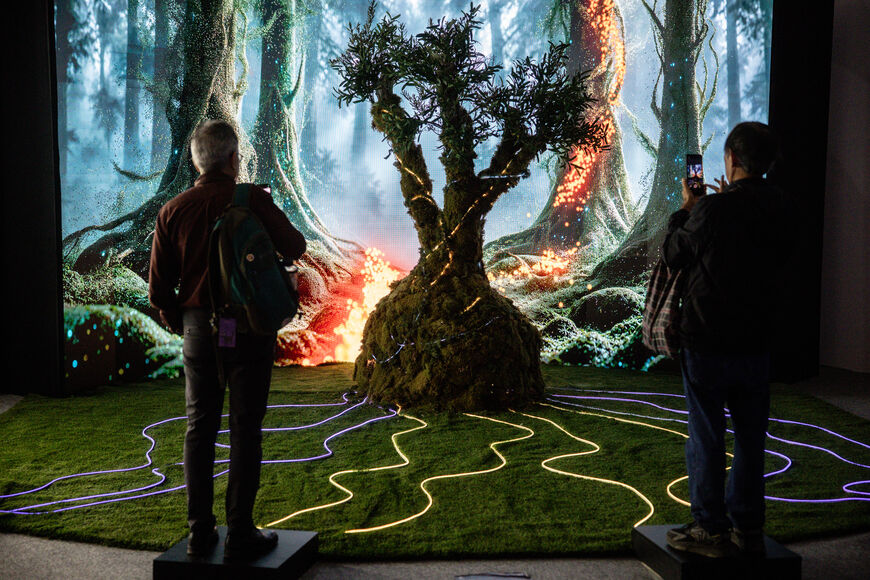
People view art on display at the COPArt gallery in the Green Zone at the COP31 UNFCCC Climate Conference, Antalya, Turkey, Nov. 19, 2026.
Nearby, Eva Jospin’s “Foret” builds a woodland out of cardboard, itself a product of felled trees: Art can remake a forest far more easily than nature can. Clarissa Tossin preserved in silicone a maple tree from Mulhouse, France, that had died from heat and drought, calling the work “Death by Heat Wave.” Turkish artist Vuslat coated dried mullein in silver for “Last Seen,” with each plant sculpture resting on a water-filled clay base inscribed with the year one of five plant species driven to extinction by humans was last seen in the wild.
Fossil fuels in the frame
Fossil fuels, the issue that sank the Antalya Pact, also found their way onto the cultural scene, both inside and outside the official program.
Greenpeace and Danish artist Thomas Dambo, known for his giant trolls built from scrap wood, planted a six-meter (20-feet) Trojan Horse in front of Konyaalti municipality. A trapdoor in its belly spilled plastic waste, which Greenpeace presented as a symbol of an oil and gas industry betting on plastics to sustain its growth. Inside the venue, Greenpeace laid a 3D floor installation titled “Don’t Fall For Fossil Fuels” along a main corridor.
The Polish Institute in Istanbul, inaugurated in August, brought the debate into the Green Zone with a panel titled “From Coal Dust to the Light: Upper Silesia, A European Laboratory for the Energy Transition and Beyond.” Co-organized with the EU Delegation to Turkey, the panel featured speakers including Lukasz Galusek, director of the Silesian Museum in Katowice. The museum transformed a former coal mine into a “culture mine,” with galleries 14 meters (46 meters) underground and the old Warszawa II hoisting shaft now serving as a viewing tower overlooking the city.
“For centuries, Upper Silesia ran on its coal mines,” said Radosław Sadowski, the institute’s director, who moderated the panel. “EU accession changed the direction of our energy policy. Former industrial sites became museums and business hubs through a fair transition that preserved the region’s heritage. It is a lesson worth sharing with other countries, including our host.”
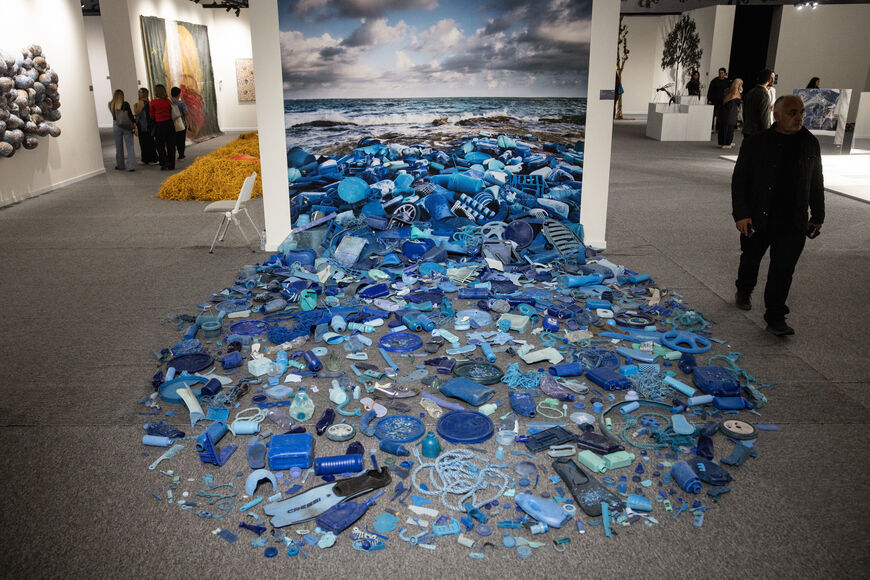
People view art on display at the COPArt gallery in the Green Zone at the COP31 UNFCCC Climate Conference, Antalya, Turkey, Nov. 19, 2026.
The national canon goes to the coast
The Turkish selection resembled a museum survey, featuring works by late Ottoman and early Republican painters such as Seker Ahmet Pasha, Osman Hamdi Bey, Hoca Ali Riza and Ibrahim Calli. Scattered across different pavilions, “Six Masters, Six Traces” brought together the trailblazers Fahrelnissa Zeid, Burhan Dogancay, Omer Uluc, Devrim Erbil, Mehmet Guleryuz and Haluk Akakce. Some pieces, borrowed from collectors’ homes and offices, went on public display for the first time.
“We also used the opportunity to introduce Ottoman calligraphy to our foreign visitors,” Karagoz said. “Few of them would have seen it elsewhere.”
The most openly political room was the Palestinian section. Some of its works had previously been exhibited at the Mahmoud Darwish Museum in Ramallah, where Karagoz curated an exhibition of Turkish artist Ahmet Yusuf Aygec’s “Posters for the Olive Tree in Exile” in July. The section also featured works by the late Palestinian painter Suleiman Mansour and Nabil Anani.
“The Palestine section was a display of our stance on this issue as the host country,” Karagoz said, adding that COPArt drew an average of 5,000 visitors a day.
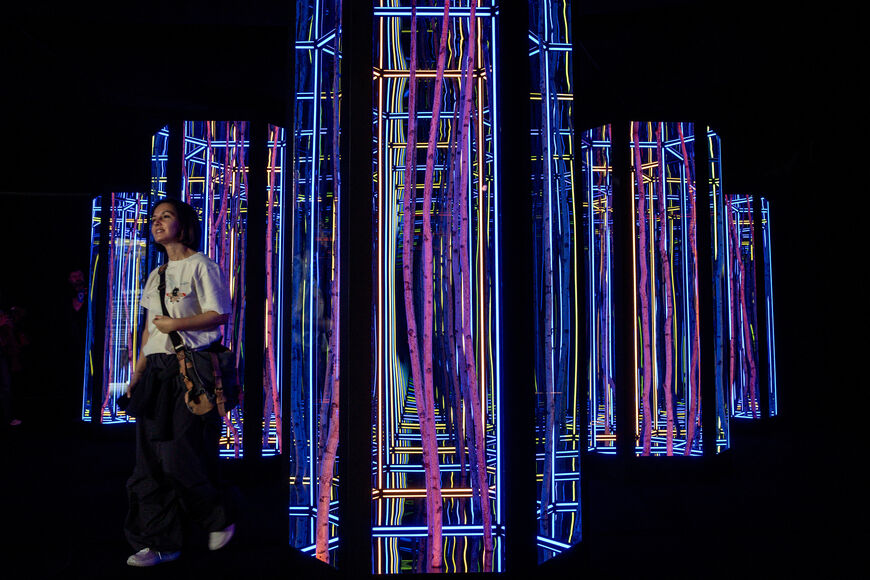
People view art on display at the COPArt gallery in the Green Zone at the COP31 UNFCCC Climate Conference, Antalya, Turkey, Nov. 19, 2026.
A controversial soundtrack
The summit also came with a soundtrack. The ministry set the tone on Oct. 23 with its own English-language anthem, “Let's COP.” Pop star Tarkan followed a week before the summit with “Wake Up,” an English-language reworking of his 2008 song “Uyan.” Sertab Erener, Turkey's 2003 Eurovision winner, added “One Home,” a song that Kurum shared on the summit's opening day.
“Let's COP” turned out to be an easy target. Germany's weekly Freitag called it Eurovision-style, noted that COP is not a verb and reported that officials had admitted to using artificial intelligence in its production. The paper contrasted the song with Turkish President Recep Tayyip Erdogan's announcement, at the start of the summit, of two new oil fields, Gaziler and Cardakli, expected to increase Turkish oil output by 30%.
This one's on us.
The story doesn't end here.
Our correspondents are already on the next chapter. Read everything they file, from $2/week.