


Israel president taps Eisenkot to form new government


Israel's president announced on Saturday he would task Gadi Eisenkot with forming the next government following last week's election, in what Netanyahu's rivals see as a first step to remove the country's longest-serving prime minister.
The opposition bloc led by Eisenkot, a former military chief and political newcomer who has tried to appeal to secular and liberal Israelis, has opened the door to a once improbable alliance with ultra-Orthodox Jews, which could give it the numbers to form a coalition.
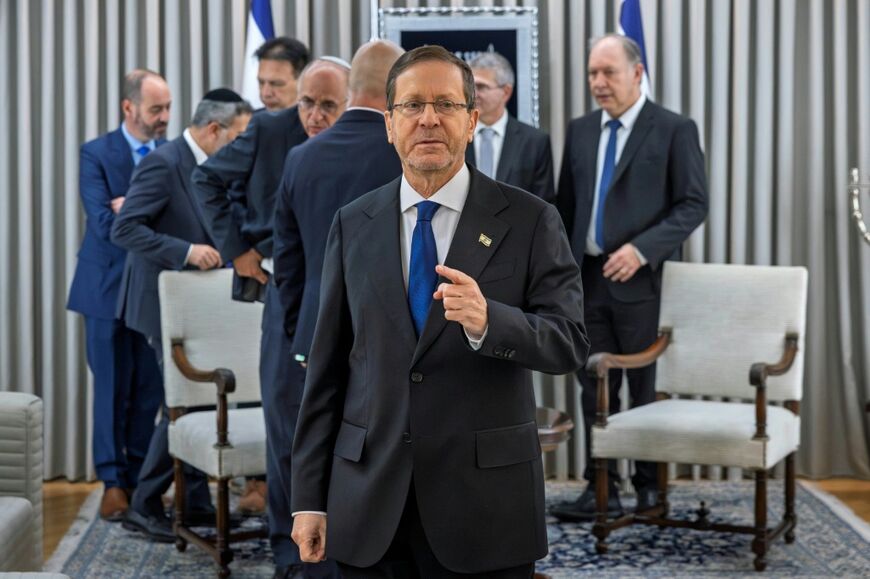
President Isaac Herzog said that after consultations with all parties during the week, he would grant Eisenkot the first chance to form a government after the October 27 election, in which neither side secured a majority in a country deeply polarised by Netanyahu's hard-right rule and worn down by three years of war.
The formal appointment would take place in an official ceremony on Sunday at the president's residence in Jerusalem, Herzog's office said.
Eisenkot was recommended by parties representing 67 lawmakers as opposed to 46 for Netanyahu's bloc.
But the recommendations for Eisenkot included members of Israel's Arab minority -- whose seat haul soared in the election on the back of anger against Netanyahu -- and right-leaning segments of the opposition oppose relying on Arab votes.
- Netanyahu pushes unity government -
Herzog, who originally came from Israel's now defunct left-wing Labour Party but who has a non-partisan role and has forged a working relationship with Netanyahu, has signalled that he would like to explore a national unity government that would seek to bring together Jewish Israelis from across the political spectrum.
Pressure for a unity government could build if Netanyahu follows through on threats to resume war on Iran, although US President Donald Trump has not given the green light and received his own drubbing in Tuesday's midterm elections.
Netanyahu, who has led Israel on and off for nearly two decades and guided its sharply rightward turn in recent years, faces corruption charges and potentially jail if he leaves office. He also faces an arrest warrant over the Gaza war from the International Criminal Court, whose authority he rejects.
Netanyahu has already called for a unity government but the opposition has stood firm on removing him first.
He has attacked opposition leaders for even considering working with Israeli Arabs, descendants of Palestinians who stayed after the creation of Israel in 1948.
The incumbent premier said on Saturday that a potential coalition between opposition parties and Arab lists, which he called Islamists, would "dismantle the State of Israel from within" and urged the formation of a unity government comprising "all the Zionist parties that want to safeguard our state."
In response, Eisenkot's Yashar party urged Netanyahu's allies and members of his Likud party to form a unity government led by Eisenkot and to "publicly announce the dissolution of their alliance with the extremists".
Opposition bloc member Avigdor Liberman, a former Netanyahu aide turned fierce critic who nonetheless shares his hawkish views on the Palestinians, has made clear that he will not sit with Eisenkot if he relies on Israeli-Arab votes.
But on Friday, Liberman -- a staunch secularist whose support base initially was Russian-speaking immigrants -- made a U-turn on another group he had shunned and said he was open to discussions on a law that would enshrine an exemption for ultra-Orthodox Jews from mandatory military service.
Liberman and another opposition leader, Naftali Bennett, had made closing the exemption a core campaign promise and had viscerally criticised ultra-Orthodox Jews as burdens on the state, responding to wide resentment by other Israelis at a time when reservists are serving multiple tours in Gaza and Lebanon.
Eisenkot has proposed requiring national service for all Israelis but allowing citizens to choose a civilian option rather than the military, opening the door to integrating the ultra-Orthodox.
In a message delivered on Friday before Israel shut down for the sabbath, Eisenkot said it was urgent to replace Netanyahu, calling him a threat to the "very existence of Israeli democracy".
He called for the swift formation of a government, which could initially rely on outside support, with more parties joining eventually.
Following his appointment, Eisenkot will have 28 days to come up with the 61 votes needed for a government. If he comes up short, Herzog can provide a 14-day extension before he has to offer the mandate to someone else.
If neither side succeeds, Israel will head to fresh elections. The country held five elections between 2019 and 2022 due to repeated deadlocks.
sct-glp/dcp
This one's on us.
The story doesn't end here.
Our correspondents are already on the next chapter. Read everything they file, from $2/week.