


'Generational wipeout': Democratic gains to reshape Trump's final years
Tuesday's vote has shifted the balance of power in Washington, giving Democrats greater leverage to challenge the Trump administration during the president's final two years in office.


Democrats won control of both chambers of Congress in Tuesday's midterm elections, delivering a stunning rebuke to President Donald Trump and making historic gains in states that have long been Republican strongholds.
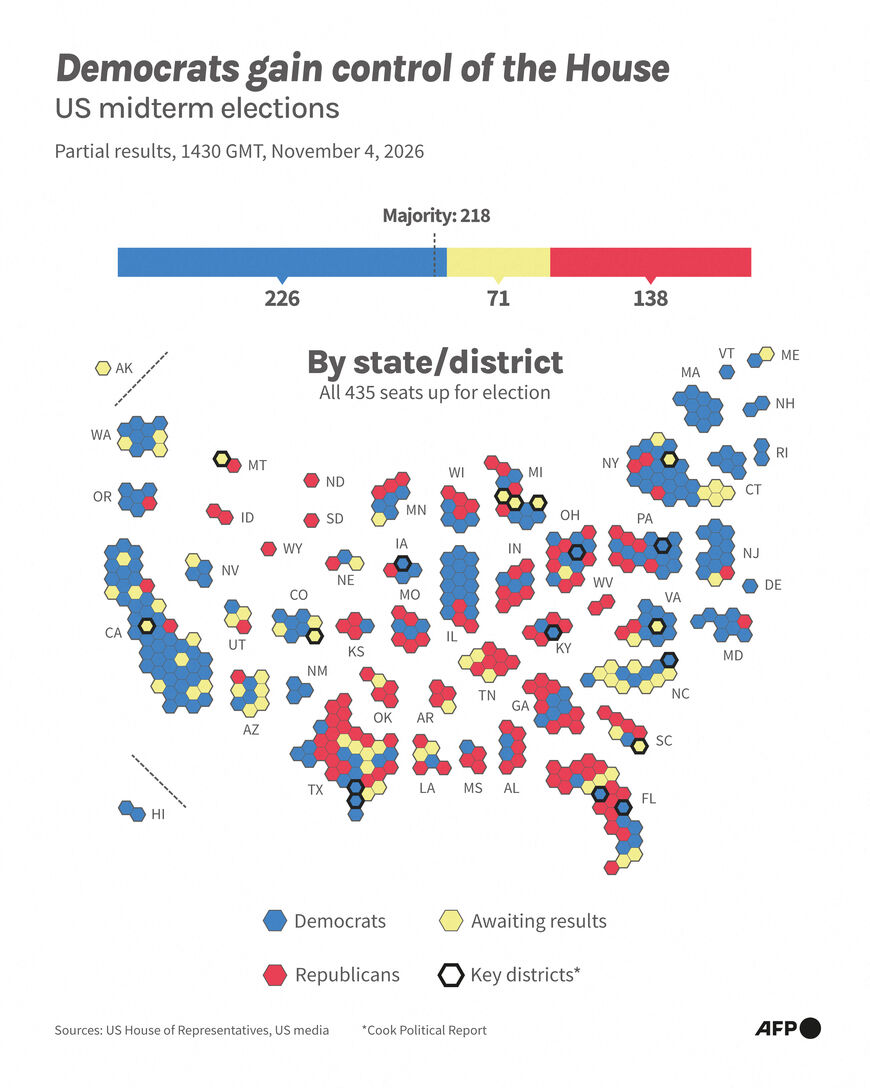
Democrats took the House of Representatives, securing at least 228 seats to Republicans' 139, with a number of races still uncalled. They also reclaimed a majority in the Senate, flipping at least seven Republican-held seats and bringing their caucus to 54 seats, including two independents, compared with 44 for Republicans. Two Senate races remained uncalled as of Wednesday morning.
Elections analyst Dave Wasserman, an editor at the Cook Political Report, called the results a "generational wipeout" in a post on X Wednesday. The New York Times described the outcome as a "GOP rout," while The Wall Street Journal called it a "stunning rebuke of Trump."
The results mark a dramatic reversal for Republicans, who entered the election with majorities in both the House and the Senate. Democrats also won key races in traditionally conservative states including Kansas, Texas and South Carolina.
Democrats largely outperformed polling averages, notably in several closely watched Senate races in Iowa, Maine and Michigan, where their margins of victory exceeded expectations.
The victories also brought new political voices to Washington. Michigan Democrat Abdul El-Sayed became the first Muslim elected to the US Senate and New Jersey Democrat Adam Hamawy will become the state's first Muslim member of the House. New York Democrat Darializa Avila Chevalier also won a House seat, adding to the growing representation of Muslim Americans in Congress.
Other historic victories included those of Democrats Peggy Flanagan, who became the first Native American woman elected to the Senate in Minnesota, and Chris Pappas in New Hampshire, who will become the first openly gay man in the chamber.
Several candidates critical of current US foreign policy secured high-profile victories. El-Sayed and Hamawy both campaigned against US military assistance to Israel. Meanwhile, in Texas, senator-elect James Talarico has pledged to support a war powers resolution to end what he called a reckless war with Iran, while South Carolina's Annie Andrews described the conflict as illegal and unconstitutional, linking it to rising fuel prices.
Democrats break through in Republican strongholds
The scale of the Democratic gains was perhaps most striking in states that have increasingly favored Republicans, including several that Trump carried by double digits in 2024.
In Iowa, state Rep. Josh Turek defeated Republican Ashley Hinson, winning 50.5% of the vote to her 46.4% in the race to replace retiring Sen. Joni Ernst. Democrats also won the governor's race and flipped three House seats.
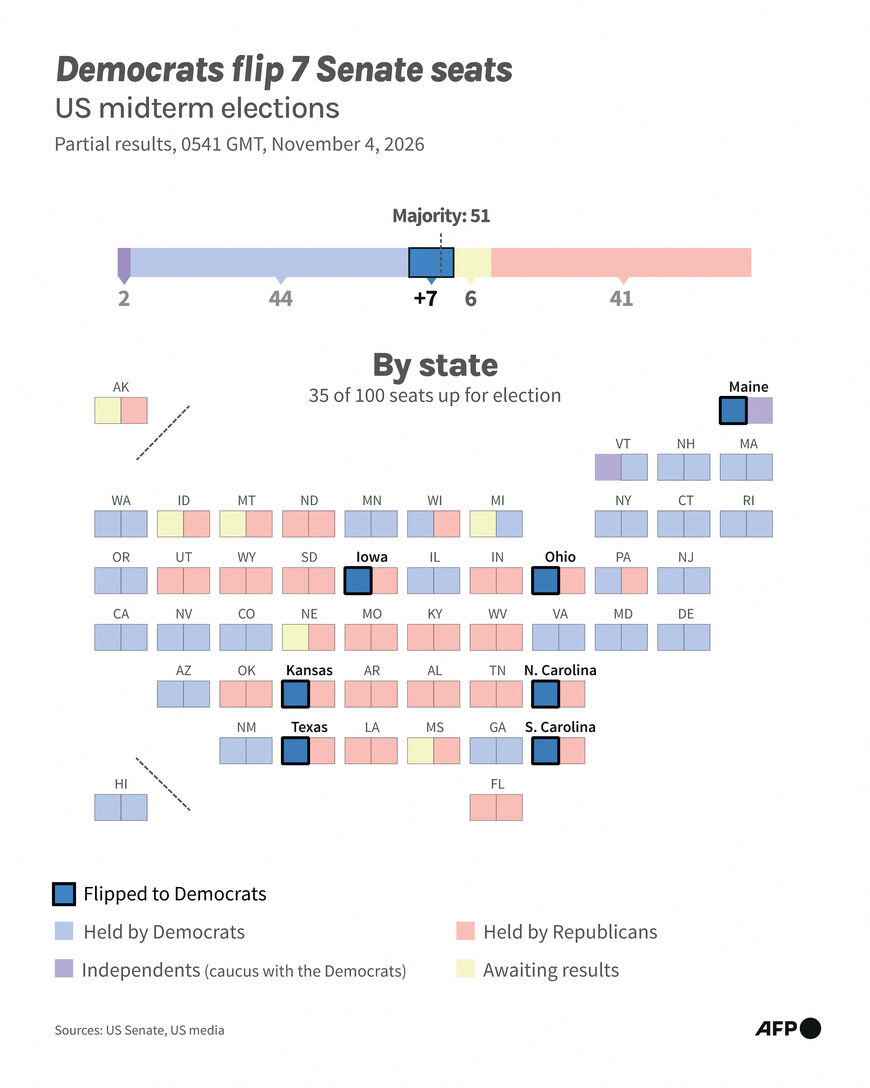
Former president of Maine's state senate Troy Jackson won 53.8% of the vote to defeat five-term Republican Susan Collins. Collins' defeat was one of the cycle's most consequential upsets.
Kansas delivered another historic result. Democrat Adam Hamilton defeated Republican incumbent Roger Marshall, winning 50.9% to 46.1%. The victory marked the first time since 1932 that Kansas had elected a Democrat to the Senate.
In South Carolina, Dr. Annie Andrews, a pediatrician, defeated Republican Darline Graham 51.1% to 46.7%, becoming the state's first Democratic senator since 1998. Graham, appointed after the death of her longtime senator brother, Lindsey Graham, had Trump's endorsement. The result came despite Trump's 18-point margin in the state in 2024.
One of the biggest shocks came in Texas, where state Rep. James Talarico defeated Republican Ken Paxton, winning 55.1% of the vote to Paxton's 43%. The victory gave Democrats their first Senate win in Texas in nearly four decades. Democrat Gina Hinojosa also defeated incumbent Governor Greg Abbott to become the state's first Latina governor and end more than three decades of Republican control of the governor's office.
The map pic.twitter.com/BeFmdL3o8y
— Anne Applebaum (@anneapplebaum) November 4, 2026
Mississippi, typically a deep-red state, offered another indication of the scale of the shift. On Wednesday morning, Democrat Scott Colom was leading Republican Sen. Cindy Hyde-Smith by fewer than 100 votes, about 96% of the expected vote counted. The race remained too close to call as of time of publication. If Colom holds his narrow lead, he would become the first Democrat to win a Senate race in Mississippi since 1982.
Iran war takes toll
On the campaign trail, Trump urged voters to treat the midterms as a referendum on his presidency. “Get out and vote tomorrow, and pretend I’m on the ballot. And really, I am on the ballot,” he said to South Carolina voters on Monday. But his approval rating stood at 32% in a Reuters/Ipsos poll conducted from Oct. 29 to Nov. 2, just one percentage point above his record low of 31% in October.
The Iran war may have further eroded his standing, particularly as it drove up energy costs. Disruptions to global oil supplies, including through the Strait of Hormuz, pushed the national average price of gasoline to roughly $4.13 per gallon on election day, about 30% above the same time last year and an election day record, according to the American Automobile Association.
Christopher Preble, senior fellow and director of the Reimagining US Grand Strategy program at the Stimson Center, told Al-Monitor, “I think that the Iran war was the decisive factor in this election. If President Trump hadn’t launched the war unilaterally in the end of February, the results likely would have been different."
In a phone interview with the New York Times on Tuesday night, Trump said he did not regret the decision to go to war. He suggested voters were less concerned about the conflict itself than its economic fallout. “They don’t mind the Iran [war], but they probably weren’t happy with the oil price,” he said.
Brian Katulis, a senior fellow at the Middle East Institute, cautioned against overstating the Iran war's role in the election. He noted that, unlike the 2006 midterms, when the war in Iraq was the leading issue for voters, this election was driven primarily by economic concerns. “It wasn't a foreign policy election in the sense that 20 years ago, when there was a vote in the midterms in 2006, the top number-one issue was the Iraq War. That wasn't the case here. It was mostly about costs and affordability,” he said.
In 2006, Democrats took control of both chambers from Republicans. Pew Research Center found that 53% of voters named the Iraq War as their first or second most important issue in deciding how to vote.
New check on Trump's power
Democratic control of Congress will give the party greater leverage over the final two years of Trump's presidency.
In the Senate, Democrats will be able to block or delay presidential nominations, while control of committees in both chambers will give them greater power to investigate the administration's handling of the Iran war, its spending decisions and other policies.
“The war needs to be funded, and if Congress doesn’t fund the war, then the war will stop,” Preble said. He added that he expects the incoming Democratic chairs of the House Foreign Affairs Committee and the Senate Foreign Relations Committee to take a more active role in scrutinizing foreign policy.
Rep. Gregory Meeks (D-N.Y.), the current ranking Democrat on the House Foreign Affairs Committee, is expected to reclaim the gavel, while the Senate Foreign Relations Committee will have a new Democratic chair following the retirement of Sen. Jeanne Shaheen (D-N.H.).
Katulis added that Congress will likely hold hearings on “the corrupt use of office and officials using positions of negotiation for the US to actually enrich themselves,” pointing to Jared Kushner. Kushner, Trump's son-in-law and former senior adviser, founded private equity firm Affinity Partners after leaving the White House in 2021. The firm has received billions of dollars from investors in Saudi Arabia, Qatar and the United Arab Emirates, raising questions about conflicts of interest as Kushner has continued to participate in the administration's Middle East diplomacy. Kushner has denied that his business interests influence his diplomatic work.
The new balance of power will also complicate Trump's ability to advance his legislative agenda, particularly on issues where Democrats are united in opposition. Trump told Politico on Tuesday night that he was prepared to work with Democrats, saying, “I don't want to be just sitting there for two years vetoing everything.” He added that Democratic leaders had already called him, though he declined to say who.
However, the party will face its own challenge of translating an electoral victory into a coherent governing agenda. Democrats enter the new Congress with a broad coalition that includes progressives who want a more confrontational approach to the Trump administration and more moderate lawmakers focused on bipartisan deals and appealing to swing voters. With an eye on the 2028 presidential election, Democratic leaders will also face pressure to show voters what the party stands for beyond opposition to Trump.
Katulis said Democrats currently lack a proactive, forward-looking foreign policy alternative to the Trump administration, relying instead largely on criticism of the status quo. Without a coherent alternative, he said, “They're unlikely to be able to build a coalition that keeps their party unified, but also picks off some Republicans to reach a meaningful number that can check the president's significant powers in the foreign policy realm.”
He also noted that Democrats will not have the veto-proof majority needed to override a presidential veto, which requires a two-thirds majority in both chambers: 290 votes in the House and 67 in the Senate if all members vote. “I have the ultimate power — it's called veto,” Trump told CBS News on Tuesday.
This developing story has been updated since initial publication.
An AL-MONITOR subscriber gifted you this article. Gifted by an AL-MONITOR subscriber.
A gift worth sharing.
This one's on us. Subscribe for unlimited access to everything we publish, plus gift articles for your inner circle. As low as $2/week. This one's on us. Get unlimited access, plus gift articles for your inner circle, from $2 a week.
Already a subscriber? Sign in