



Eisenkot and Netanyahu to hold coalition talks Sunday after rotating PM offer


Israeli caretaker prime minister Benjamin Netanyahu and his rival Gadi Eisenkot will meet on Sunday morning for coalition talks, the premier's party said, after the incumbent suggested a unity government with a rotation deal for the top job.
The country held inconclusive elections in late October that left neither main bloc with a majority, but Eisenkot was the one tasked by Israeli President Isaac Herzog with forming a government after the head of state consulted with all the parties.
Since then, Eisenkot has been trying to cobble together a coalition to oust Netanyahu, but he is hemmed in both by opposition to relying on Arab-Israeli parties and to the possible compromises required to bring ultra-Orthodox parties on board.
"Prime Minister Benjamin Netanyahu and Yashar Party Chairman Gadi Eisenkot spoke and agreed to meet tomorrow at 10:00 (0800GMT)" at a hotel in Israel's coastal city of Herzliya, Netanyahu's Likud party said in a statement published late on Saturday.
Proposing a unity government in a social media post late on Saturday, Netanyahu, Israel's longest-serving premier, said "my responsibility as a leader requires me to set everything aside... and agree that Gadi Eisenkot will serve first as prime minister, while I will serve as alternate prime minister at the beginning of the term".
That prompted Eisenkot to respond with an offer of his own to Netanyahu and his right-wing Likud party.
In a statement, he said, "If Likud is ready for genuine unity, I am prepared to see how serious it is over the next 24 hours."
The day before, Eisenkot had vowed to announce the formation of a new government by the official deadline of December 6, without using the option of a 14-day extension.
- 'Transparent con' -
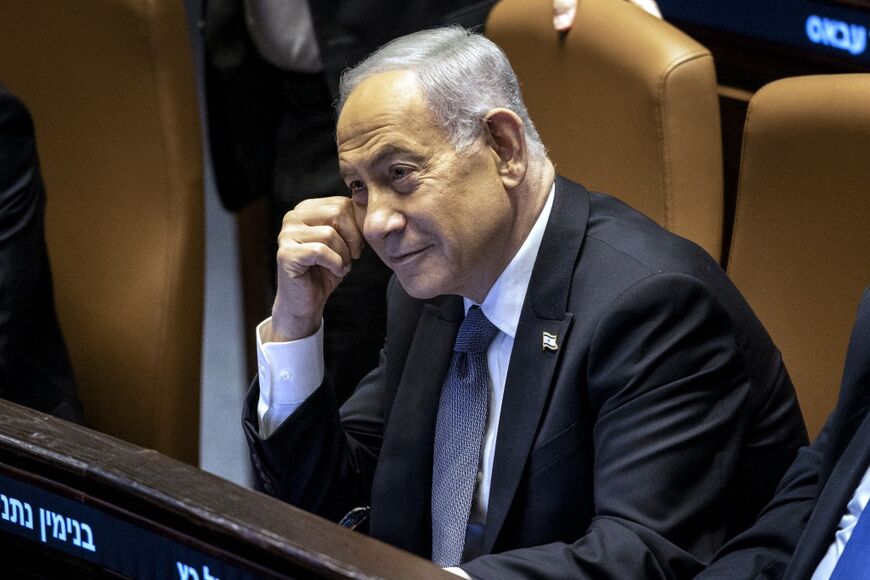
Eisenkot had been expected to form a coalition with anti-Netanyahu parties, but he instructed his centrist Yashar party to conduct negotiations with Netanyahu's right-wing Likud.
On Friday, the former military chief turned politician accused Likud of stalling coalition talks in a bid to bring about new elections.
"Likud... has been unwilling to compromise and, over two weeks, refused to put a single concrete proposal on the table," Eisenkot said in a statement.
On Saturday, he said the party had not responded to a "detailed proposal" made earlier.
His wide-ranging camp has faced divisions over whether to forge alliances with the ultra-Orthodox parties, the Arab-majority lists, or form a unity government with Likud.
Netanyahu other opponents scoffed at the prime minister's offer of a rotating premiership.
Youssef Jabareen, leader of the Arab-majority Joint List, which is expected to support an Eisenkot-led government without joining it, wrote: "The democratic majority has decided: this bloodstained, neglectful government must go. It is time to fulfill the shared will of the entire public, Jews and Arabs alike, and remove Netanyahu this (upcoming) week."
Former prime minister and co-chair of the centrist Beyachad party Yair Lapid, meanwhile, called the offer "yet another transparent con by a serial fraudster who has deceived every partner and violated every agreement".
Yashar has so far agreed coalition deals with the left-leaning Democrats and the right-wing Israel Beiteinu party.
Together, they have a combined total of 36 lawmakers -- far short of the 61 needed for a majority in Israel's 120-seat parliament.
- Arab lists may join Eisenkot bloc -
Meanwhile, Mansour Abbas, the leader of the second Arab-Israeli party, Raam, on Saturday implicitly recognised Hamas as a "terror group" -- a move that could pave the way for his party to join a coalition led by Eisenkot, who has made condemnation of Hamas a precondition for joining.
Abbas said he would be willing to take part in such a coalition from the start or join at a later stage.
In an interview with Israel's Channel 12, Abbas noted that the two Arab-majority parties, his Raam and the Joint List, supported a bill this week to set up a commission of inquiry into the October 7, 2023 security failures which described Hamas as a "terror group," thereby acknowledging the designation.
He said he had refused to make such a statement in the past knowing that an explicit recognition could have negative ramifications within Israel's Arab community and in relations with Palestinians in the West Bank and Gaza.
glp/dcp
This one's on us.
The story doesn't end here.
Our correspondents are already on the next chapter. Read everything they file, from $2/week.