


On election day, Israeli settlers look beyond Netanyahu to far right


At a polling station in the Israeli settlement of Kiryat Arba, home of far-right firebrand Itamar Ben Gvir in the southern West Bank, voter Lishay Cooper said the country needed a tougher leader than famously hawkish Prime Minister Benjamin Netanyahu.
"Netanyahu has made mistakes, we can't count on him," the 22-year-old bookstore employee told AFP. "We need someone stronger."
Behind her, volunteers for Netanyahu -- who is facing a close fight for reelection in Tuesday's poll -- handed out flyers to voters, but privately acknowledged they were on the turf of Ben Gvir and Bezalel Smotrich, staunch advocates of the settler movement.
The pair have served as national security and finance minister respectively in Netanyahu's coalition government, one of the most right-wing in Israel's history and one of the friendliest to settlements in the occupied West Bank, which are considered illegal under international law.
But Cooper said she decided to tack further to the right after losing friends during Hamas's October 7, 2023 attack on Israel, and now wants someone tough on Palestinians.
"As far as I'm concerned it's Ben Gvir or (Moshe) Feiglin," she said, referring to a Smotrich-aligned libertarian Zionist candidate. "They've shown that they won't let this happen."
More than 500,000 Israeli settlers live in settlements in the West Bank, which is also home to more than three million Palestinians.
Violence has soared in the territory since the October 7 attack, with more than 1,100 Palestinians killed by soldiers and settlers, and nearly 50 Israelis killed in Palestinian attacks or during Israeli military operations.
- 'Part of the world' -
Meir Menahem, 67, voting just after Ben Gvir came to cast his own ballot, said the future of the settler movement and the Jewish character of the country were his main concerns.
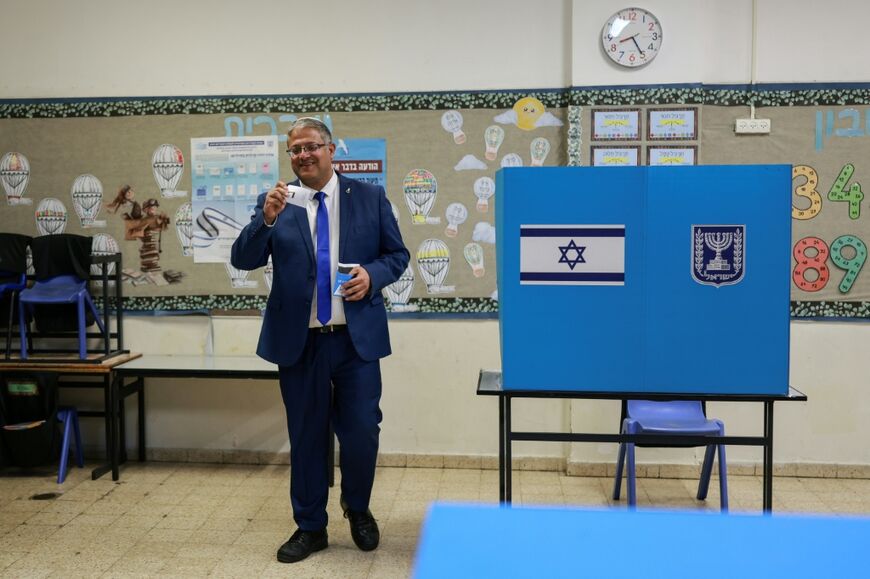
He faulted mainstream parties for supporting internationally inspired, secular judicial frameworks, rather than settling matters according to Jewish religious law.
"They want to be a part of the world, but we don't want that," he said, a handgun holstered under his ultra-Orthodox garb.
The last opinion polls to be published before the vote showed Netanyahu, Israel's longest-serving prime minister, running neck and neck with his main rival Gadi Eisenkot, a centrist political novice and former military chief.
Eliya Tzeiri, a 22-year-old student at a yeshiva, religious school, feared for the settler movement should an Eisenkot-led coalition take power.
"It will lead to the evacuation of the new settlements that were established, and that would be a shame."
Adjacent to Kiryat Arba is Hebron, home to about 500 settlers living in the historic old town, separated from what is also the largest Palestinian city in the West Bank, with around 250,000 residents.
Voters there came out in droves and stayed to chat after casting their ballots, near empty streets and stores that were once bustling with Palestinian shoppers a stone's throw from the Patriarchs Cave, known to Muslims as the Ibrahimi Mosque, a sacred site to both religions.
From Hebron to Jerusalem on road 60, the main artery of the West Bank, billboards urged voters to choose Smotrich, Ben Gvir and sometimes Netanyahu -- with almost none for Eisenkot, despite him polling even with the premier.
-'Didn't take responsability'-
Closer to Jerusalem, in the settlement of Efrat, known for its large US-born population, many voters expressed discontent with Netanyahu, citing issues such as army conscription, poor management and October 7.
Barry Lin, a 62-year-old professor who came to cast his ballot with his daughter Yael, said he once voted for Netanyahu after years of being a self-described liberal. But now he felt politically adrift, believing the prime minister consistently placed his own survival before all else.
"He's the only one who didn't take responsibility for what happened on October 7," he said, adding that public services had also suffered.
But Arieh Yeza, a schoolteacher originally from Argentina, said he still liked Netanyahu's economic policies for middle-class families like his.
"No government is perfect, but at the end of the day regular people vote with their purse, and I like the government's foreign policy too, because we need to defend ourselves."
lba/smw/rh
This one's on us.
The story doesn't end here.
Our correspondents are already on the next chapter. Read everything they file, from $2/week.
See Offers