



Iran hits out at Gulf neighbors as US presses on with strikes
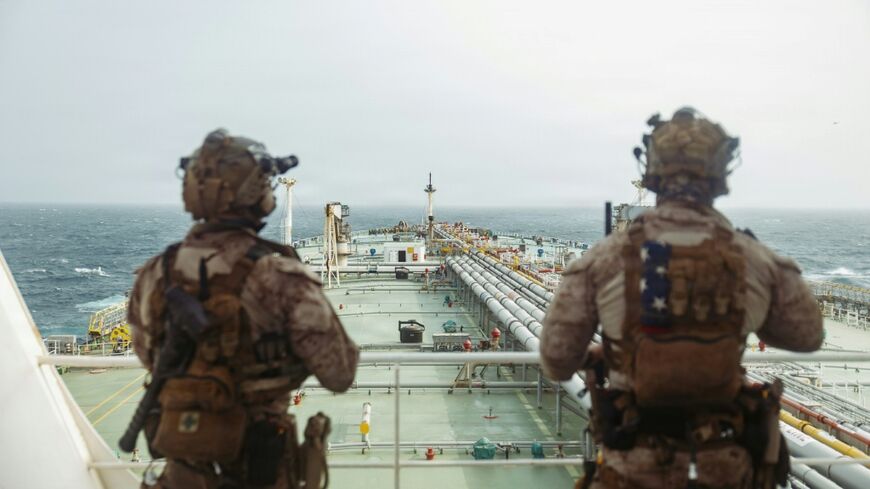
Washington and Tehran traded strikes on Monday as US deaths in the renewed fighting climbed to three and more ships came under attack in the strategic Strait of Hormuz. The UK Maritime Trade Operations agency said on Monday that a vessel was on fire in the strait, citing information from military authorities.


Washington and Tehran traded strikes on Monday as US deaths in the renewed fighting climbed to three and more ships came under attack in the strategic Strait of Hormuz.
Oil prices surged to a one-month high as the United States and Iran tussled for control of the vital strait, with Brent crude rising above $91 a barrel -- the highest price since June 11.
Since the start of the war on February 28, Iran has struck back by targeting US allies and military assets in its own neighborhood, and by virtually blocking the waterway through which a fifth of world oil supplies transited prior to the war.
A preliminary deal aimed at ending the war has collapsed as the foes fight to break a deadlock over the Strait of Hormuz.
Iran's Revolutionary Guards said on Monday that two oil tankers trying to transit the strait "exploded and were brought to a halt", according to a statement reported by the Tasnim news agency.
The UK Maritime Trade Operations agency said on Monday that a vessel was on fire in the strait, citing information from military authorities. The fire's cause has not been verified.
On Sunday, US Secretary of State Marco Rubio called on countries around the world to share the burden of protecting global shipping.
"It's clear that Iran, at least some people in Iran, want to control the straits and hold that as leverage against the world," Rubio told reporters.
"The United States will do and continue to do what it needs to, to protect global shipping, but other countries need to begin to step up and provide, whether it's hardware or finances, to help carry that burden," he said.
A fragile truce between Iran and the United States was shattered following reports of Iranian attacks on ships in the strait, though Rubio said he will "continue to try" to reach a diplomatic solution.
US Central Command (CENTCOM) said on Sunday that it successfully completed the ninth consecutive night of strikes against Iran.
The attacks were meant to "further diminish Iran's ability to attack commercial vessels and civilian mariners transiting the Strait of Hormuz", CENTCOM wrote on X.
The fresh fighting came after a weekend in which the US announced three new US military fatalities and one service member missing in action.
Two were killed during Iranian missile and drone attacks on Jordan Friday, while another service member died in northern Iraq during the controlled detonation of unexploded ordnance from a downed Iranian drone, CENTCOM said.
President Donald Trump said Sunday the latest US strikes on Iran "hit them very hard" in honor of the American fatalities.
The deaths brought to 17 the confirmed number of American military fatalities since conflict began.
On Friday, Iran's health ministry reported that 50 people had been killed in recent fighting and more than 500 wounded.
- Iran strikes neighbours -
Iran's Revolutionary Guards announced on Monday that they had hit targets in Syria, Jordan, and Kuwait overnight.
In Syria, Iranian forces launched "a surprise attack on the enemy special operations command centre in the Al-Tanf region", according to a Guards statement carried by state media.
In Jordan, the Guards said it targeted US military aircraft stationed at Aqaba Airport "with ballistic missiles, causing severe damage to a number of them".
The Guards also said they hit US military targets based in Kuwait, including an early-warning radar system that was "completely destroyed".
Kuwaiti air defences were "engaging hostile drone attacks following Iranian aggression", its army said early Monday.
Bahrain's interior ministry also said that its air raid sirens had sounded and urged citizens and residents to head to "the nearest safe place".
- Strait as 'leverage' -
On Sunday, the Revolutionary Guards said two ships attempting to transit the strait were stopped.
"Four violating ships, with the mischief and support of American terrorists... intended to disrupt and exit the Strait of Hormuz via an unsafe route, two of which had an accident and were stopped in place," the Guards said, adding that the other two ships abandoned their journey.
Rubio said on Sunday that Tehran "can't have an MOU that's alive if they're violating the terms of it", referring to the memorandum of understanding signed last month.
"I think we're always open to diplomacy. It has to be real. It has to be a deal that they're willing to live by," Rubio said, ahead of travelling to the Philippines for a meeting of foreign ministers with the Association of Southeast Asian Nations (ASEAN).
"What I will say is that the United States always remains open to a diplomatic solution. We've tried multiple times with Iran, and we'll continue to try."
burs-ksb/hol/fox
This one's on us.
The story doesn't end here.
Our correspondents are already on the next chapter. Read everything they file, from $2/week.
See Offers