Meet Mojtaba Khamenei, hard-liner with IRGC ties, likely Iran’s next supreme leader
The late supreme leader's son has long operated behind the scenes in Iran’s political system and has close ties to the Islamic Revolutionary Guard Corps.

President Donald Trump said Thursday that he wants a role in shaping the choice of Iran’s next supreme leader and dismissed the most widely discussed contender, the son of slain Iranian Supreme Leader Ayatollah Ali Khamenei, Mojtaba Khamenei, as "unacceptable."
"They are wasting their time. Khamenei’s son is a lightweight. I have to be involved in the appointment," Trump said in an interview with Axios on Thursday, adding, "We want someone that will bring harmony and peace to Iran."
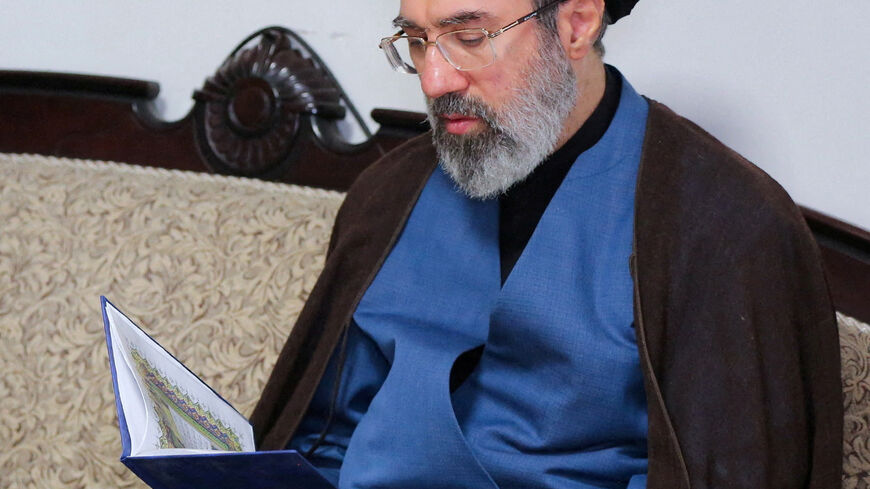
Khamenei, the late supreme leader’s 56-year-old second son, is a cleric who has largely operated behind the scenes in Iran’s political and religious establishment.
Reports of his potential succession — along with an AI-generated video which showed a fake inaugural speech by Mojtaba Khamenei — have circulated since Ali Khamenei was killed during US and Israeli strikes on Iran on Saturday. The strike also reportedly killed Mojtaba’s wife, Zahra Haddad Adel, with whom he reportedly has three children. He has not been seen publicly since the attack.
Early life
Born in 1969 in the northeastern city of Mashhad, Khamenei grew up as his father rose through the ranks of Iran’s revolutionary movement against strongman Shah Mohammad Reza Pahlavi.
He spent much of his childhood in the northwestern city of Sardasht and in Mahabad, where he received his early schooling. Following the 1979 Islamic Revolution, his family relocated to Tehran as his father rose in national politics, eventually becoming Iran’s supreme leader in 1989.
After graduating from high school in Tehran, he studied Islamic theology. His first teachers were his own father and Ayatollah Mahmoud Hashemi Shahroudi, who would later become Iran’s judiciary chief, chairman of Iran’s Assembly of Experts and later the country’s powerful Expediency Council. Shahroudi also taught former Hezbollah chief Hassan Nasrallah.
In 1986, at the age of 17 and while his father was president of Iran, Mojtaba Khamenei reportedly joined the Habib ibn Mazahir Battalion to serve in the Iran-Iraq War. The battalion was under the Islamic Revolutionary Guard Corps’ 27th Mohammad Rasulullah Division, Tehran's own division.
Many members of the Habib Battalion went on to hold powerful positions in the IRGC, including its paramilitary volunteer militia, the Basij, and Iran’s intelligence apparatus. Mojtaba’s service in it is believed to have helped establish his longstanding ties to the IRGC.
In 1999, he moved to Qom to become a cleric. He was taught there by clerics including Ayatollah Lotfollah Safi Golpayegani, ultraconservative cleric and political theorist Mesbah Yazdi and Ayatollah Sayyed Mohsen Kharrazi.
He began teaching advanced jurisprudence at the Qom seminary in 2009, a role generally seen as a marker of clerical experience that may have bolstered his standing as a potential successor. In 2024, however, he suspended his religious lectures at Qom.
Mojtaba Khamenei, the son of Iran's Supreme Leader who's widely known as his possible successor, announced in his online class that he will be discontinuing his "Advanced Islamic Jurisprudence and Principles" class after 13 years.
— Iran International English (@IranIntl_En) September 22, 2024
He's said his decision to cancel the class is… pic.twitter.com/SEFpICapl8
Reports of his clerical rank vary. He has long been thought to hold the rank of hojjatoleslam, one level below ayatollah, but in 2022, the Qom seminary website referred to him as ayatollah for the first time.
Iran’s constitution says the supreme leader should be a learned Islamic scholar, but Mojtaba’s father was elevated to supreme leader in 1989 despite holding the rank of hojjatoleslam at the time. The constitution was subsequently amended to reduce the formal theological qualifications needed for the post.
Influence
Mojtaba Khamenei has long been viewed as an influential figure within his father’s inner circle despite holding no formal government position. He is believed to have exercised significant influence through the networks surrounding his father’s office and affiliated security networks.
He has also reportedly played a role in the oversight of the Islamic Republic of Iran Broadcasting, the state-run media organization.
Beginning in the 2000s, reports described Mojtaba as an emerging political power broker.
Mehdi Karroubi, a former speaker of parliament and a Reformist presidential candidate in 2005, publicly accused Mojtaba of generating and mobilizing support for the candidacy of ultraconservative politician Mahmoud Ahmadinejad by illegally involving mosques, the IRGC and the Basij. Karroubi said that Mojtaba had initially backed Mohammad Bagher Ghalibaf, the current speaker of the parliament who is reportedly close to Mojtaba Khamenei, before shifting support to Ahmadinejad.
Ahmadinejad’s disputed reelection in 2009 sparked mass demonstrations known as the Green Movement, one of the largest protest waves since the 1979 Islamic Revolution.
In 2019, the US Treasury Department imposed sanctions on Mojtaba, saying he had worked closely with the head of the IRGC's Quds Force and the Basij to "advance his father’s destabilizing regional ambitions and oppressive domestic objectives."
The Basij has been a key force for the government's suppression of dissent, playing a major role in the violent crackdown on nationwide protests in January.
In late January, Bloomberg reported that Mojtaba Khamenei oversaw his family’s shadowy "sprawling investment empire," including Swiss bank accounts and luxury properties in Europe.
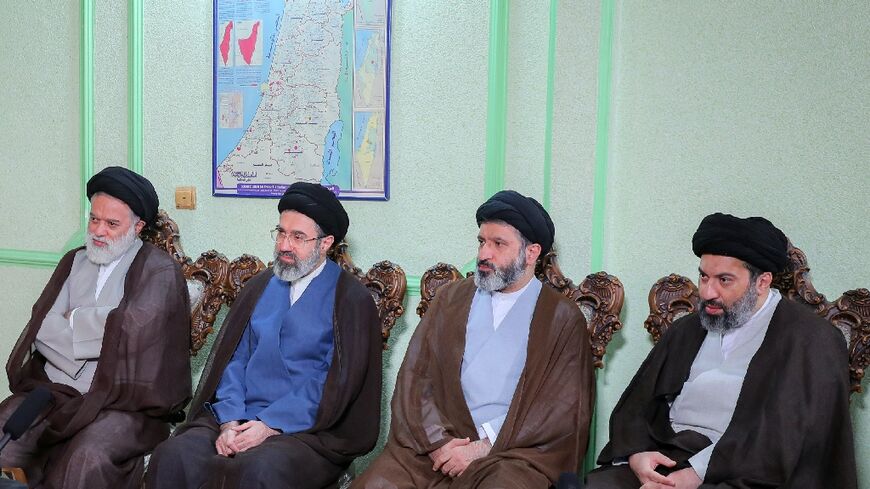
Public appearances in 2024 suggest that Mojtaba maintains ties with senior leaders of Hezbollah, the militant group mainly operating in Lebanon that has long been backed and armed by the IRGC. After Israel killed the group's longtime leader, Hassan Nasrallah, in September 2024, Iranian media published photographs of Mojtaba meeting at Hezbollah's office in Tehran with Abdullah Safieddine, the brother of Hashem Safieddine, who headed Hezbollah's executive council before he was killed by Israel the following month.
Around that time, Mojtaba was separately photographed visiting Hezbollah operatives wounded in Israel's September 2024 pager attack, a hospital visit he made alongside his brothers, reportedly on behalf of their father.
Other candidates
Under Iran’s constitution, the supreme leader is selected by the Assembly of Experts, an 88-member clerical body. The assembly deliberates privately over clerics who meet constitutional qualifications and, per the constitution, must choose a new leader "within the shortest possible time."
On Tuesday, Israel said it struck the Assembly of Experts building, but it was unclear if any of the body's members were in the building at the time. Iranian media, along with Israel's Channel 12, have reported that none of the assembly's 88 members were in the building at the time of the strike.
Other names under consideration include Alireza Arafi, 67, a senior cleric and head of Iran’s seminaries; Sadegh Larijani, 64, former judiciary chief and head of the Expediency Council; and Gholam-Hossein Mohseni-Ejei, 69, a current judiciary chief with decades of experience in intelligence and prosecutorial roles. Also being floated is the more moderate Hassan Khomeini, 53-year old grandson of Ayatollah Ruhollah Khomeini.
If Mojtaba is chosen, it will be the first time Iran’s highest office remains in the same family.
The next supreme leader will likely have a target on his back. Speaking at the White House on Wednesday, Trump said that Iran’s leadership is "rapidly going," adding, "Everybody that seems to want to be a leader, they end up dead."
Also on Wednesday, Israeli Defense Minister Israel Katz wrote in a post on X, "Every leader appointed by the Iranian terror regime to continue and lead the plan to destroy Israel, to threaten the United States and the free world and the countries of the region and to suppress the Iranian people, will be an unequivocal target for elimination."