



Rubio sees G7 building 'coalition' against Iran strait control


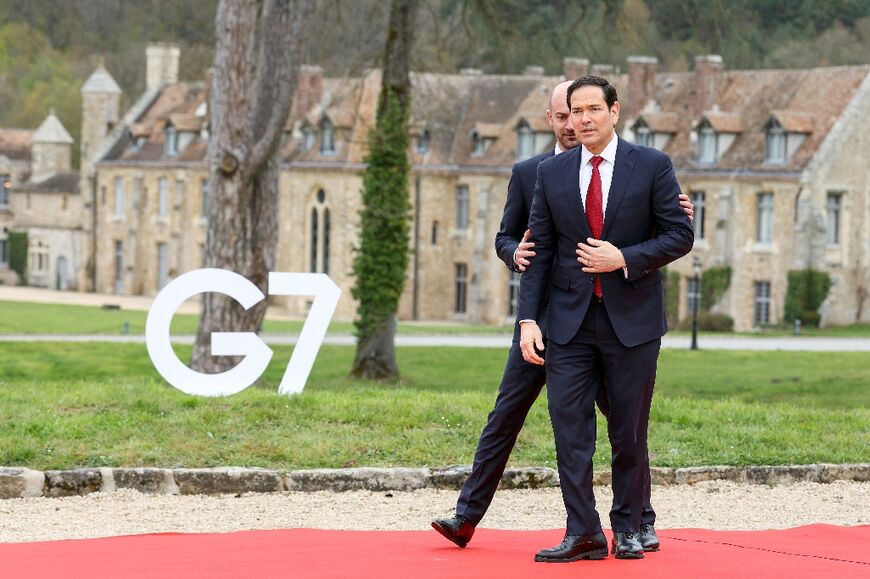
US Secretary of State Marco Rubio said Friday he saw European readiness to help form a coalition against Iranian control of the strategic Strait of Hormuz after US-Israeli attacks unleashed a regional war.
Rubio joined top diplomats from the Group of Seven powers for talks as he assured them that the war launched a month ago would only continue for a matter of weeks.
The top US diplomat voiced alarm that Iran would seek to establish a permanent "tolling system" for vessels in the Strait of Hormuz, the narrow waterway through which one fifth of global oil normally transits.
"Not only is this illegal, it's unacceptable, it's dangerous to the world, and it's important that the world have a plan to confront it," Rubio told reporters after the meeting in a historic abbey on the outskirts of Paris.
He said he had found "a lot of buy-in" to opposing any Iranian tolling, with Britain taking a leading role.
"We're willing to be a part of that coalition, but we've encouraged others to sort of put it together," he said.
The Strait of Hormuz was open to international shipping before the conflict, but has since ground to a standstill, leading to a surge in global energy prices.
Rubio said that the opposition to tolling was part of planning for the immediate aftermath of the war, which has failed to dislodge the Islamic republic, despite the killing of top leaders.
A final communique on the war in the Middle East from the G7 ministers called for "an immediate cessation of attacks against civilians and civilian infrastructure".
"There can be no justification for the deliberate targeting of civilians in situations of armed conflict as well as attacks on diplomatic facilities," it said.
US President Donald Trump had threatened to strike Iranian energy facilities, but subsequently rowed back that warning to give Tehran more time for talks he said were taking place.
It was Rubio's first trip abroad since the war. Key US ally Saudi Arabia joined in the talks.
Before leaving France, Rubio told reporters the US expected to finish Iran operations in the "next couple of weeks".
He said Tehran had not yet responded to a plan to end the war.
But "we've had an exchange of messages and indications from the Iranian system -- whatever's left of it -- about a willingness to talk about certain things," he added.
- 'Global economy hostage' -
The G7 meeting was dominated by uncertainty over the current US strategy in the Middle East conflict.
"The Iranian regime would be well advised to enter into serious negotiations with the United States now," German Foreign Minister Johann Wadephul said after the meeting.
Wadephul said the international community needed to collaborate even more closely now it was dealing with two wars in which Russia and Iran were cooperating -- including the conflict sparked by Moscow's 2022 invasion of Ukraine.
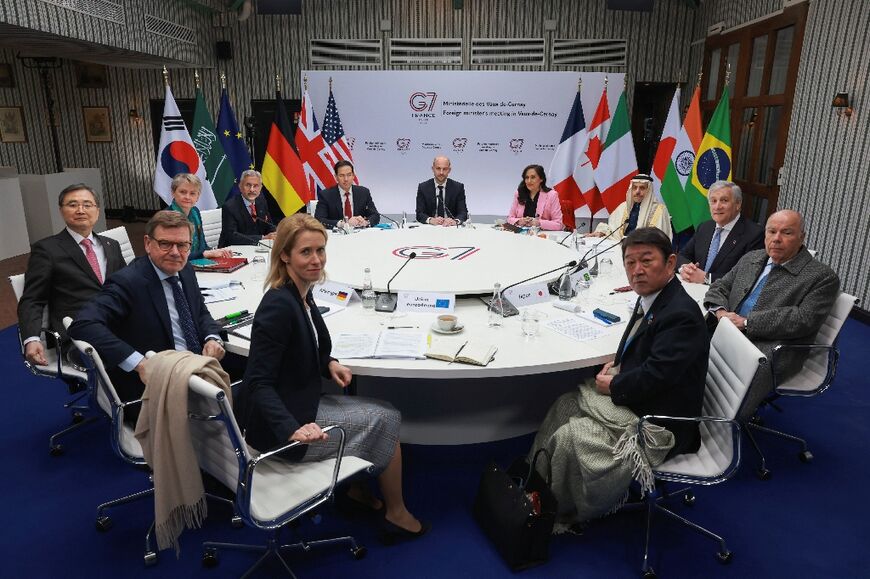
"We need to strengthen our unity," he told reporters.
The UK's foreign minister Yvette Cooper urged a "swift resolution to this conflict that restores regional stability".
"Iran cannot be able to just hold the global economy hostage," she said.
The final statement said ministers had "reiterated the absolute necessity to permanently restore safe and toll-free freedom of navigation in the Strait of Hormuz".
- 'Play into Putin's hands' -
With Ukraine's Foreign Minister Andrii Sybiha in attendance, European ministers were keen to emphasise support for Kyiv must not be forgotten.
"Putin is cynically hoping that the escalation in the Middle East will divert our attention from his crimes in Ukraine," Wadephul said.
"This calculation must not succeed," he said, warning that any compromising on Ukraine's defence capabilities would "play into Putin's hands".
But Rubio said that Russia had not impeded the US war effort and said that the United States was willing to divert Western weapons for Ukraine to help the United States fight Iran.
"If we need something for America and it's American, we're going to keep it for America first," Rubio said.
The elite G7 club -- whose origins go back to the first G6 summit held in the nearby Chateau de Rambouillet in 1975 -- comprises Canada, Germany, France, Italy, Japan, UK and United States.
This one's on us.
The story doesn't end here.
Our correspondents are already on the next chapter. Read everything they file, from $2/week.
See Offers