

From Nixon to Trump: A look at US presidential visits to the Gulf
Subscribe for as low as
$2/week
to access this story and all reporting.
By entering your email, you agree to receive AL-MONITOR's daily newsletter and occasional marketing messages.
Why AL-MONITOR?
AL-MONITOR is an award-winning media outlet covering the Middle East, valued for its independence, diversity and analysis. It is read widely by US, international and Middle East decision makers at the highest levels, as well as by media, thought and business leaders and academia.
Read by
Live news & notifications
Follow over 100 expert journalists based across the region and get notified in real time of breaking stories and exclusives. *Expanded coverage on Energy & Defense sectors.
Premier analysis of the Middle East
Access the sharpest and most diverse regional minds giving you all the angles on regional trends.
Live events & video
Priority access to roundtables, summits and other events alongside AL-MONITOR's global community of regional influencers.
Specialized Newsletters
Get timely reporting on key countries and sectors with up to 10 daily and weekly newsletters straight to your inbox.
Big, exclusive interviews
Follow conversations with the region's biggest names in politics and business.
AL-MONITOR archives since 2012
Access a repository of over a decade's worth of regional coverage, insights and trends.
Subscribe for unlimited access
By becoming an AL-MONITOR subscriber, you drive our team’s rigorous and independent journalism spanning the Middle East.
From Nixon to Trump: A look at US presidential visits to the Gulf
As Trump prepares for his visit to Saudi Arabia, Qatar and the United Arab Emirates, Al-Monitor looks back at the history of US presidential trips to the Gulf.

President Donald Trump is greeted by Air Force Col. Paul R. Pawluk as he arrives to board Air Force One on May 12, 2025, at Joint Base Andrews, Maryland. — Win McNamee/Getty Images
WASHINGTON — President Donald Trump is heading back to the Gulf on Tuesday, with planned stops in Saudi Arabia, Qatar and the United Arab Emirates, revisiting the region that hosted his first foreign trip in office and where he signed the largest arms deal in American history with Saudi Arabia.
Trump’s return underscores the longstanding importance of the Gulf in US foreign policy in the Middle East. US presidential visits to the Gulf began with Richard Nixon’s historic visit to Saudi Arabia in 1974 and continued through the years as other presidents navigated war, diplomacy and oil in the region.
President Richard Nixon became the first sitting US president to visit the Gulf when he landed in Saudi Arabia on June 14, 1974. The visit was part of a tour that included stops in Iran, Egypt, Syria and Israel. While in Riyadh, Nixon met with Saudi Arabia’s King Faisal, seeking to stabilize relations in the aftermath of the 1973 oil embargo, when Arab oil producers cut exports to the US in retaliation for its support of Israel during the Yom Kippur War, causing fuel shortages and economic turmoil in the West.
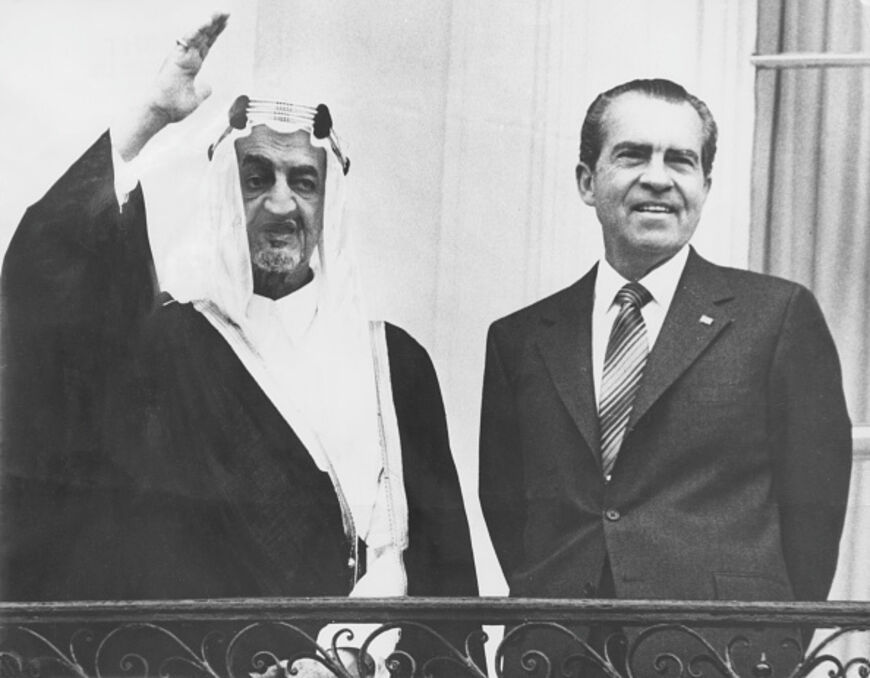
US President Richard Nixon (R)) with King Faisal of Saudi Arabia (L) meet on the South Portico of the White House in Washington on June 2, 1971. (Keystone/Hulton Archive/Getty Images)
Four years later, President Jimmy Carter followed suit, visiting Saudi Arabia in January 1978. He met King Khalid and Crown Prince Fahd and also made stops in Iran and Egypt.
During the Gulf War, in a show of solidarity with coalition forces, President George H.W. Bush visited Saudi Arabia in November 1990. He met King Fahd and the Emir of Kuwait and delivered a speech to American and British troops stationed near Dhahran in eastern Saudi Arabia. He returned for a final meeting with King Fahd on Dec. 31, 1992, just weeks before leaving office, to address stability in the region in the aftermath of the Gulf War.
President Bill Clinton carried the baton into the post-Cold War era. On Oct. 28, 1994, he visited Kuwait, meeting with Emir Jaber Al-Ahmad Al-Sabah and addressing US troops still stationed in the country following Operation Desert Storm, the 1991 military campaign to expel Iraqi forces from Kuwait after Saddam Hussein's invasion during the second phase of the Gulf War. In his second term, Clinton became the first and only sitting US President to visit Oman in 2000, where he met with Sultan Qaboos bin Said in Muscat. The meeting was reportedly a last-minute arrangement, with the two leaders meeting at the airport.
Sultan Qaboos of Oman escorts US President Bill Clinton upon his arrival on March 25, 2000, to Oman airport. Clinton made a stopover in Oman on his way to Geneva for talks with Syrian President Hafez al-Assad on the Middle East peace process. (Photo by MOHAMMED MAHJOUB/AFP via Getty Images)
The presidency of George W. Bush saw a significant uptick in presidential visits to the Gulf following the September 11 attacks and amid wars in Iraq and Afghanistan. Bush became the first sitting US president to visit Qatar in June 2003, during which he met with Emir Hamad bin Khalifa Al Thani and visited US Central Command headquarters in Doha, where he addressed military personnel.
US President George W. Bush (R) is greeted by the emir of Qatar Sheikh Hamad bin Khalifa Al Thani in Doha on June 5, 2003. (Photo by KHALED MOUFTAH/AFP via Getty Images)
In January 2008, Bush toured Kuwait, Bahrain, the UAE and Saudi Arabia. His tour included meetings in Bahrain with King Hamad Bin Isa Al Khalifa, and in the United Arab Emirates, where he met with President Khalifa Bin Zayed Al Nahyan and Prime Minister Mohammed bin Rashid Al Maktoum. On this visit, Bush became the first sitting US President to visit both Bahrain and the UAE. In Kuwait, he met with high level US military officials in the country, addressed troops at Camp Arifjan and held talks with Emir Sabah Al-Ahmad Al-Jaber Al-Sabah.
Abu Dhabi Crown Prince Sheikh Mohammed Bin Zayed Al Nahyan (R) looks on as US President George W. Bush holds a falcon at the the Royal Stables of the Al-Asayel Racing and Equestrian Club in Suwaihan on Jan. 13, 2008. (MANDEL NGAN/AFP via Getty Images)
His last Gulf stop on that visit was in Saudi Arabia, where he met with King Abdullah in Riyadh. He held another meeting in Riyadh with the Saudi leader later that year in May. The visits came even as tensions lingered over issues such as oil prices and counterterrorism cooperation. The meetings were set against the backdrop of ongoing scrutiny of Saudi Arabia’s role in the September 11 attacks, as 15 of the 19 hijackers were Saudi nationals.
President Barack Obama first visited Saudi Arabia in June 2009, meeting with Saudi King Abdullah in Riyadh just a day ahead of Obama's landmark speech in Cairo on June 4, in which he called for a "new beginning" between the United States and the Muslim world.
US President Barack Obama and Saudi King Abdullah bin Abdul Aziz Al Saud (R) share a laugh during a welcoming reception at the king's ranch in al-Janadriya on the outskirts of Riyadh, on June 3, 2009. (MANDEL NGAN/AFP via Getty Images)
He returned in March 2014 to meet with King Abdullah during a period of heightened regional turbulence linked to the aftermath of the Arab Spring and to discuss Iran's regional activities, and again in January 2015 following the death of King Abdullah, where he met with newly crowned King Salman in Riyadh. During his final year in office, Obama attended a Gulf Cooperation Council summit in Riyadh in April 2016, focusing on counterterrorism and the freshly implemented Iran nuclear deal that Gulf states were notably wary of.
US President Barack Obama (R) speaks with Sheikh Mohammed bin Zayed Al Nahyan (L), the crown prince of Abu Dhabi, during the US-Gulf Cooperation Council Summit in Riyadh, on April 21, 2016. (JIM WATSON/AFP via Getty Images)
During his first term, current President Donald Trump chose Riyadh as the destination for his first foreign visit, arriving in Saudi Arabia on May 20, 2017. Trump met with King Salman and also with GCC leaders at the Arab Islamic American Summit in Riyadh. During his visit to Saudi Arabia, he signed a $350 billion arms deal with the kingdom — the largest arms deal in history.
US President Donald Trump (C) and Saudi Arabia's King Salman bin Abdulaziz Al Saud (R) and Crown Prince of Abu Dhabi Mohammed bin Zayed Al Nahyan (L) pose for a group photo in Riyadh on May 21, 2017. (MANDEL NGAN/AFP via Getty Images)
While his visits were limited to Saudi Arabia during his first term, Trump’s Gulf engagement extended beyond the kingdom. His first administration signed the Abraham Accords, which saw the UAE and Bahrain normalize relations with Israel. Trump has previously said that he aims to bring Saudi Arabia into the fold of this agreement, but the war in Gaza has complicated any such plans, as Saudi Arabia has said normalization is contingent on a path to Palestinian statehood.
President Joe Biden, for his part, made his own regional diplomatic push in July 2022, traveling to Jeddah to deliver a speech to the Gulf Cooperation Council +3 (Egypt, Iraq and Jordan) summit. There he met Crown Prince Mohammed bin Salman, a policy reversal after saying he would make Saudi Arabia a "pariah" state following the 2018 killing of columnist Jamal Khashoggi. The reversal reflected a strategic shift, as Biden sought Gulf cooperation on stabilizing global energy markets in the wake of Russia's invasion of Ukraine.
US President Joe Biden (L) and Saudi Crown Prince Mohammed bin Salman (R) arrive for the family photo during the Jeddah Security and Development Summit in Saudi Arabia's Red Sea coastal city of Jeddah, on July 16, 2022. (Photo by MANDEL NGAN/AFP via Getty Images)
You're reading a free AL-MONITOR Original
Want more like this?
AL-MONITOR All-Access gives you unlimited access to all our journalism, the full Daily Briefing, exclusive interviews, premium newsletters, and live events — for less than $2/week.
