



Three ways Saudi-Turkey-Pakistan pact could benefit China

Hi, readers:
Nearly six months into the US war in Iran and with no clear exit strategy for Washington, a new security reality is emerging in the Gulf, one that plays into China’s hands and its vision for the region.
Part of that new architecture was on display in Mecca last week, where Saudi Arabia, Pakistan and Turkey signed a new defense pact. Beijing is not a signatory but it could stand to benefit from the agreement.
Let’s dig in,

Leading this week
Last Friday, the leaders of Saudi Arabia, Turkey and Pakistan signed a joint defense agreement that commits the three countries to treating an armed attack against one as an armed attack against all. The agreement, dubbed the Mecca pact, calls for greater military coordination, including intelligence sharing, training, logistics and defense industry cooperation.
The pact’s practical significance remains uncertain, but it reflects an effort by regional powers to forge security arrangements that do not depend entirely on the United States.
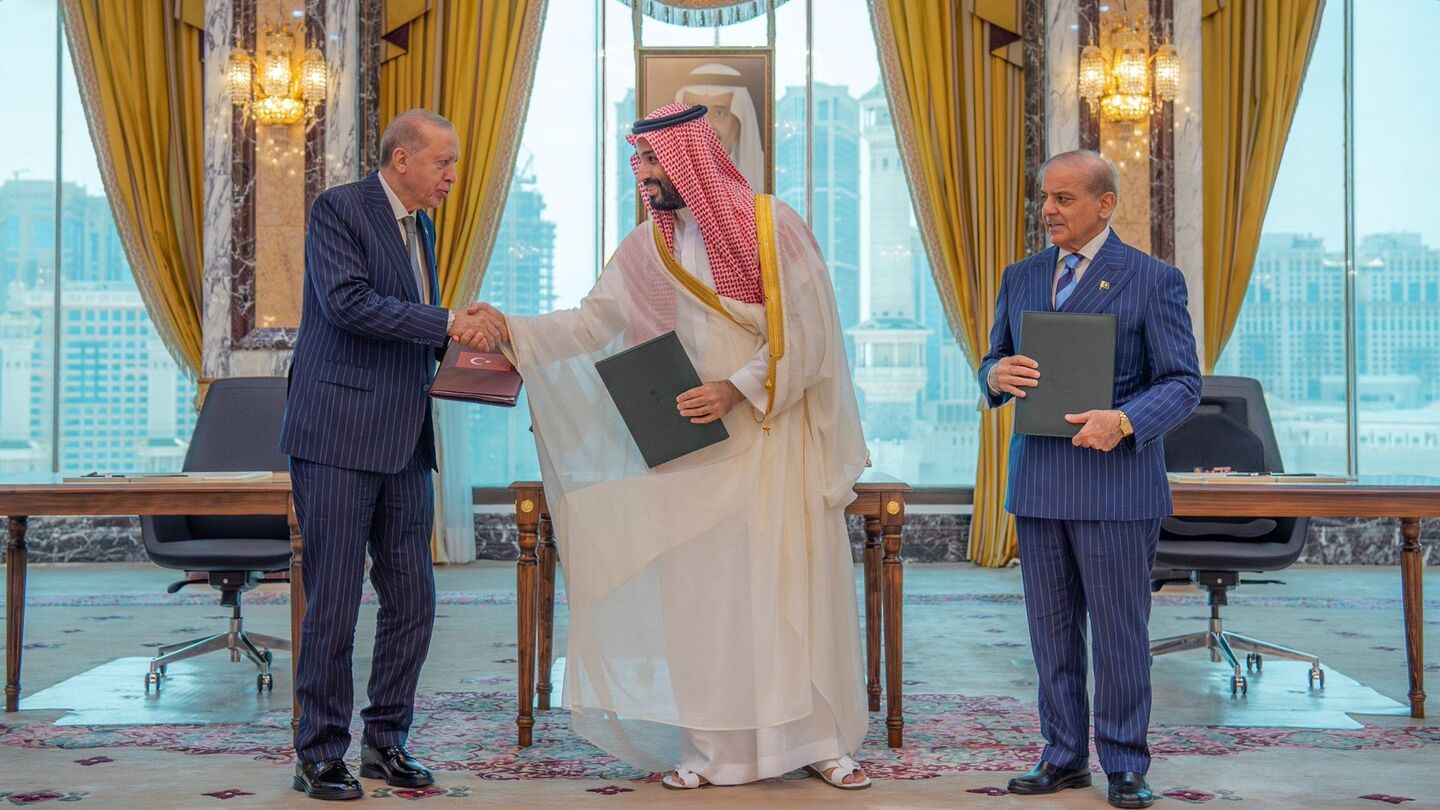
Saudi Crown Prince Mohammed bin Salman, Turkish President Recep Tayyip Erdogan and Pakistani Prime Minister Shehbaz Sharif sign the Mecca Joint Defense Agreement in Mecca on Aug. 7, 2026. — (Saudi Foreign Ministry)
An opening for China
China has not officially endorsed the pact, but its state-run Xinhua news agency highlighted the agreement as a response to rising regional security concerns. More broadly, the pact fits Beijing’s long-running argument that Middle Eastern states should play a leading role in shaping regional security, rather than relying on an external power. China has promoted what it calls “common, comprehensive, cooperative and sustainable security,” while arguing for a regional security architecture less dominated by outside actors.
There are three ways Beijing could benefit from the agreement.

1. Diversification away from the United States: Yun Sun, senior fellow and director of the China Program at the Stimson Center, told Al-Monitor, “So far, the pact has been viewed positively by China because it represents a diversification of security arrangement in the Middle East, which diminishes the central role of US as the security provider.”
Sun said that China “has been calling for a regional organic security arrangement that is more independent from US influence.”
Beijing has advanced versions of this idea for years. In 2022, during President Xi Jinping’s visit to Saudi Arabia, China said it would support Gulf states in maintaining their security and building a “new and comprehensive” security architecture for the Gulf. Chinese officials and scholars have also framed greater regional responsibility as a form of burden-sharing: Regional states provide more of their own security while outside powers play a less central role.
This does not mean Beijing is looking to replace Washington as the region’s security guarantor. China lacks both the regional military presence and, so far, the appetite to take on that role. But a more diversified security landscape could give Beijing more room to deepen relationships that are already expanding across the region.
The pact comes as Washington faces growing questions about the durability of its military posture in the Middle East. The US still maintains a substantial network of bases and forces across the Gulf and elsewhere in the region, but the war with Iran has exposed the vulnerabilities of that footprint. US military installations have come under repeated Iranian missile and drone attacks, prompting debate in Washington and among Gulf states about whether the US military presence needs to be reconfigured.
For China, the opportunity is as political as it is military. A region in which Gulf states diversify their defense partnerships can be more receptive to Chinese diplomacy, arms sales, technology and investment without requiring Beijing to provide the kind of alliance guarantee that Washington has long supplied.

2. The Pakistan card: Pakistan is one of Beijing’s closest defense partners and a major recipient of Chinese arms. The two countries have developed extensive cooperation, ranging from fighter aircraft and submarines to joint drone production. For example, Pakistan’s JF-17 fighter aircraft, which serves as the backbone of its air force, was jointly developed by the Pakistan Aeronautical Complex and China’s Chengdu Aircraft Industry Group.
Pakistan is also the only nuclear power in the pact. “Given China’s overwhelming influence over Pakistan, this indirectly contributes to the increase of Chinese influence,” Sun said.
During a May meeting with Pakistani Prime Minister Shehbaz Sharif, Chinese President Xi Jinping hailed China's relationship with Pakistan as "unbreakable."
As Pakistan becomes more integrated into Gulf security arrangements, Chinese-built systems, training and maintenance networks could gain a wider role in the region.
Saudi Arabia has expanded military and economic cooperation with China in recent years. In March, reports indicated that Riyadh and Beijing had reached a $5 billion agreement to establish a production line for Chinese Wing Loong-3 combat drones in Jeddah. Neither government has publicly confirmed the arrangement, but such a deal would mean a shift from Saudi Arabia simply purchasing Chinese equipment toward producing it locally, deepening Beijing’s footprint in the kingdom’s defense industry.
Turkey, meanwhile, has increasingly prioritized its domestic defense industry and broadened its strategic relationships. Its defense partnership with Pakistan is already substantial, while Saudi Arabia is a major buyer of Turkish drones. For China, that creates a potential opening for overlapping supply chains and joint projects among the three pact members, even if Turkey’s defense ties with China remain less developed than Beijing’s relationship with Pakistan.

3. More defense sales for China: The Iran war has highlighted the centrality of drones, missiles and air defense in Gulf security. China is well positioned to compete in that market because it can offer relatively affordable armed drones, air-defense systems and, increasingly, local production and technology partnerships.
The reported Wing Loong-3 project in Saudi Arabia illustrates the appeal of that model. Rather than simply selling a finished platform, China could become embedded in Saudi Arabia’s training, maintenance, supply chain and industrial infrastructure. The reported Jeddah facility would produce roughly 48 drones a year.
The Mecca pact could make such possibilities more attractive. Greater defense coordination among Saudi Arabia, Pakistan and Turkey may create demand for interoperable systems, shared training and industrial cooperation. Pakistan’s longstanding use of Chinese equipment gives Beijing an inside track in one member state, while Saudi Arabia’s reported drone-production plans could give it a larger industrial foothold in another.

Our take: The pact does not mark a break with the United States. Its members have stressed that it is defensive and does not replace existing agreements, including their arrangements with Washington and NATO.
But it does point to a more multipolar Middle Eastern security order, one in which Washington is no longer the unquestioned center of Gulf security. That shift works in China’s favor: Beijing can expand its political influence, arms exports and defense-industrial ties while regional states assume more responsibility for their own security.

Photo of the week
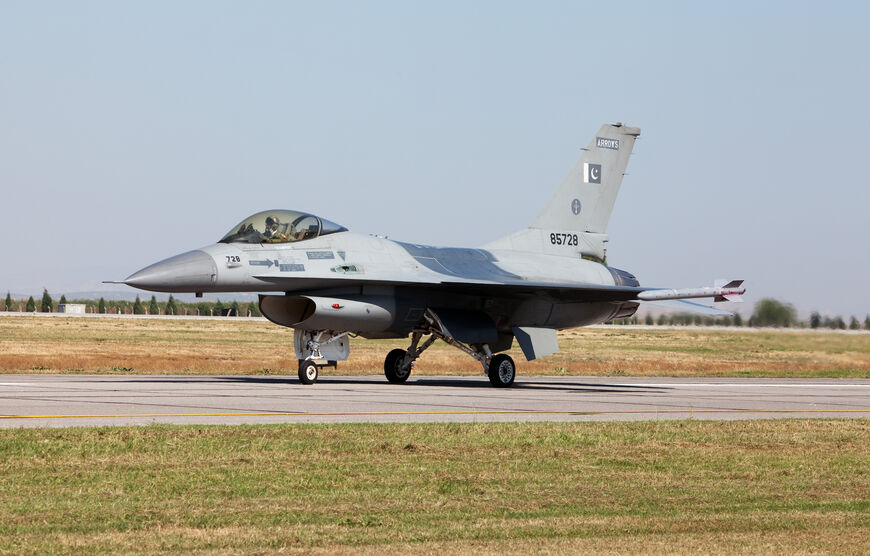
A Pakistani JF-17 combat aircraft stands on the runway after completing a demonstration flight. (Getty)
Deals and visits ✈️
- China sends new naval escort fleet to Gulf of Aden, Somali waters
- China’s Huawei, Saudi Arabia’s Zain KSA launch new optical network
- Algerian energy minister meets delegation from China’s Baowu Steel Group
- China Harbor Engineering Co. wins contract for solar power plant in Morocco
- UAE to receive shipment of over 6,000 BYD vehicles via new direct shipping route between Shenzhen and Sharjah
- Chinese AI company signs partnership with Egyptian tech retailer
- Chinese envoy expresses concern over recent escalation in West Bank and Gaza

What we are reading
- Zhu Rongji, former premier who pushed China to a market economy, dies at 97: The New York Times
- China’s great jobs squeeze: Financial Times
- How China’s big push to win back tourists is paying off: Bloomberg
This one's on us.
The story doesn't end here.
Our correspondents are already on the next chapter. Read everything they file, from $2/week.
See Offers