



Top Oman official visits China
Secretary-General of Oman’s National Security Council Idris Abdulrahman Al Kindi visited China just last week, less than a month after a meeting between Omani Foreign Minister Sayyid Badr Al Busaidi and China’s special envoy to the Middle East, Zhai Jun.


Hi, readers:
Since President Donald Trump threatened in May to bomb Oman — a longtime US partner and historic mediator in Middle East conflicts — diplomatic traffic between Beijing and Muscat has increased.
Secretary-General of Oman’s National Security Council Idris Abdulrahman Al Kindi visited China just last week, less than a month after a meeting between Omani Foreign Minister Sayyid Badr Al Busaidi and China’s special envoy to the Middle East, Zhai Jun.
As Muscat faces growing pressure from the Trump administration, could it be tilting east? Let's unpack.
Thanks for reading!

Leading this week
On July 8, 2026, Vice Chinese Foreign Minister Miao Deyu met with Omani National Security Council Secretary-General Idris Abdulrahman Al Kindi.
A statement from China's Foreign Ministry following the meeting said that China "stands ready to work with the Omani side to continue to firmly support each other on issues concerning each other's core interests, deepen the alignment between the Belt and Road Initiative and Oman Vision 2040" and "jointly safeguard regional peace and stability."
The two officials also "had in-depth exchanges on regional hotspot issues of common concern," the ministry said.
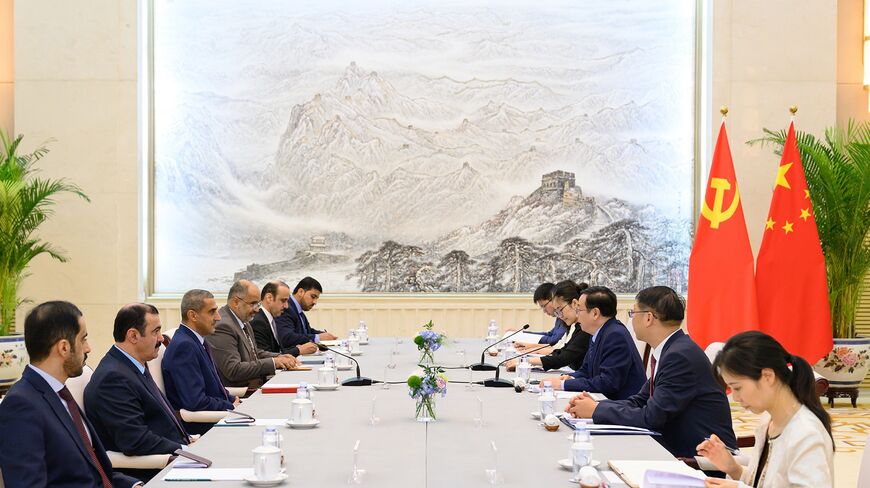
Jin Xin, deputy minister of the International Department of the CPC Central Committee (C-L), meets with Idris Abdulrahman Al Kindi, Secretary-General of the National Security Council of Oman (C-R) and their respective teams in Beijing on July 10, 2026. Credit: International Department of the CPC Central Committee
Al Kindi also met with Jin Xin, vice minister of the International Department of the CPC Central Committee, who told the Omani official that the IDCPC is "ready to develop exchanges and cooperation with the Omani National Security Council," according to a statement.
The statement added that Oman’s National Security Council hopes to "learn from the CPC's concepts on state governance and administration as well as the development experience, and promote cooperation between Oman and China in such fields as economy and trade, investment, industrial parks and tourism."
The war with Iran may have made a lasting dent in US credibility across the region, especially among Gulf states that were directly exposed to Iranian drones and missiles. That has pushed Saudi Arabia and others to look harder at their own security architecture and to seek out partners that can provide leverage in trying to contain a less predictable Iran. That does not mean Saudi Arabia is abandoning the United States. But the war has offered lesson in the Gulf: When regional security is in flux, dependence on a single power is not a sound option.

US-Oman tensions
High-level engagement between Muscat and Beijing is growing while Oman's relationship with Washington is under increasing strain. Once close partners, the relationship has soured since the US-Israel war with Iran. The main point of friction is the Strait of Hormuz, the strategic waterway Oman shares with Iran.
The southern shore of the strait lies along Oman's Musandam Peninsula. Before the war, Hormuz carried roughly a quarter of the global seaborne oil trade. International shipping lanes pass through Omani territorial waters, giving Muscat a key role in any discussions over the strait's future administration.
Trump said during a White House cabinet meeting in late May that if Oman sought to control the Strait of Hormuz alongside Iran, "we'll have to blow them up."
The memorandum of understanding signed by Iran and the US in mid-June included a provision for Tehran and Muscat to "conduct dialogue" on "the future administration and maritime services" of the Strait of Hormuz, in consultation with other Gulf littoral states.
Later in June, Iranian Parliament Speaker Mohammad Bagher Ghalibaf met with Oman's prime minister, Sultan Haitham bin Tariq, in Muscat to discuss management of the waterway. The two sides agreed to establish a joint working group to negotiate arrangements for navigation, maritime services and "the costs associated with them in accordance with international standards."
The Wall Street Journal reported last month that Washington viewed Oman’s approach toward Tehran as at odds with US interests. Citing US and Arab officials, the newspaper said the Trump administration had pressed Oman to choose sides and consider cutting diplomatic ties with Iran.
Omani officials did not comment on the report. But in a recent op-ed for Le Monde, Busaidi called for the recalibration of Oman’s ties with the US.
"At a minimum," Busaidi wrote, the new reality "requires a clear-eyed assessment of relationships with major partners such as the United States." He went as far as naming Israel as the most destabilizing force for Gulf security.
"The most serious threats to Gulf security do not originate within the region itself but from decisions made outside it, above all in Tel Aviv," the diplomat wrote.

🇨🇳 Muscat looks eastward
For decades, the relationship between Beijing and Muscat has been "primarily driven by trade," Jalal Al-Shukaili, a foreign policy scholar based in Muscat, told Al-Monitor.
According to China's Foreign Ministry, bilateral trade reached $36.7 billion in 2024. China is Oman’s largest trading partner, while Oman is China's fourth-largest trading partner among Arab states.
By comparison, Oman-US trade totaled just $4.3 billion in 2024, according to the US Trade Representative.
Shukaili argued that political ties have remained steady but secondary. Unlike many Gulf counterparts, "There have been no state visits between the leaders of the two countries, and military cooperation remains limited," Shukaili said.
Still, diplomatic engagement has continued. Chinese Foreign Minister Wang Yi visited Oman in 2021, Busaidi traveled to China in 2022 and Chinese President Xi Jinping met late Omani Deputy Prime Minister Sayyid Fahd bin Mahmoud Al Said during the China-GCC Summit in Riyadh later that year.
Oman is also China's fifth-largest supplier of crude oil. In 2024, China imported more than 40.7 million tons of Omani crude, according to China's Foreign Ministry.
Like other Gulf states, Oman hopes to diversify beyond oil through Vision 2040 by expanding logistics, tourism, technology and investment. China is an important partner in achieving those goals.
Last July, Future Fund Oman and Hong Kong-based Templewater launched Oman's first energy transition fund, investing $200 million in clean energy and low-carbon technologies.
China, meanwhile, sees Oman as a strategic Belt and Road partner for expanding trade routes and securing maritime access.

🏗️ China's foothold in Duqm
China's largest economic investment in Oman is the industrial park in Duqm.
Under a 2016 agreement, Beijing and Muscat established a 50-year lease to develop the industrial zone, backed by more than $10 billion in planned Chinese investment.
Speculation has grown that China could eventually seek a military presence in Oman. Bloomberg reported in 2023 that President Joe Biden had been briefed by US officials that Chinese military representatives had discussed a possible military facility with Omani counterparts.
"Some Western media outlets have speculated in recent years that China’s growing economic presence — particularly its investments in Omani ports — could eventually lead to a Chinese military foothold in Oman," Shukaili told Al-Monitor, but added that there is no publicly available evidence supporting those claims.
Meanwhile, Oman's Salalah port has served as a logistical stop for Chinese naval deployments since 2009, allowing ships to refuel and replenish supplies.

Our take: China's economic footprint in Oman is expanding, but its strategic influence remains limited. Beijing has become Muscat's leading trading partner, but has not replaced the United States as Oman’s principal security partner.
Muscat continues to host US forces under a longstanding facilities-access agreement expanded in 2019 to include Duqm and Salalah. According to the US State Department, Washington had 63 active foreign military sales agreements with Oman worth more than $2.7 billion as of January 2025. For Oman, though, recalibrating its ties with Washington after the Iran war means diversifying its partnerships — leaning more on European allies like France and deepening its relationship with China.

Photo of the week

A boy poses next to a statue of Argentinian footballer Lionel Messi at a shopping mall in Beijing on July 9, 2026. (ADEK BERRY / AFP via Getty Images)
Deals and visits ✈️
- Chinese UN envoy urges de-escalation between Saudi Arabia and Houthis in Yemen
- Saudi communications minister leads delegation on China tour
- Ruler of UAE’s Ras al Khaimah receives Chinese ambassador
- Chinese construction giant wins contract to build 55-story office tower in Kuwait
- UAE’s ADNOC chief tours China
- Saudi Arabia, China sign MoU to strengthen copyright protections
- Egyptian Electricity Ministry hosts delegation from China Southern Power Grid International
- Sudanese military says it shot down Chinese-made drone
- Libyan foreign minister meets with China’s ambassador to Libya

What we are reading
- China’s rulers have a woman problem: The Economist
- Plenty of players but no grassroots: Can China ever grow into a footballing giant?: The Guardian
- How China is winning friends and influencing people: Foreign Affairs
This one's on us.
The story doesn't end here.
Our correspondents are already on the next chapter. Read everything they file, from $2/week.
See Offers