A month of Israel-Hamas war has changed everything

One month after Israel was wracked by Hamas attacks, life has been upended for both the Palestinians and Israel after it launched a war of reprisal in the Gaza Strip.

The October 7 attacks by Hamas militants who stormed across from Gaza and struck kibbutzim and southern Israeli areas killed 1,400 people, mostly civilians, and deeply scarred the nation.

Images of charred and mutilated bodies invoked comparisons to the horror of the Holocaust, and the abduction of more than 240 people by the Hamas gunmen continues to stir political and emotional turmoil.

Mourners attend the funeral of a man killed in Hamas' attack on Kibbutz Beeri

Protesters slam Biden's Israel policy at pro-Palestinian march in Washington

Thousands of protesters in the US capital on Saturday called for a ceasefire in Gaza amid Israel's relentless bombing campaign, with some slamming President Joe Biden's support for Washington's top ally in the Middle East.

The rally, at which demonstrators waved Palestinian flags and wore the traditional keffiyeh scarf, was the largest protest in Washington since the beginning of the Israel-Hamas conflict on October 7.

"Free, free Palestine," and "End the siege on Gaza now," the protesters shouted.

Thousands of demonstrators rally in support of Palestinians in downtown Washington

Thousands in Israel protest government war response

Thousands demonstrated in Israel on Saturday, as pressure mounts on Prime Minister Benjamin Netanyahu over his government's lack of preparedness for the October 7 attacks and its handling of the ensuing hostage crisis.

The attacks by Gaza's ruling Islamist movement Hamas took the Israeli military and political establishment by surprise and killed more than 1,400 people, most of them civilians, with 240 more taken hostage, according to the army.

Security forces block a march by Israelis protesting the hard-right government's lack of preparedness for the October 7 attacks and its handling of the ensuing hostage crisis

AFP calls for investigation over strike on Gaza bureau

AFP on Saturday called on Israel for "an in-depth and transparent investigation" into the exact involvement of its army after a strike severely damaged its office in Gaza City, which has been shelled for weeks.

AFP "has taken note of the recent statements from the Israeli army spokesman concerning 'an army strike nearby (the AFP office) that might have caused debris'," it said in a statement.

A gaping hole is seen in the side of the building that houses the bureau of Agence France-Presse in Gaza City

Blinken reaffirms US support for 'humanitarian pauses' in Gaza war

Secretary of State Antony Blinken on Saturday reaffirmed US support for "humanitarian pauses" in fighting between Israel and Hamas to ensure people in the besieged Gaza Strip get help.

Speaking at a news conference in Amman about sparing civilians and speeding up aid deliveries, Blinken said: "The United States believes that all of these efforts will be facilitated by humanitarian pauses.

US Secretary of State Antony Blinken (C) arrives for a joint news conference in Amman with his Egyptian and Jordanian counterparts Sameh Shoukry (L) and Ayman Safadi

'I want my legs back': the child amputees of Gaza's war

Layan al-Baz cries in agony when the effect fades of the painkillers she receives after her legs were amputated -- the result of a strike on Gaza as Israel fights Hamas.

"I don't want a false leg," the 13-year-old Palestinian tells AFP in Khan Yunis's Nasser hospital, in the southern Gaza Strip, where getting artificial limbs was nearly impossible anyway.

The impoverished Palestinian territory, under a crippling Israeli-led blockade for years and besieged since war erupted on October 7, suffers severe shortages of food, water and fuel, and medical supplies are scarce.

Thirteen-year-old amputee Layan al-Baz receives treatment at the Nasser hospital in Khan Yunis

Anti-hijab protests 'changed Iran and its prisons', says freed researcher

The protest movement that erupted in Iran last year has transformed the country both outside and also inside prison, a French-Iranian academic, who returned to Paris last month after being held in the country since 2019, told AFP.

Fariba Adelkhah was finally allowed to leave Iran in October after a four-and-a-half year ordeal that began with her sudden arrest in 2019 and saw her spend years in Tehran's notorious Evin prison.

Adelkhah has spent much of the last half decade in an Iranian jail

Fierce fighting in Gaza as US envoy faces Arab anger

Israel battled into the fifth week Saturday of its war to crush Hamas, showing no signs of letting up even as US Secretary of State Antony Blinken faced a rising tide of anger in meetings with Arab foreign ministers.

Blinken reaffirmed US support for "humanitarian pauses" in the fighting in Gaza to ensure desperate civilians get help a day after Israel's hawkish Prime Minister Benjamin Netanyahu gave the idea short shrift.

However, US President Joe Biden said progress had been made on securing a so-called "humanitarian pause", without elaborating.

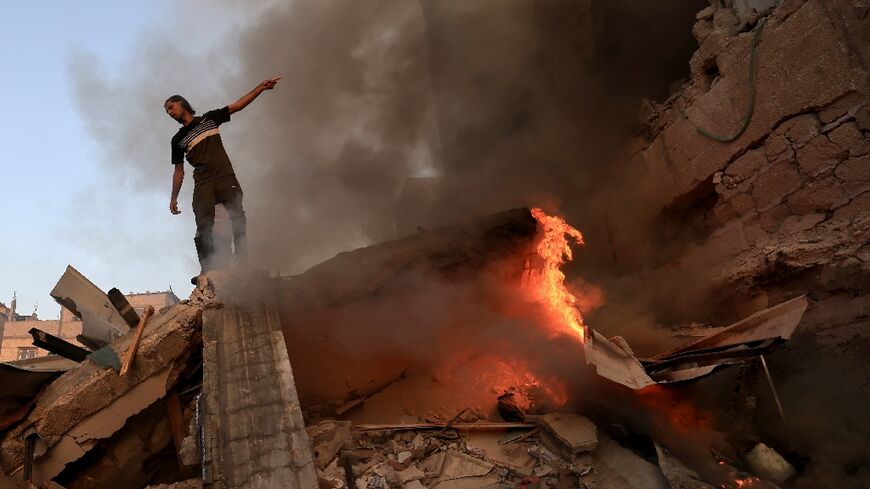
A man stands on the rubble of a collapsed building after a strike on Khan Yunis on November 4

Turkey recalls envoy to Israel, 'writes off' Netanyahu

Turkey said Saturday it was recalling its ambassador to Israel and breaking off contacts with Prime Minister Benjamin Netanyahu in protest at the bloodshed in Gaza.

Ankara announced the decisions on the eve of what promises to be a difficult visit to Turkey by US Secretary of State Antony Blinken.

Palestinian ally Turkey had been mending torn relations with Israel until last month's start of the Israel-Hamas war.

Turkish President Recep Tayyip Erdogan said he was 'writing off' Israeli Prime Minister Benjamin Netanyahu

Battling public mood, Turkey quietly assimilates Syrians

Like millions of other Syrians fleeing war, Mahmud Abdi came to Turkey hoping to return once the bloodshed ebbed.

Almost a decade later, the 30-year-old carpenter is looking to open his own workshop in the southeastern Turkish city of Sanliurfa, where a quarter of the two million inhabitants are Syrian.

"I've learned to handle new machines," said Abdi, who fled the Islamic State's short-lived "caliphate" in Syria's Raqqa. "After my course, I'm going to work for a furniture maker."

Polls show most Turks blaming Syrian migrants for their own economic problems