Fleeing Israel too, Ukrainian Jews seek refuge in Hungary

Rabbi Mendel Moscowitz from the northeastern city of Kharkiv never imagined his family would be forced to flee a second war after leaving Ukraine for Israel last year.

Following Russia's invasion of Ukraine in February 2022, the family of seven settled close to relatives in southern Israel to start a new life there.

Their peace was disrupted on October 7, when Hamas militants carried out the deadliest ever attack on Israel, killing 1,200 people and seizing 240 hostages, according to Israeli figures.

Young girls play at the 'rescue village' run by the Association of Hungarian Jewish Communities

Israel bombs Gaza after warning Hamas nears 'dissolution'

Israel pressed on with its bombing of Gaza on Tuesday after saying its campaign to destroy Hamas has left the Palestinian militant group on the "the verge of dissolution".

Humanitarian leaders fear the besieged territory will soon be overwhelmed by disease and starvation, and are piling diplomatic pressure on Israel to boost efforts to protect civilians.

Fighting raged on Tuesday, with Hamas saying clashes had taken place in central Gaza and witnesses reporting deadly Israeli strikes in the south of the territory.

Survivors from Israeli strikes on al-Maghazi refugee camp inundated Al-Aqsa hospital in Deir Balah

Jordan's mission to save its ancient olive trees

Every morning, Jordanian farmer Ali Saleh Atta swallows two cloves of garlic with a cup of olive oil before heading out to check on his ancient olive trees.

"These trees represent the history of Jordan," said the 84-year-old, looking at the 2,000-year-old trees whose enormous gnarled trunks hoist up branches with delicate, pale green leaves.

The trees are a beloved national symbol, but they are also under threat from urban sprawl, illegal logging for firewood and uprooting to the homes and gardens of the wealthy for decoration.

"These trees represent the history of Jordan," says Ali Salih Atta, 84

UN General Assembly overwhelmingly demands Gaza ceasefire

The UN General Assembly overwhelmingly passed a non-binding resolution Tuesday demanding a ceasefire in Gaza -- taking the lead from the paralyzed Security Council, and piling pressure on Israel and Washington.

The body, which includes all 193 UN member nations, voted 153 in favor of the resolution -- exceeding the 140 or so countries that have routinely backed resolutions condemning Russia for its invasion of Ukraine.

Ten countries including the United States and Israel voted against, while 23 abstained.

'We agree the humanitarian situation in Gaza is dire,' said Washington's ambassador to the UN Linda Thomas-Greenfield ahead of the vote

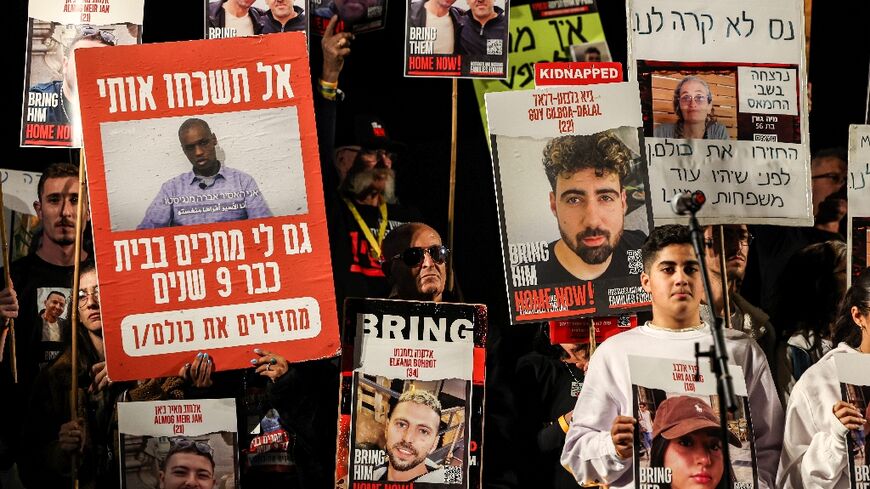
Hostages were drugged, abused in Gaza: Israeli doctor

Hostages hauled into Gaza during Hamas's October 7 attack on Israel were drugged to keep them docile in captivity and subjected to psychological and sexual abuse, a specialist said Monday.

"I've never seen anything like that" in 20 years of treating trauma victims, said Renana Eitan, director of the psychiatric division of the Tel Aviv Sourasky Medical Centre-Ichilov.

"The physical, the sexual, the mental, the psychological abuse of these hostages that came back is just terrible," she added. "We have to rewrite the textbook."

Protesters in Tel Aviv show portraits of Israeli hostages on December 9

Menstrual periods an ordeal, health risk for Gaza women and girls

Women and girls getting their periods in Gaza face humiliating conditions and infections, forced to use diapers or scraps of cloth after more than two months of war.

Food, water and sanitary items are in desperately short supply across Gaza as around 80 percent of its 2.4 million people have been displaced by the conflict between Israel and Hamas.

"I cut up my kid's clothes or any piece of cloth I find, and I use them like sanitary towels for my period," said 25-year-old Hala Ataya in the southern city of Rafah where many have fled.

Shortages of water and supplies are risking infection and disease

Not all Arab states backing Saudi Arabia in COP28 talks

Saudi Arabia, the staunchest opponent of phasing out fossil fuels at COP28, may dominate the Arab bloc at the UN climate talks in Dubai. But it is far from the only voice.

"We're seeing a split between the UAE and other big petrostates on the future of fossil fuels," said Jim Krane of Rice University in Texas.

While Riyadh, the world's top crude exporter, didn't want fossil fuels mentioned at all in a draft text at the UN talks, the Emirati president of COP28, Sultan Al Jaber, urged an historic accord that addresses the fate of oil, coal and gas.

A two-degree rise in temperatures could make the Muslim hajj pilgrimage to the holy city of Mecca difficult

Palestinians shut shops, schools in protest at Gaza onslaught

Shops, schools and government offices shut in the occupied West Bank, annexed east Jerusalem and allied countries Monday as Palestinians staged a general strike protesting against Israel's relentless onslaught in Gaza.

The bloodiest ever war in the Gaza Strip has killed more than 18,200 Palestinians in the territory, mostly women and children, as well as 104 Israeli soldiers, according to the latest reported death tolls.

Palestinians carry a list of Gaza victims during a general strike rally in Ramallah, the occupied West Bank

Antique stoves in Gaza the only way to cook during war

In a workshop in the war-torn and besieged Gaza Strip, Ibrahim Shouman is bringing old brass stoves back to life, giving hope to displaced people deprived of gas for cooking.

With a squeeze of pliers, a new wick, and a refill of homemade fuel, a flash of fire miraculously begins to crackle.

"People have gone back to the old times and are bringing their brass camping stoves for repair because there is no gas or fuel available," Shouman told an AFP journalist in Rafah in the south of Gaza, near the border with Egypt.

Old brass stoves are getting a new makeover in the besieged Gaza Strip as civilians displaced by Israel's war on Hamas hope and deprived of gas hope to fire them up for cooking

Children of Nobel winner Mohammadi 'worried' about her health

The children of imprisoned Iranian human rights activist and Nobel Peace Prize laureate Narges Mohammadi said Monday they were "extremely worried" about her health after she undertook a hunger strike in a Tehran prison.

Mohammadi, who has campaigned against the compulsory wearing of the hijab and the death penalty in Iran, stopped eating on Sunday in parallel with Sunday's Nobel prize ceremony in Oslo, where she was represented by her 17-year-old twins, Ali and Kiana.

It is not known whether her hunger strike is continuing or if it was just for the day.

Nobel Peace Prize laureate Narges Mohammadi was represented by her 17-year-old twins, Ali and Kiana