Belgium deploys soldiers to reinforce security at Jewish sites

BRUSSELS, March 23 (Reuters) - Soldiers were deployed on the streets of leading Belgian citieson Monday to bolster security for the Jewish community, after what officials said were antisemitic attacks in Belgium and the Netherlands.

The move follows an explosionthis month at a synagogue in Liege that authorities called an antisemitic act.

“From today we're putting soldiers back on the streets in Brussels and Antwerp because safety is a basic right,” Belgian Defence Minister Theo Francken said in a post on X on Monday.

Belgian army personnel patrol a street as part of a deployment of soldiers outside Jewish institutions in Antwerp and Brussels following attacks at Jewish sites in Belgium and other European countries, in Antwerp, Belgium, March 23, 2026. REUTERS/Yves Herman

World gave Israel 'licence to torture Palestinians': UN expert

The world has given Israel "a licence to torture Palestinians", a UN expert said Monday, with life in the occupied territories "a continuum of physical and mental suffering".

Francesca Albanese, the UN's special rapporteur on the rights situation in the Palestinian territories occupied since 1967, alleged that "torture has effectively become state policy" in Israel.

Francesca Albanese presented her latest report to the UN Human Rights Council in Geneva

Explainer-With top figures dead, who is now running Iran?

March 23 (Reuters) - Iran's veteran supreme leader and a host of other top figures and Revolutionary Guards commanders have been killed in U.S.-Israeli strikes but the ruling system has maintained its ability to strategise and operate in the war that began on February 28.

Born from a 1979 revolution, the Islamic Republic built a complex power structure with layered institutions buttressed by a shared commitment to the survival of the theocratic system rather than relying on a small number of individuals.

A banner with a picture of the late leader of the Islamic Revolution, Ayatollah Ruhollah Khomeini, and the late Supreme Leader of Iran, Ayatollah Ali Khamenei and Iran's new Supreme Leader, Mojtaba Khamenei, is displayed on a street, amid the U.S.-Israeli conflict with Iran, in Tehran, Iran, March 23, 2026. Majid Asgaripour/WANA (West Asia News Agency) via REUTERS

Ukraine has 'irrefutable' evidence of Russia providing intelligence to Iran, Zelenskiy says

March 23 (Reuters) - Ukraine's military intelligence has "irrefutable" evidence that Russia continues to provide intelligence to Iran, Ukrainian President Volodymyr Zelenskiy said on Monday after meeting the head of military intelligence.

"Russia is using its own signals intelligence and electronic intelligence capabilities, as well as part of the data obtained through cooperation with partners in the Middle East," he said on X.

FILE PHOTO: Ukrainian President Volodymyr Zelenskiy looks on as he delivers a statement along with Bavarian federal state prime minister Markus Soeder (not pictured), chairman of the Munich Security Conference Wolfgang Ischinger (not pictured), Polish Prime Minister Donald Tusk (not pictured) during the Munich Security Conference MSC, at the Residenz of the former Bavarian Kings, in Munich, Germany, February 14, 2026. REUTERS/Liesa Johannssen/File Photo

Trump's ever-shifting positions on the war with Iran

How long will the Iran war last and what are the US goals? President Donald Trump has issued a dizzying number of conflicting answers to these questions since launching the conflict three weeks ago.

The stakes have risen as Iran has retaliated with drone and missile strikes across the Gulf after the United States and Israel started their attacks on February 28.

Here, in Trump's own words, are his shifting positions:

- Duration of the war -

March 1: "Well, we intended four to five weeks." (To the New York Times)

US President Donald Trump has given conflicting reasons for the goals of the war against Iran and how long he thinks it will last

Countries act to limit fuel price rise, cut consumption

The surge in fuel prices triggered by the war in the Middle East has prompted countries to take measures to limit the financial impact on consumers and businesses.

Countries have also moved to reduce consumption, especially when they have limited reserves.

Here are some of the measures that have been adopted:

- Tax cuts and aid -

Some countries are targeting the price of fuel in order to limit the impact of the rise of crude oil prices on consumers and businesses.

Countries have taken measures to limit the financial impact of fuel price rises from the Middle East war on consumers and businesses

UK sending air defence systems to Gulf: PM

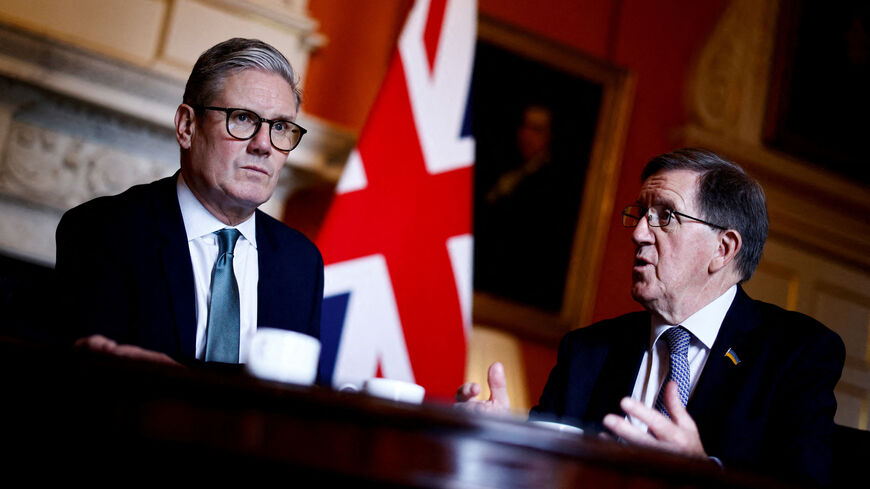
Britain is sending short-range air defence systems to the Gulf to help counter Iranian missile attacks, Prime Minister Keir Starmer said Monday.

"We're deploying short range air defence systems to Bahrain at speed," Starmer told a parliamentary committee, adding the UK was "doing the same with Kuwait and Saudi Arabia".

The UK is working with industry to "distribute air defence missiles to Gulf partners", which have faced waves of Iranian barrages in retaliation for US-Israeli strikes, and has embedded airspace specialists there, Starmer said.

The UK has allowed the US to use the RAF Fairford base in southwest England for Iran operations

Iran's true casualty figures unknown as internet blackout hampers monitors

Iran has not updated its official death toll figures for weeks, while human rights groups outside the country are struggling with chronic communication problems, meaning the number of people killed during the war remains largely unknown.

The last time Iran's health ministry gave a full update about casualties was on March 8, the ninth day of the conflict, when it said around 1,200 civilians had been killed in US and Israeli airstrikes across the country.

Despite considerable damage it remains unclear how many people have been killed Iran

Israel pounds south Beirut, says captured Hezbollah members

A series of strikes hit Beirut's southern suburbs on Monday and early Tuesday, the first attack on the Hezbollah stronghold in days, as Israel's military said it captured two members of the Iran-backed group in southern Lebanon.

An earlier Israeli strike hit the upscale, predominantly Christian area of Hazmieh near Beirut, with Israel saying it targeted a member of the Iranian Revolutionary Guards' foreign operations arm.

Smoke rises from the site of an Israeli airstrike in Beirut’s southern suburbs