



Sudan's mineral reserves open door for China

Hi readers,
As Sudan's civil war grinds into its third year, China is making headway into the strategic Horn of Africa country. In the span of a month, China has signed a port development agreement, forgiven millions of dollars in Sudanese debt and is reportedly negotiating a copper mining concession.
The latest development came Monday, when Sudan's state-owned Sea Ports Corporation signed a memorandum of understanding with state-owned China Harbour Engineering Company to develop and modernize Sudan's ports, as Al-Monitor’s Beatrice Farhat reported. According to Sudan's state news agency, the agreement covers the rehabilitation of port infrastructure and equipment as well as the construction of new seaports.
Let’s unpack,

Leading this week
China’s engagement
The ports agreement signed on Monday follows other signs of warming ties. On June 28, China agreed to cancel four interest-free loans to Sudan worth around $50 million, a small portion of the estimated $5 billion in debt Sudan owes to the Asian superpower. In the same meeting, the two sides also reviewed progress on Chinese-funded projects, including a roughly $66 million slaughterhouse project in West Omdurman and a separate $31 million grant supporting Sudan's energy, water and agriculture sectors.
There’s also been a flurry of meetings:
- June 25: Sudan’s ambassador to China met with the vice president of China National Petroleum Corporation.
- June 24: Sudan participated in the first senior officials’ meeting of the Belt and Road Energy Partnership.
- June 16: Sudanese Foreign Ministry officials held talks with Chinese embassy officials.
- June 1-14: Sudan participated in the High-Level Dialogue Forum on Global Development in China.
- June 7: Sudan’s Agricultural Bank signed a memorandum of understanding on strategic cooperation with Chinese machinery manufacturer LOVOL.
- June 6: The general manager of Sudan’s Agricultural Bank held talks in Beijing with the vice president of the China-Africa Development Fund.
- June 4: Sudan’s ambassador to China met with the deputy head of the International Department of the Chinese Communist Party.
The uptick in engagements comes as Sudan seeks to rebuild an economy devastated by three years of war. The United Nations Development Programme estimates the conflict wiped out nearly $6.4 billion in GDP in 2023 alone.

Chinese Foreign Minister Wang Yi (R) and Omar Siddig, Sudan's then-foreign minister, (L) attend a meeting during the China-CELAC Forum at Diaoyutai State Guest House on May 14, 2025 in Beijing, China. (Photo by Florence Lo - Pool/Getty Images)
What does China want?
One answer lies beneath Sudan’s soil. Reports of a potential copper mining deal — though not confirmed by either side — point to growing interest in the country’s largely untapped mineral wealth.
After reports from publications including Sudan Nile and Sudan Akhbar, that Sudanese officials were preparing to finalize a copper mining agreement with a Chinese company, the Eastern Sudan Advisory Council urged Sudanese Armed Forces chief Abdel Fattah al-Burhan to suspend the planned concession, arguing that the deal was being negotiated without adequate oversight or consultation.
The council said the proposed 30-year deal would leave Sudan with a 30% share of profits and valued the agreement at $300 million.
For Cameron Hudson, an independent Africa analyst and former US intelligence official, the contrast between the debt relief and the reported mining concession is telling. “That they would get $50 million in debt written off, but the Chinese would gain access to a $300 million copper mine is a pretty good deal in the direction of Beijing. What Sudan gets from it, however, is something that you can't put a price tag on,” Hudson told Al-Monitor.
Sudan’s benefit, Hudson said, is political as much as economic. The Chinese agreements represent “a kind of legitimacy or a vote of confidence” in the SAF-led government, which “is struggling right now to present itself as the legitimate government of Sudan.”
Sudan holds significant mineral wealth, including gold, copper, uranium and rare earth elements. Earlier this year, Sudan's authority for geological research said that approximately 75% of the country’s mineral resources remain unexplored. The country’s Al-Qutb copper deposit in Red Sea state has been estimated by Sudanese officials to contain around 5 million metric tons of copper.
The prospect of the mining deal is attractive for China, the world's largest consumer and processor of copper. According to a 2025 report by CME Group, China accounted for nearly 60% of global refined copper consumption in 2024 and processed roughly 45% of the world's copper, driven by infrastructure spending, power grid expansion and electric vehicle manufacturing.
While the reported concession would be relatively modest in the context of China's global mining portfolio, Hudson said it illustrates Beijing's higher tolerance for political and security risk than many Western or Gulf investors.
Hudson said that China, “during this conflict, and during many conflicts in Africa, has tended to keep a low profile to step back when its security wasn't guaranteed.”
He went on, “The idea of making a $300 million investment in a copper mine is something that they're willing to do. Even though the political context and the security context in Sudan is not particularly desirable right now, they're still willing to do that because of their kind of high risk tolerance.”
China’s willingness to pursue investments in Sudan also reflects the different nature of its engagement overseas, Hudson said. “Unlike, say, the US or the Europeans or the Gulf, they're not trying to shape political outcomes on the ground.”

Photo of the week
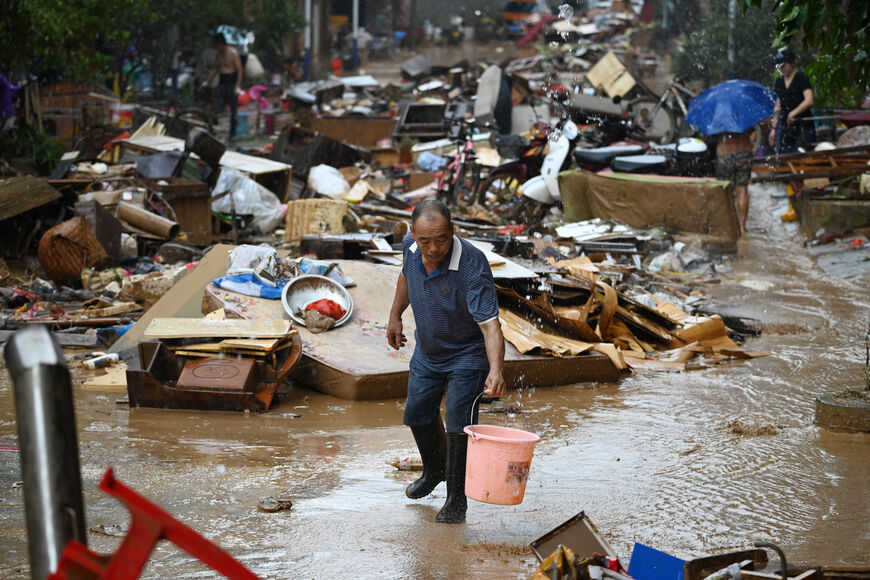
A man collects rain water outside a row of houses that were flooded up to the second floor when a reservoir collapsed near Gantang, in China's southwest Guangxi region, on July 9, 2026. (Greg Baker/AFP via Getty Images)

Deals and visits ✈️
- Egypt records $1.5-$2B in Chinese investments in first half of 2026
- Shanghai hosts China-Arab Media Dialogue
- China to launch direct air cargo route with Libya
- Iran’s China envoy promises "special considerations" for Chinese ships transiting Strait of Hormuz
- China increases Middle East oil purchases
- China names new ambassador to Iraq
- Chinese official attends Khamenei funeral in Tehran

What we are reading
- Why China fired a long-range missile into the Pacific (New York Times)
- Soccer fans in China are rooting for Norway’s Erling Haaland, their ‘Ha Bao’ (NBC News)
This one's on us.
The story doesn't end here.
Our correspondents are already on the next chapter. Read everything they file, from $2/week.
See Offers