Another war is taking place within the Syrian war — one between Iran and Israel. This conflict is not new. Rather, it began when Lebanon’s Hezbollah movement and Iran rushed to defend the government of defiant Syrian President Bashar al-Assad against his opposition. They saw in Assad the only real and dependable ally in the fight against Israel, in Lebanon, with the Palestinian factions, and Syria’s border with Israel a potential new base that could add to the resistance axis a new card in the war for influence and power in the Middle East.
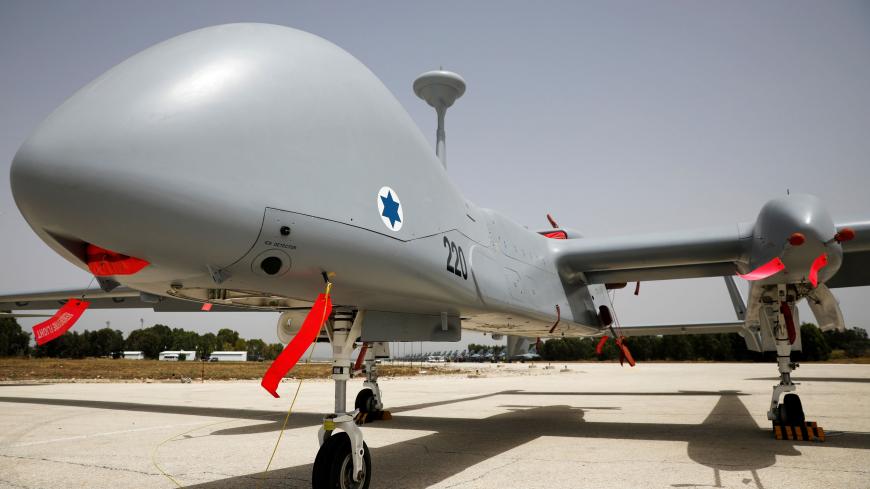
Israel knew this from the beginning; therefore, its first raid on Syria came as early as Jan. 30, 2013, when Israeli fighter jets hit a target deep inside Syria, a target that American officials told The New York Times was a convoy carrying sophisticated anti-aircraft weaponry.
The strike was only the beginning. Israel and Iran never halted their confrontation, though on the Iranian-led resistance axis’ side, Lebanon’s Hezbollah was Israel’s target, given the fact the group was the one functioning directly against Israel. Both sides were seeking to draw their rules of the game — Israel by setting its own red lines and the other side by breaking them. These involved dozens of Israeli raids on Hezbollah targets; in return, there were attempts by the Lebanese group to change tactics and attempt to get its military needs through unconventional means and routes. Iran was present beside Hezbollah, yet it’s possible to say that while the Lebanese group was struggling to get hold of weapons that could be used in any future war to deter Israel, the Iranians had a different objective. Iran’s Islamic Revolutionary Guard Corps (IRGC) was keen at creating an infrastructure that could give Tehran leverage in a future regional war or in the event Israel decided at any level to strike inside Iran or threaten Iranian national and regional security.
On April 8, warplanes thought to be Israeli targeted the Tiyas air base near Homs, known also as the T4 air base. For the first time, the Israeli raid was against a solely Iranian target, and also for the first time, Iran announced that seven of its soldiers in Syria, known in the country as "defenders of the shrine," were killed in the raid. The Iranian announcement was rare, as Iranians tend not to announce their soldiers’ deaths together and without mentioning how and where they were killed. This was an indication that the incident wasn’t just another one.
AL-MONITOR All-Access gives you unlimited access to all our journalism, the full Daily Briefing, exclusive interviews, premium newsletters, and live events — for less than $2/week.