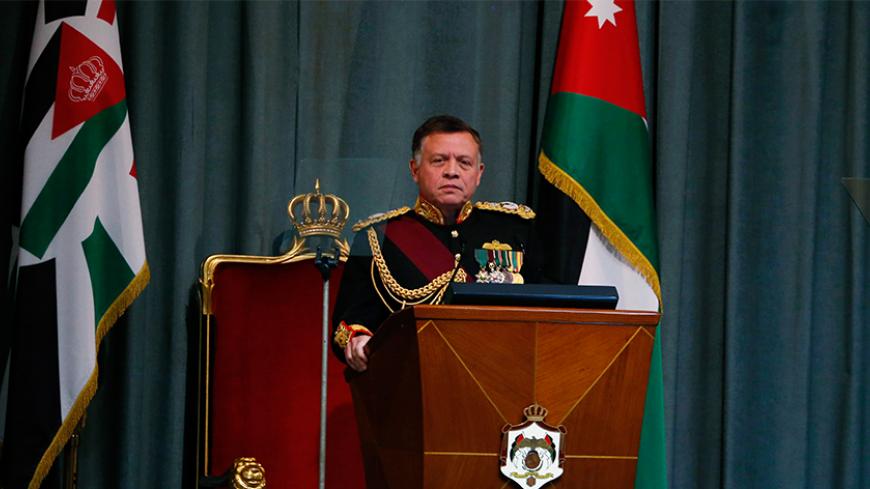
On Aug. 14, the Jordanian government announced that it would ask parliament to approve two constitutional amendments giving the king sole authority to appoint the head of the armed forces and director of the kingdom’s General Intelligence Department (GID). Almost three years ago, in October 2011, in response to public protests calling for political reforms, King Abdullah II had approved a number of constitutional amendments that curtailed some of his powers and allowed for the creation of a Constitutional Court and an Independent Elections Commission.
These reforms were hailed as a major step toward full constitutional monarchy. Jordan’s version of the Arab Spring was largely peaceful and bloodless, and Abdullah was able to project himself as a champion of political reforms that would lead, according to statements made in June 2011, to the formation of parliamentary governments. That promise remains to be fulfilled.
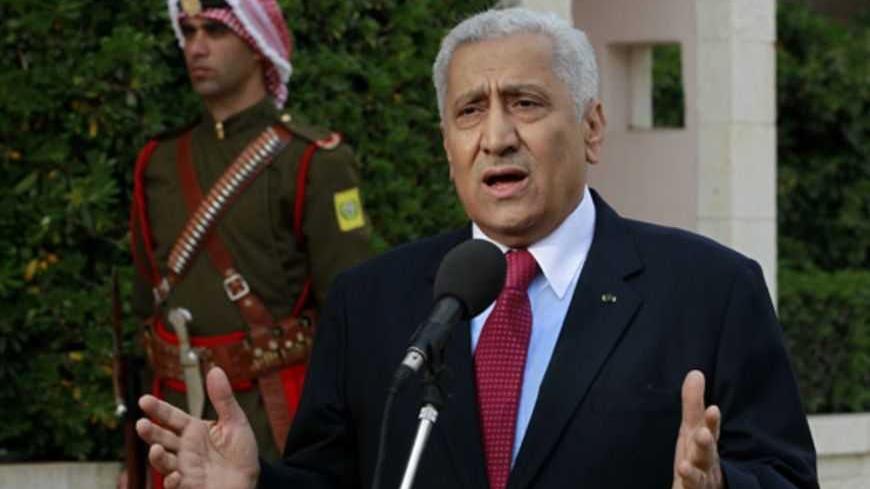
The Muslim Brotherhood’s Islamic Action Front (IAF) boycotted the 2013 legislative elections, and other political parties performed poorly, failing to fill the vacuum. Weak and unpopular, the parties' presence in the current Lower House, comprised mostly of independents, is modest. The government of Prime Minister Abdullah Ensour, appointed by Abdullah in October 2012, was supposed to include elected deputies as a precursor to the formation of parliamentary governments. To date, however, Ensour has failed to fulfill that pledge, probably due to royal objections.
It is clear that Abdullah instructed Ensour to handle the two constitutional amendments. Under the current constitution, the government recommends the appointees for head of the armed forces and GID director, and the king approves them through royal decree. The king had asked the prime minister on Aug. 12 to “activate” the Ministry of Defense, whose portfolio has been handled directly by the prime minister for decades. In effect, the portfolio will now be managed by a civilian or a retired army officer. The king said the new ministry will handle “political, economic, legal and logistical duties related to national defense … and nonmilitary services … while allowing the armed forces to dedicate its time to professional military duties.”
AL-MONITOR All-Access gives you unlimited access to all our journalism, the full Daily Briefing, exclusive interviews, premium newsletters, and live events — for less than $2/week.