



What Is Behind Success Of Tehran Stock Exchange?
The Tehran Stock Exchange has been a success in an otherwise stagnant economy.


The Tehran Stock Exchange (TSE) has been viewed as a phenomenon in the midst of the declining Iranian economy. The TSE Price Index (TEPIX) currently hovers at about 59,000 — up more than 500% since 2009, about 50% since the beginning of the current Iranian year (March 21) and about 28% since the election of Hassan Rouhani as president (June 14). As the following graph indicates, there are occasional adjustments downward — such as in the days running up to the presidential election on June 14 — however, the overall trend is upward. The question is how one can understand this uninterrupted rise and what factors are influencing this phenomenal growth.
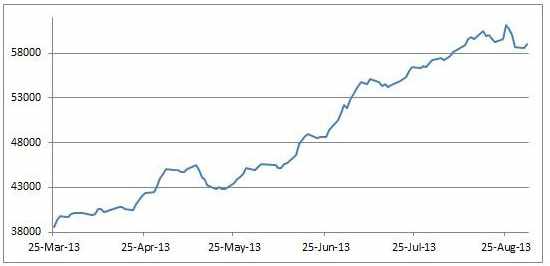
TSE Price Index since the beginning of the current Iranian year
The TSE started its operations in 1966. After the first oil price rise (1973-1974) and along with the increase in foreign exchange revenues, TSE activities increased considerably and the number of listed companies reached 102 in 1978. In the aftermath of the Islamic Revolution (1979) and the Iran-Iraq war (1980-1988), trading in many companies was suspended and turnover reduced to almost zero. Since 1988, the TSE has seen sustained periods of growth in trading and market capitalization, only interrupted by short downturns in 1997-1998 due to an overheated market, and in 2005 due to political uncertainties — following the election of Mahmoud Ahmadinejad. Market capitalization of the 320 companies currently listed on the TSE stood at 2,904,320 billion Iranian rials or more than $115 billion at the currency exchange rate as of Sept. 1. The growth in the number of listed companies is a direct consequence of the fact that most state-owned companies have been privatized through a listing of their shares on the TSE.


