



Hamdallah's Role Lacked Legitimacy
The resignation of Palestinian Prime Minister Rami Hamdallah has exposed the lack of legitimacy of a prime minister not appointed through a democratic process.
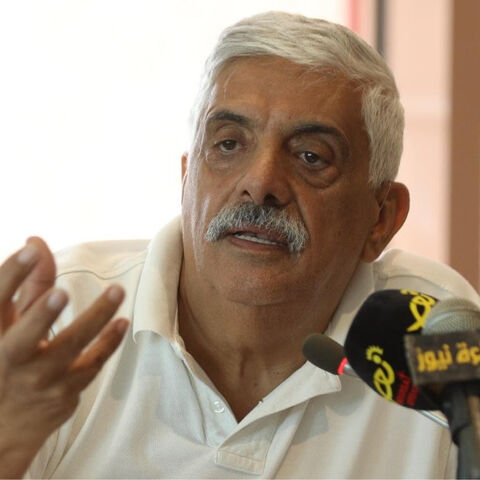

Press reports in Palestine covering the Hamdallah-Abbas controversy focused on the mode of transportation. When after 16 days in office he decided to resign as prime minister on June 22, Palestinian Prime Minister Rami Hamdallah drove to his home in Anabta using his own car without a driver or an entourage. He went to the president’s Ramallah office in al-Muqata at 6 p.m. in the same manner. But when he left al-Muqata, the full security entourage accompanied Hamdallah home. Some interpreted that as a retraction to his resignation. It wasn’t. Abbas and Hamdallah seem to have agreed on an orderly — rather than an abrupt — transitional period in which the latter stays in as a caretaker prime minister until a new premier is found.
The resignation drama started on June 20, with unsourced press reports that Hamdallah had submitted his resignation because of unclear lines of responsibility, reflecting a much larger legitimacy problem.
The apparent conflict of authority between the president and the prime minister in the Palestinian areas is certainly not new. When the Palestinian Authority was first created in 1994, Yasser Arafat was the chairman of the Palestine Liberation Organization and Mahmoud Abbas was his first prime minister. Politically, the influential powers, mainly Israel and the United States, wanted to give less power to the office of the presidency and more power to the prime minister. A few years later in early 2005, Abbas had replaced Arafat as president and after the 2006 elections and the victory of pro-Hamas candidates, those same powers were fine with the office of the president having more power than that of the prime minister, particularly given the latter post was occupied by Ismail Haniyeh.
The bias toward the presidency escalated after Haniyeh and his Hamas supporters rejected the authority of Abbas, forcing the Palestinian president to dismiss Haniyeh and appoint Salam Fayyad in 2007. The defacto suspension of the Palestinian Legislative Council meant that the appointed government did not gain a vote of confidence from the Palestinian representatives. When Fayyad attempted to question the power of the Palestinian presidency — with the refusal to allow back the resigned Minister of Finance Nabeel Kassis — he found himself on the losing end of a power struggle, and eventually had to hand in his resignation in April 2013. Hamdallah appears to have noticed this issue much earlier and seemed to have insisted on retaining all the legal and administrative powers that came with the office.


