x

Visit to Revolution ‘Birthplace’
Shows Yemen Still on Edge

A Yemeni women wears a lock around her wrist with the name of the intellectual and cultural heart of Yemen,Taiz, painted in red on her hand. (photo by AFP PHOTO/STR)


By: Nafeesa Syeed for Al-Monitor Posted on September 6.

TAIZ, Yemen — Inside a tent at Freedom Square, a sketch shows a young man, his mouth agape as blood streams from his forehead. He clutches the ends of his blue shirt, and across his chest, three Arabic letters in red, white and black — the colors of the Yemeni flag — spell out this southern city's name, Taiz.

About This Article

Summary :
Eighteen months after Yemen's revolution, some worry the country is slipping backward. Nafeesa Syeed talks to activists, politicians and everyday people in Taiz, the intellectual heart of the revolution, about their fear that Saleh's remnants have too much control, Iran and the US are fighting on their soil and women's rights are being ignored.
Author: Nafeesa Syeed
Posted on: September 6 2012
Categories : Originals Yemen  

Such graphic images comprise makeshift memorials in this square, the site of clashes during last year's uprisings that led to the ouster of former President Ali Abdullah Saleh, who ruled the country for 33 years. But the displays are not merely a remembrance of the past, as some in this city say the revolution has not run its full course. Eighteen months on, activists and political figures question the progress since Saleh's fall and suggest that foreign influences are looking to stir up divisions in the country.

"We are still in our revolution," said Horya Wabell, a face-veiled teacher and activist. "We're still in the squares because the big goals have not been achieved."

Whether Taiz, often called Yemen's cultural and intellectual heart, will lead the way in the country's transition depends on maintaining security, which government leaders here say is key to rebuilding the country, where poverty and high unemployment are widespread. Amid the prospects for change, however, some women say if they don't act now, they could lose out on gains they achieved in the revolution.

Was it Really a Revolution?

Taiz, a city of about one million, is surrounded by layered mountain ranges, with houses scaling high up the hills. Here, Maeen Al-Abidi, a young lawyer who has followed the cases of those killed in the revolution, deemed martyrs, has mixed feelings about what's transpired since Saleh's fall.

"I have hope that the goals of the revolution will be fulfilled — not soon — but step by step," said Al-Abidi, who wears a head scarf, but doesn't cover her face. She's already looking down the road to a couple of years from now, after the country holds "real presidential elections." The February elections, she said, in which current President Abdo Rabbo Mansour Hadi ran unopposed, was more of a poll on whether people wanted Saleh in power any longer.

Parties in opposition to Saleh's Almotamar party now represent 50% of the government after a power-sharing deal, but Al-Abidi, who is not a member of any party, said a gap has emerged between the halls of power and the street. "We as youth feel that the parties are pursuing their own interests,” Al-Abidi said. “And they don't respond to the demands of the youth any more.”

With Saleh back in Yemen, there's profound distrust among some activists and party leaders over whether the former leader has entirely extricated himself from state affairs. They insist that behind the scenes, he's still at the helm of Almotamar. Moreover, they say Saleh and his family members continue to oversee the army, despite Hadi having taken steps to restructure the forces. In Taiz, in particular, the resentment runs deep as revolutionaries recollect bloody army crackdowns on protests this past year. Some even refuse to consider this a transition period because they believe Saleh's regime is still in power. Among their demands are that Saleh and his family immediately leave the country; that he be put on trial for allegedly killing Yemenis; and that the money he's accused of embezzling from the country be returned.

But not everyone agrees. "There's still a large base of people supporting Saleh," according to Hanaan Hussain, a young law professor. Hussain, a Saleh supporter, said she initially backed those who wanted to rise up against corruption. "We wanted to make a revolution against corruption, not against one person," Hussein said. From her vantage, Hussain said what happened in the past year cannot, in fact, be considered a revolution. That's because, she said, the youth movements were "stolen" by Islah, the powerhouse Islamist party credited by some activists with saturating streets in Taiz and among those protecting the square with arms after authorities ambushed protestors. She's wary of Islah's rising political influence, saying it seeks to dominate the government. "Islah does not accept other points of view,” she said.

Foreign Hands

Compounding concerns over Yemen's ability to see through revolutionary change are activists' varied suspicions of the role of foreign players.

It's Saudi that has been Saleh's biggest supporter, said Eshraq Al-Maqtari, a human rights activist. "Saudis could not imagine that one day, Yemenis would go out and start a revolution against Saleh's regime," Al-Maqtari, who doesn't wear a niqab, said. The Gulf Cooperation Council (GCC) initiative — signed by Saleh and opposition parties to divide the government between the two camps and grant Saleh immunity — was rejected by youth as it left out Yemenis from the decision-making process and ensured that the new regime would be one that maintained Saudi interests in Yemen. She also said Saudi and Iran have transplanted their power struggle in the region to Yemen, distracting people from the goals of the revolution. Financial support from Saudi, Qatar and the United States is further complicating the picture, she said. "Many people now think Yemen is ruled by the US ambassador in Yemen — not by the Yemeni president."

Several activists and political operatives expressed fear that Saudi and Iran are working to incite sectarian and ideological differences among the population. Meanwhile, others pitted the power struggle as being between the US and Iran.

Shaykh Hamoud Al-Mikhlafi, a prominent leader of Islah in Taiz, supported the GCC initiative, but said Saleh is attempting to push Yemen into becoming like Syria. He said the only "honest country" has been Qatar, which supported the revolution.

"The big danger now is Iran. It's a competition between America and Iran in Yemen and Iran wants to overcome the US in Yemen," Al-Mikhlafi said. "We don't mind international influences being in Yemen, but only in what will benefit Yemen."

The Order of Things

Even though the square may not be packed daily as it once was, some remain encamped there. Taizi activists unabashedly assert that they're the pioneers of the revolution. In a “charter of honor” signed in August by members of various political outfits, their promises included not to raise weapons against one another. The compact reinforced the idea that it's their initiative that's helping move the revolution into a new phase.

For some public officials, however, getting Taiz's own house in order must come first. At the head of the Taiz governorate, is Shawki Ahmed Hayel Saeed, the province's reluctant governor. Saeed, who wears a graying goatee, was content as chief financial officer of Hayel Saeed Anam Co., his family's group of companies, which has a turnover of some $8 billion and 12,000 employees in Taiz, and another 13,000 around the world. When President Hadi made the appointment in April, Saeed was shocked, though he had previously served as the province's head of finance and planning. In his first days in office, he said many streets were blocked; people were rampantly brandishing arms; car-jackings and other crimes were frequent; schools, universities and hospitals were closed because of demonstrations and riots; the water supply in some areas had been off for months; and most public employees weren't in their offices. "So my first priority was just to get things back in order," he said.

Shawki deployed a new division of army and police officers. For some areas, he said it was the first time in a year and a half where there was visible law enforcement. They confiscated guns from those who lacked permits, halving the weapons with an electric saw.

While some fugitives and gangs remain at large, Shawki said he's confident his local forces will catch them. But an ongoing problem here and elsewhere in the country, is Al Qaeda, the target of US drone operations in Yemen. "They are present in Taiz; they are present usually in places where people are poor," Shawki said. In a couple of lower-income neighborhoods, he said Al Qaeda gives out money to recruits, trains them and brainwashes them into terrorists. In March, Al Qaeda was reportedly linked to the killing of an American teacher. Shawki said for safety concerns, authorities keep an extra eye on foreigners in Taiz.

Although he can't wait for his two-year term to be up, Shawki said when he meets foreign leaders and tells them he's from Taiz, there's instant recognition. In a way, the city has become a brand. "Taiz is a name now. So I was telling everybody that being a businessman...I know where the opportunities are — if we don't capture this opportunity and really try to do whatever we can do for Taiz and if we miss it and then that's it. It will take another 20 years for us to really capture it," he said. "Ambassadors of the GCC, the Americans, the Europeans are saying, 'OK what are your requirements? Tell me and we'll help.'" Just this week, at a conference in Riyadh, international donors pledged more than $6.4 billion to help Yemen over the next year and a half. Saudi Arabia is to contribute nearly half of that amount.

When asked whether Yemen has prioritized security over immediate humanitarian needs, as some international agencies have implied, Shawki replied: "I would say if we ignore security, then we're going to be another Somalia for a long time." According to the World Bank, 10 million people in Yemen lack food security and employment rates have topped 40% among youth. Shawki said if joblessness and poverty aren't resolved, then Taiz will remain in its revolutionist state forever, so stability is key.

Other groups have emerged as influential non-state brokers in Taiz. Al-Mikhlafi, of the Islah party, and his compatriots who used arms to defend demonstrators became known as protectors of the square. In the current context, weapons are not so essential. Besides his political function, Al-Mikhlafi plays another significant part in Taiz: He essentially acts as a judge as many here turn to him to settle their disputes. "We resolve cases, as a result of the lack of justice in Yemen," said Al-Mikhlafi. "Many cases come from the courts and will be solved here at our hands.”

Women in Waiting

At a charred building in Freedom Square, a poster depicts a woman whose face is concealed by a black niqab, the staple for Yemeni women. But her dark eyes are looking upward into the distance. The bold Arabic lettering reads: Tufaha Saleh Al-Antari, martyred on Nov. 11, 2011. Her first name means “apple.” Women such as Al-Antari were instrumental in revolutionary movements of the past year, particularly in Taiz, where the population is more than 50% female. It also happens to be the hometown of Nobel Peace Prize winner, Tawakkol Karman. But some wonder if after gaining ground in public spaces, the situation is backtracking on women at this crucial moment when the legal and political framework is being redefined.

During (the past) 18 months, I would say that there's a strong attempt to ignore women after what [we] achieved last year,” said activist Anisa Al Hamze, who wore a white-printed head scarf. “If women do not maintain what they've achieved, they will be ignored. Holding on to it requires putting pressure on the government and decision-makers to reform the laws, because if these laws are not reformed in the way that give women their status and rights, I believe that women will be ignored.”

Among the most vocal on this front is Boshra Al-Maqtary, a well-known socialist and writer. Although not in niqab, Al-Maqtary donned a red scarf and pendant with the face of Che Guevara. “We noticed that after the revolution, women were excluded from political activities,” Al-Maqtary said. “They don't want women to really take part in forming a new constitution that guarantees women's full participation — and not partial participation.”

Al-Maqtary said religious scholars are targeting prominent women activists. For one, she's been accused of apostasy. She fears that factions in Yemen are becoming entrenched with religion, threatening women as well as secular and leftist groups.

Just as similar questions regarding women have arisen around Islamist parties in power in Egypt and Tunisia, in Yemen some say the onus is on Islah. Sumayah Alward, a young member of Islah who wears a face veil, said she believes the party is now encouraging women to take on decision-making roles and it's also known for running training centers for women where they can study languages or computer skills. “It's the Arab culture and the Arab environment that has this fear of women to be in such positions. Maybe because the woman herself made this fear, because she isolated herself from participating in these roles,” Alward said. “There are some great examples that have emerged in Islah which slowly have made this fear disappear.”

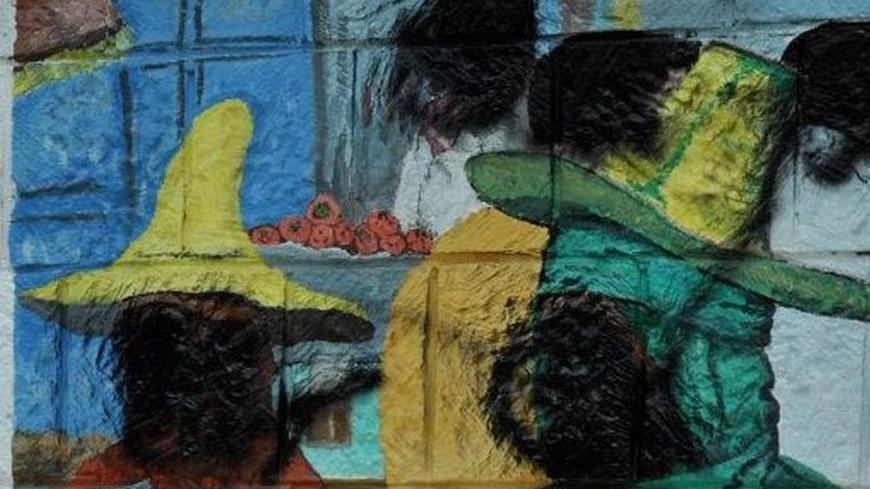
The tension and potential roosting in Taiz's next generation was evident in Al-Mikhlafi's 18-year-old daughter, Zainab. At their home, she sat beneath a wall covered by a technicolor mural of birds around a pond. In the vista, her father's likeness looms above in the clouds. In her halting English, which her father doesn't speak, she said: “At our university, our doctor say to us: 'Don't speak about politics because everyone have party.'” What does she think about that kind of directive? “It's not good, because if we speak about politics, we can take our freedom.”

Back to news list


Related Articles


Welcome to Al-Monitor!
Our site brings together, for the first time, top journalists from across the Middle East including Iran, Iraq, Israel, Lebanon, Palestine and Turkey. Plus daily translations from 20 major news organizations in the region.


Watch a video about us.